For millions of South Africans, the Truth and Reconciliation Commission (TRC) was never meant to be the final word. It was, as Archbishop Desmond Tutu famously described it, “a bridge” between a brutal past and a hopeful future. But more than two decades after the TRC submitted its final report, that bridge has remained stubbornly half-built — with perpetrators of apartheid-era atrocities still walking free, victims’ families still waiting for closure, and the National Prosecuting Authority (NPA) still struggling to turn truth into justice.
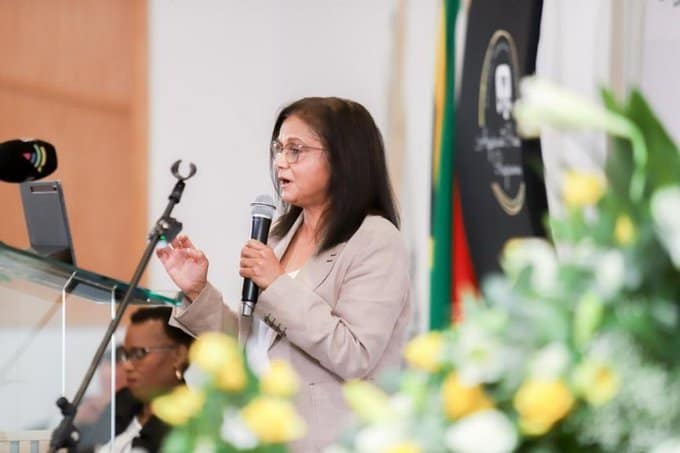
On Wednesday, former National Director of Public Prosecutions Shamila Batohi stepped into that painful gap to defend her office’s record. Speaking at a symposium on transitional justice hosted by the University of the Witwatersrand, Batohi insisted that despite severe resource shortages, political indifference, and the sheer complexity of three-decade-old crimes, the NPA under her leadership never abandoned the TRC docket.
“The NPA remains committed to closing long-standing TRC cases,” Batohi told a hushed auditorium. “Not because it is politically convenient. Not because the world is watching. But because the Constitution demands it. And because victims have waited long enough.”
Her words carried the weight of a woman who knows she is leaving unfinished business behind. Batohi’s five-year term as National Director of Public Prosecutions ended last month. She was not reappointed. In her place, President Cyril Ramaphosa has appointed a yet-to-be-confirmed successor. But Batohi made clear that accountability for apartheid crimes should not retire with her.
The TRC’s broken promise
The TRC, which sat from 1996 to 1998, was a global pioneer in restorative justice. In exchange for full disclosure of politically motivated crimes, perpetrators could apply for amnesty. Those who did not come forward — or who were denied amnesty — were supposed to face prosecution.
But of the hundreds of cases referred to the NPA for possible prosecution, only a handful have ever reached a courtroom. The reasons are numerous: lost dockets, dead witnesses, aging defendants, overwhelmed prosecutors, and a political establishment that has, at times, seemed eager to let the past fade rather than face it.
According to the latest NPA data, approximately 380 TRC-related cases remain open. Most involve allegations of murder, torture, and kidnapping by operatives of the apartheid security forces, as well as by members of the African National Congress (ANC) and other liberation movements. Only 17 have resulted in successful prosecutions since 1998.
“That is a national shame,” said activist and TRC victim support group coordinator Mandla Sibeko, who attended Batohi’s address. “We are not asking for revenge. We are asking for what the TRC promised: amnesty for truth, but prosecution for lies and silence. Instead, we got nothing.”
Batohi’s defense: ‘We did what we could with what we had’
Batohi did not shy away from the criticism. She acknowledged that progress has been “painfully slow” and that some cases will likely never be resolved due to the deaths of suspects or witnesses. But she pushed back against the notion that the NPA was indifferent.
“When I took office in 2019, the NPA was a hollowed-out institution,” she said. “We had lost hundreds of experienced prosecutors. Our budget had been cut year after year. The TRC unit had been reduced to three people sharing one broken printer. That is not an excuse. That is a fact.”
Under her leadership, the NPA’s Investigating Directorate (ID) was strengthened, and a dedicated TRC task team was reconstituted. Several high-profile cases were reopened, including the investigation into the 1985 assassination of Cradock Four activists Matthew Goniwe, Fort Calata, Sparrow Mkhonto, and Sicelo Mhlawuli — a case that finally saw former security branch officer Gerhardus “Ben” van Rensburg arrested in 2023. (Van Rensburg’s trial is ongoing.)
“We secured that arrest,” Batohi said, her voice rising slightly. “We built the docket. We found witnesses who had been hiding for thirty years. That is not failure. That is progress. Slow, painful, underfunded progress — but progress nonetheless.”
The political headwinds
Batohi’s tenure was marked not only by resource constraints but by political turbulence. She was appointed to clean up an NPA that had been captured and weakened during the Jacob Zuma years. Her relationship with the presidency was often tense, and she faced repeated accusations from ANC figures of being “too aggressive” in pursuing corruption cases involving party members.
On TRC cases, the political pressure was different but no less challenging. Successive ministers of justice have shown little appetite for large-scale apartheid-era prosecutions, fearing they would open old wounds and destabilize the governing alliance. Some ANC veterans themselves face potential prosecution for crimes committed during the anti-apartheid struggle — a fact that has made the party nervous.
Batohi acknowledged the political reality without naming names. “Prosecuting crimes from thirty years ago is never popular,” she said. “There are powerful people — on all sides — who would prefer that these cases simply disappear. My job was not to be popular. My job was to follow the evidence.”
What remains undone
Despite Batohi’s defense, the list of unresolved TRC cases remains staggering. Among the most notorious:
- The 1982 death of activist Siphiwo Mthimkulu, who was abducted from Lesotho and never seen again. His family has fought for four decades to have the case reopened.
- The 1986 Trust Feed massacre, in which eleven people were killed by apartheid-aligned vigilantes. Only low-level operatives were ever convicted.
- The 1988 killing of activist Topsy Madaka, whose murder was linked to the Civil Cooperation Bureau (CCB), a covert apartheid death squad. No one has ever been held accountable.
Batohi’s successor will inherit these cases, along with the institutional challenges that have hampered them for decades. The NPA’s current budget for TRC-related prosecutions is approximately R18 million per year — barely enough to fund a team of five full-time investigators.
“The money is a joke,” said legal analyst and human rights lawyer Fatima Hassan. “You cannot investigate thirty-year-old crimes with a shoestring budget. Witnesses need to be traced. Forensic evidence needs to be re-examined. Cold-case techniques need to be applied. That costs real money. The state has not been serious about that.”
A moral imperative
For all the legal and political complexities, Batohi returned again and again to a simpler argument: justice delayed does not have to mean justice denied.
“Closure is not just a word,” she said, looking directly at the front row, where several TRC victims’ family members sat. “It is a right. It is what the TRC promised. It is what the Constitution guarantees. And it is what I promised myself when I took this job: that I would not let these cases gather dust simply because they are difficult.”
She paused, then added: “I did not finish the work. I am honest about that. But I started a fire that cannot be extinguished. The next NDPP will have to decide: do they let that fire burn out, or do they fan the flames? I know what I hope they will choose.”
The road ahead
As Batohi walked out of the auditorium into a grey Johannesburg afternoon, she was met by a small group of activists holding faded photographs of murdered relatives. One woman, elderly and leaning on a walking stick, reached out and touched Batohi’s arm. “Thank you for trying,” she whispered. “My son is gone. But I am still here. I will keep coming until someone is held accountable.”
Batohi nodded, squeezed the woman’s hand, and continued walking. Behind her, the symposium continued without her — legal scholars debating the finer points of transitional justice, international experts citing examples from Rwanda to Colombia.
But for the families in the front row, the debate is not academic. It is the story of their lives: stolen, interrupted, and still waiting for an ending.
The TRC closed its doors in 1998. But for Shamila Batohi — and for the thousands of South Africans who still seek justice — the truth was never the finish line. It was only the starting block. The race, however exhausted the runners, continues.
And somewhere in the docket rooms of the NPA, in boxes labeled with names like Goniwe, Mthimkulu, and Madaka, the evidence waits. Silent. Patient. Demanding only one thing: to be heard
About The Author