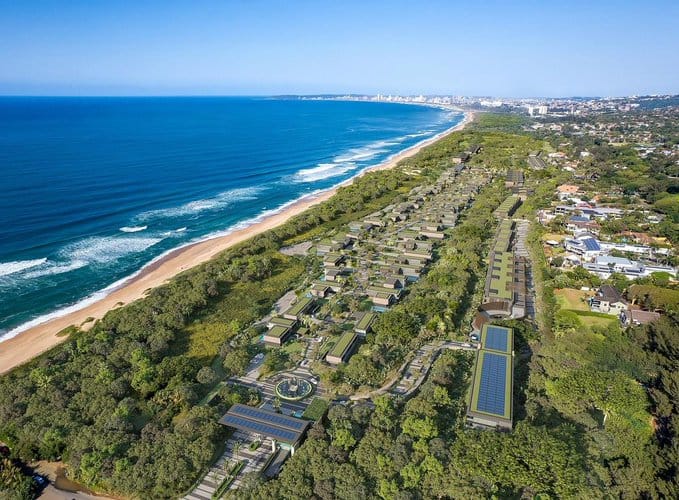
In a landmark transaction that signals both the growing clout of Islamic finance in South Africa and the enduring appeal of the country’s coastal property market, First National Bank (FNB) has approved R800 million in funding for a premium beachfront residential estate in Durban North. The deal, described by banking insiders as “the largest of its kind in the bank’s history,” marks a major milestone as FNB’s first Shari’ah-compliant residential development financing agreement.
The funding, which was finalized after eighteen months of negotiations between FNB’s Islamic Banking division and the development consortium behind the yet-to-be-named estate, will bankroll the construction of approximately 340 luxury residential units—a mix of apartments, penthouses, and freestanding villas—on a prime stretch of coastline overlooking the Indian Ocean. The development will span 8.2 hectares of reclaimed and rezoned land, making it one of the largest beachfront projects to break ground in KwaZulu-Natal in over a decade.
“This is not just a banking transaction,” said Amman Muhammad, FNB’s Head of Islamic Banking, speaking exclusively to reporters from the bank’s Durban headquarters. “This is a statement of confidence. Confidence in Durban. Confidence in the luxury property sector. And confidence in the growing demand for financial products that align with the values and beliefs of Muslim homebuyers and investors. The R800 million we have approved will build homes, create jobs, and generate economic activity that ripples far beyond this coastline.”
Breaking Ground on Shari’ah-Compliant Finance
The term “Shari’ah-compliant” is often misunderstood. It does not mean that the development is exclusively for Muslim buyers, nor does it impose religious restrictions on residents. Rather, it refers to the structure of the financing itself.
Conventional bank loans involve the payment of interest (riba), which is prohibited in Islamic finance. Instead, Shari’ah-compliant structures use alternative models such as Murabaha (cost-plus financing), Ijara (lease-to-own), or Musharaka (joint partnership). In the case of the Durban North estate, FNB’s Islamic Banking division has structured the deal as a combination of Murabaha and Ijara: FNB will purchase the construction materials and land rights on behalf of the development consortium and then sell them to the consortium at an agreed markup, with payment made in installments over a fixed period. Additionally, certain infrastructure components will be financed through a lease structure, where FNB retains ownership of the underlying assets while the developer pays rent.
“The beauty of Shari’ah-compliant financing is that it is asset-backed,” explained Dr. Yasmin Khan, a professor of Islamic finance at the University of KwaZulu-Natal. “The bank cannot simply lend money and charge interest. It must own something—bricks, land, steel—and then transfer that ownership to the client. This creates a direct link between finance and the real economy. It also means that the bank bears some of the risk. If the development fails, FNB cannot simply demand repayment of the loan plus interest. It must absorb its share of the loss. That alignment of risk and reward is the ethical core of Islamic finance.”
While Islamic banking has grown steadily in South Africa over the past two decades—FNB launched its Islamic Banking division in 2009, followed by ABSA and Standard Bank—the Durban North deal is the first time a major bank has used a Shari’ah-compliant structure for a residential development of this scale. Industry analysts expect it to open the floodgates.
“This is a proof of concept,” said property economist Erwin Rode of Rode & Associates. “If the Durban North estate is successful—and there is every reason to believe it will be—we will see a wave of Shari’ah-compliant development financing across the country. Cape Town’s Atlantic Seaboard, Johannesburg’s Waterfall Estate, even the new smart cities being planned in Limpopo and the Eastern Cape. The Muslim market is substantial, underserved, and increasingly discerning. FNB has just claimed first-mover advantage.”
The Development: A Premium Beachfront Destination
The estate itself, designed by the Durban-based architectural firm Sphere Holdings, is intended to rival the most prestigious coastal developments in the country. Renderings released to the media show a low-density, environmentally sensitive design that maximizes ocean views while preserving public beach access.
Key features include:
- 340 residential units ranging from two-bedroom apartments (starting at R2.8 million) to six-bedroom penthouses (priced up to R15 million) and private villas (R18 million to R25 million)
- A central communal garden designed by award-winning landscape architect Patrick Watson, featuring indigenous coastal forest species, walking trails, and a natural tidal pool
- A residents-only wellness center with a gym, spa, swimming pool, and yoga deck overlooking the ocean
- 24-hour security with biometric access control, perimeter fencing, and a dedicated rapid-response unit
- Retail and dining spaces on the ground floor of the main building, including a café, a delicatessen, and a small convenience center
- Underground parking for 680 vehicles, removing cars from the streetscape and preserving the beachfront aesthetic
The developer, the AmaKhosi Coastal Consortium—a joint venture between a KwaZulu-Natal-based property group and an international investment fund based in the United Arab Emirates—has committed to using local contractors for at least 70% of the construction value.
“We are not building a gated fortress,” said consortium spokesperson Thabo Ndlovu. “We are building a community. The beach will remain open to the public. The promenade will be accessible. The retail spaces will serve not just residents but the wider Durban North neighborhood. This is luxury with a conscience. That is the only way to build in 2026.”
Economic Impact: Jobs, Revenue, and Growth
The R800 million in FNB funding is expected to generate significant downstream economic benefits. According to an independent economic impact assessment commissioned by the consortium and reviewed by this publication, the development will:
Create thousands of jobs: During the 30-month construction phase, an estimated 2,800 direct jobs will be created (architects, engineers, construction workers, electricians, plumbers, etc.), with a further 4,500 indirect jobs in supply chains (materials manufacturing, transport, catering, security). Post-completion, the estate will support approximately 350 permanent jobs in security, maintenance, landscaping, housekeeping, and retail.
Generate municipal revenue: Once fully occupied, the estate is projected to contribute over R45 million annually to the eThekwini Municipality in property rates, utility fees, and other levies. This represents a significant boost for a municipality that has struggled with revenue collection and service delivery in recent years.
Support local infrastructure: As part of the development agreement with the municipality, the consortium will fund R65 million in off-site infrastructure improvements, including the upgrade of the adjacent Beachwood Road intersection, the installation of new stormwater drainage, the extension of the beachfront promenade, and the refurbishment of the public tidal pool.
Attract further investment: The success of the Durban North estate is expected to catalyze additional development in the surrounding area, including a proposed R300 million hotel and conference center on an adjacent site and the long-planned upgrade of the Virginia Airport precinct.
“Durban has been overlooked for too long,” said eThekwini Mayor Mxolisi Kaunda, who has been briefed on the project. “Investors have preferred Cape Town’s Atlantic Seaboard or Umhlanga’s newer developments. This R800 million deal sends a message: Durban North is back. The beachfront is back. And the city is open for business.”
The Shari’ah-Compliant Advantage
Why did the consortium choose Shari’ah-compliant financing over a conventional loan? The answer, according to Ndlovu, is twofold: market demand and ethical alignment.
“South Africa has a significant Muslim population—over 1.5 million people, concentrated in Durban, Cape Town, and Johannesburg,” he explained. “Many of them are affluent, educated, and actively looking for property investments that align with their religious values. A conventional mortgage involves interest, which is prohibited. So they rent. Or they buy cash. Or they invest offshore. We wanted to give them an alternative: a premium development financed and sold in a way that respects their faith.”
The consortium has confirmed that it will offer Shari’ah-compliant purchase options to homebuyers as well, using the same Murabaha and Ijara structures. This means that a Muslim family can purchase a unit in the estate without ever paying or receiving interest—from the development financing all the way down to their individual home loan.
“This is vertical integration of Islamic finance,” said Muhammad of FNB. “The development is funded Shari’ah-compliant. The homebuyers can finance their purchases Shari’ah-compliant. The entire ecosystem is riba-free. That has never been done before in South Africa at this scale. It is genuinely historic.”
Demand for Coastal Property
The R800 million deal also reflects broader trends in South Africa’s property market. Despite economic headwinds—high interest rates, load-shedding, political uncertainty—demand for premium coastal property has remained remarkably resilient.
According to Lightstone data, coastal property prices in KwaZulu-Natal have appreciated by an average of 8.2% per annum over the past five years, outpacing inland markets (3.5%) and even Gauteng’s luxury segment (5.1%). The reasons are familiar: semigration, remote work, and a post-pandemic revaluation of lifestyle over proximity to the office.
“People are voting with their feet,” said property analyst John Loos of FNB’s home loan division. “They are leaving Gauteng in record numbers. Many are heading to the Western Cape, but KwaZulu-Natal is increasingly competitive. The weather is warmer. The property prices are more affordable than Cape Town. And developments like this Durban North estate offer a level of luxury and security that rivals anything on the Atlantic Seaboard—at half the price.”
The consortium has reported strong pre-sales interest, with over 40% of units already reserved by prospective buyers, many of whom are cash-rich professionals, retirees, and semigrants from Johannesburg and Pretoria.
“We have a waiting list,” Ndlovu said. “People have been calling us for months, asking when they can put down deposits. The R800 million from FNB gives us the certainty to start construction. Without it, we would still be raising capital. With it, we break ground in six weeks.”
Challenges and Criticisms
Not everyone is celebrating. Local residents’ associations have expressed concern about increased traffic, pressure on public amenities, and the potential for “elite enclosure” of the beachfront.
“We welcome investment, but not at the cost of public access,” said Brenda Naicker, chairperson of the Durban North Ratepayers’ Association. “The beach belongs to everyone. The promenade belongs to everyone. We want assurances that this development will not become a walled city that cuts off the community from the ocean.”
The consortium has responded by noting that the estate’s design includes public walkways, public beach access points, and no private fencing on the seaward side. “You will be able to walk from the main beach, past our development, all the way to Umhlanga, without ever leaving public land,” Ndlovu said. “That is in our development agreement. It is legally binding.”
Environmental groups have also raised concerns about coastal erosion and the impact of construction on dune ecosystems. The consortium has commissioned an independent environmental impact assessment and has committed to a range of mitigation measures, including dune rehabilitation, stormwater management, and the use of indigenous vegetation.
“We have learned from the mistakes of past developments,” Ndlovu said. “We are building with the environment, not against it. That is not just good PR. It is good business. Buyers today want sustainability. They want green building. They want to know that their investment is not destroying the very thing they came to enjoy—the ocean, the beach, the natural beauty of Durban North.”
A Milestone for Islamic Finance in South Africa
For FNB, the R800 million deal is the culmination of a sixteen-year journey in Islamic banking. Since launching its Shari’ah-compliant division in 2009, the bank has grown its Islamic banking assets to over R15 billion, serving more than 50,000 customers. But until now, its focus has been on retail home loans, vehicle finance, and transactional banking—not development funding.
“This deal changes our strategic trajectory,” said Muhammad. “We have proven that we can do large-scale, complex, Shari’ah-compliant development finance. We have proven that the demand exists. We have proven that the returns are competitive with conventional lending. Now we scale.”
FNB is already in discussions with developers in Cape Town, Johannesburg, and even Nairobi and Lagos about similar Shari’ah-compliant funding arrangements. The Durban North estate, if successful, could become a template for Islamic development finance across sub-Saharan Africa.
“The Islamic finance market globally is worth over $3 trillion,” noted Dr. Khan. “South Africa has barely scratched the surface. The Durban North deal is a signal to international investors: South Africa is open for Shari’ah-compliant business. We have the regulatory framework, the banking expertise, and the market demand. Now we need more deals like this. Many more.”
Looking Ahead
Construction on the Durban North beachfront estate is scheduled to begin in late 2026, with the first units expected to be completed by mid-2028 and full completion by early 2030. The development will be built in three phases, allowing the consortium to adjust to market conditions and incorporate lessons from earlier phases.
For the people of Durban North—the existing residents, the local business owners, the families who walk the beachfront every Sunday—the R800 million deal represents both opportunity and uncertainty. Opportunity for jobs, investment, and renewal. Uncertainty about traffic, about character, about who the beachfront is for.
“We have been here before,” said Naicker, the ratepayers’ chair. “Big promises. Big developments. Sometimes they deliver. Sometimes they don’t. We will watch. We will engage. We will hold them accountable. That is our right and our responsibility.”
For the consortium, for FNB, and for the thousands of workers who will build the estate, the message is simpler: let’s get to work.
“The money is approved,” said Ndlovu. “The plans are drawn. The team is ready. Now we build. Not just homes. Not just a development. A legacy. A new standard for coastal living. A new model for Islamic finance. And a new chapter for Durban North.”
He looked out at the ocean, where the morning sun was scattering diamonds across the waves. Somewhere below, on the public beach, a family was setting up a picnic. Children were laughing. A dog was chasing a ball into the surf.
“That,” Ndlovu said quietly, “is what we are building for. Not for the rich. Not for the investors. For the people who will live here. For the families who will walk this beach. For the children who will grow up with the sound of the waves. That is the point. That is always the point.”
*Construction is expected to begin in the fourth quarter of 2026. FNB has confirmed that it will offer Shari’ah-compliant home financing to buyers through its Islamic Banking division. Further details, including the official name of the development and the launch of sales, will be announced in the coming months.*
About The Author