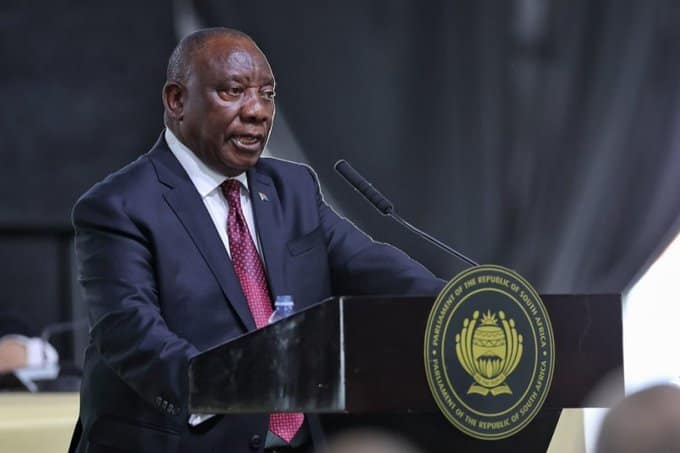
As the specter of full-scale war tightens its grip on the Middle East, the anxiety of South African families with loved ones in the region has escalated into a desperate plea for help. On Friday, President Cyril Ramaphosa moved to address that fear, offering a firm assurance from the Union Buildings that the government is mobilizing every resource to locate and extract its citizens from the danger zone.
Addressing the nation following a meeting of the National Security Council, Ramaphosa confirmed that the Department of International Relations and Cooperation (DIRCO) has been placed on high alert. Its primary mission: to identify every South African national currently trapped in Israel, the Palestinian Territories, Lebanon, and surrounding nations, and to formulate a plan to bring them home.
“We are deeply concerned about the safety of our compatriots in the Middle East,” Ramaphosa said, his tone grave. “I want to assure all South Africans that the Department of International Relations and Cooperation is working tirelessly, around the clock, to identify every citizen who is currently trapped in the affected areas. Our principle is clear: we will leave no one behind.”
The President’s statement comes amid a rapidly deteriorating security situation. The recent escalation between Israel and Hamas, coupled with rising tensions with Hezbollah in Lebanon and Iranian retaliatory strikes, has created a volatile and unpredictable environment. Commercial airlines have suspended flights, borders are tense, and the risk of being caught in the crossfire is a daily reality for civilians.
The Human Scramble
For families back home in South Africa, the past days have been a nightmare of frantic WhatsApp messages and sleepless nights. In communities from Lenasia to Bo-Kaap, the worry is palpable.
Among those watching the news with bated breath is Fatima Ebrahim, whose son, Karim, traveled to Jerusalem for a religious pilgrimage just weeks ago. What was meant to be a spiritual journey has turned into a terrifying entrapment.
“He calls us when he can, but the connection is bad, and we can hear the sounds in the background,” Ebrahim said, her eyes red from crying. “He says they are told to go to shelters. He says they are running out of food. We are begging the government, please, do not forget them. They are not soldiers. They are just people.”
It is precisely these people—pilgrims, students, business travelers, and dual nationals—that DIRCO is now scrambling to trace. The department has activated its crisis response mechanism, tasking South African embassies and honorary consuls across the region to compile lists of citizens and establish communication channels.
The Logistical Nightmare
The task, however, is monumental. Unlike a natural disaster, a war zone presents unique and extreme dangers. There are no safe corridors, and the situation on the ground can change from minute to minute.
Sources within DIRCO have indicated that the first priority is “identification and registration.” The department is urging all South Africans in the region to register with their nearest embassy or consulate immediately. Social media channels and emergency hotlines have been flooded with information, but reaching those in the most remote or dangerous areas remains a challenge.
Once identified, the next hurdle is extraction. With airspace contested and commercial options nonexistent, the government may have to rely on overland routes to neighboring countries like Jordan or Egypt, or coordinate with international partners for evacuation flights. This requires delicate diplomacy and precise timing.
“Identifying them is the first step, but it is a crucial one,” Ramaphosa explained. “We need to know who is where, what their condition is, and what their needs are. From there, we will work with our partners in the region and the international community to facilitate their safe passage out of the conflict zone.”
A History of Evacuation
South Africa has been here before. During the height of the COVID-19 pandemic, DIRCO orchestrated a complex series of repatriation flights to bring stranded citizens home from across the globe. More recently, during the Sudan conflict, the South African National Defence Force (SANDF) was deployed on extraction missions.
The President hinted that a similar military contingency is being considered for the Middle East if the situation worsens. “All options are on the table,” he said. “We will use diplomatic means first, but if the safety of our people requires a more robust intervention, we will not hesitate.”
As the world watches the Middle East hold its breath, the South African government is in a race against time. For the families waiting by the phone, every minute feels like an hour. The President’s words offered a measure of comfort, but the real comfort will only come when the first plane carrying stranded South Africans touches down on home soil.
“We hear you. We see you. And we are coming for you,” Ramaphosa concluded, a direct message to the citizens trapped abroad. “Hold on. Help is on the way.”
About The Author