The arrivals hall at O.R. Tambo International Airport is a cathedral of controlled chaos. On a sleepy Sunday afternoon, the low hum of luggage carousels and the murmur of exhausted travelers were shattered—not by an explosion, but by the quiet, deliberate click of handcuffs.
A 34-year-old Brazilian man, clad in a nondescript black hoodie and faded jeans, had just touched down on a long-haul flight from São Paulo. To the casual observer, he was just another passenger blending into the grey concrete maze of South Africa’s busiest port of entry. But to a specialized team of the South African Police Service (SAPS), he was the final piece of a puzzle they had been assembling for weeks.
Brigadier Athlenda Mathe, the national police spokesperson, later described the operation as “intelligence-driven.” In plain terms, that means the net began tightening long before the Airbus A330 wheels hit the tarmac. Acting on a tip-off routed through transnational crime units, a joint team comprising the SAPS National Intervention Unit and Border Policing had been lying in wait, their eyes scanning the sea of arriving passengers with surgical precision.
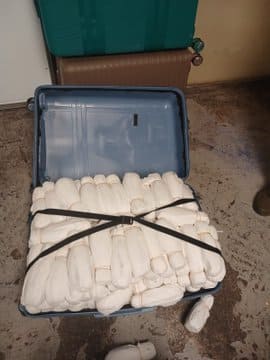
The man was intercepted not at a grandiose security checkpoint, but in a quiet, utilitarian corridor used for secondary baggage inspections. When officers asked to search his luggage, his demeanor shifted—a flicker of panic, a bead of sweat on his temple. They unzipped his primary suitcase. At first glance, it was mundane: folded T-shirts, a pair of sneakers, toiletries. But something felt wrong. The lining of the suitcase bulged unnaturally.
Using a knife, an officer slit the inner fabric. What emerged was not clothing, but a series of dense, sausage-like parcels wrapped in bright, almost neon, yellow plastic. One by one, the officers extracted them. One block. Five blocks. Ten. In total, they found multiple kilograms of a compact white powder. A field test turned the chemical reagent a deep cobalt blue: cocaine of a high purity.
The total street value, estimated by forensic investigators, landed at a staggering R8.7 million (approximately $470,000 USD).
“This is not a mule; this is a courier high up in the food chain,” whispered one investigator on the scene, who spoke on condition of anonymity. “The volume, the wrapping, the route—this was destined for the luxury nightclubs of Sandton or the drug dens of Durban. It would have fueled addiction and violence for months.”
The Brazilian’s face, captured in a police photograph that would later circulate on social media, betrayed a grim resignation. Standing flanked by two officers in tactical vests, his hands cuffed behind his back, he stared straight ahead—a man whose journey had ended 8,000 kilometers from home in a holding cell.
Brigadier Mathe addressed the media from Pretoria late Sunday night, her tone measured but triumphant. “This arrest is a significant disruption of transnational organized crime. O.R. Tambo is a gateway not just for people, but for illicit economies. We are sending a clear message: if you attempt to use our skies as a drug highway, you will land in our courts.”
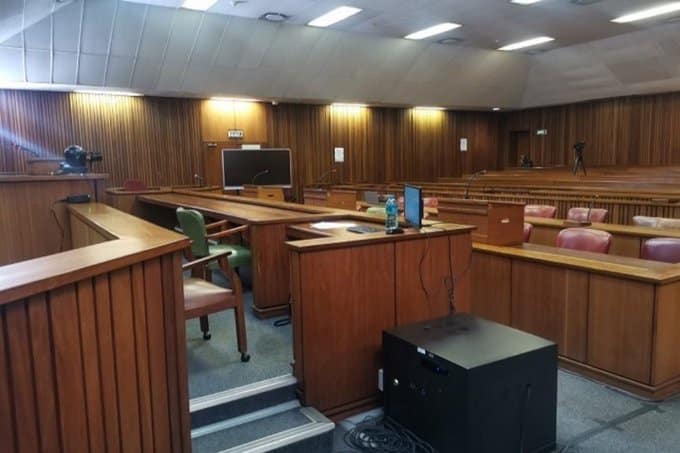
The suspect was processed at the Kempton Park Police Station, where he was formally charged with drug trafficking—a violation of South Africa’s Drug Trafficking Act, which carries a hefty minimum sentence of 15 years for large-scale deals. He will appear before the Kempton Park Magistrate’s Court on Tuesday morning, where the State is expected to oppose bail fiercely, arguing he is an extreme flight risk.
As the sun set over the highveld on Sunday, the yellow plastic parcels sat like toxic piñatas on an evidence room shelf. For the Brazilian in his cell, the silence was broken only by the distant roar of departing jets—a sound that once carried him toward fortune, but now only marked the seconds until his reckoning.
Meanwhile, Brigadier Mathe confirmed that investigations are ongoing. “One man is in custody, but the network remains. This is a single cut, not the head of the snake. Tuesday’s court appearance is just the first act.”
About The Author