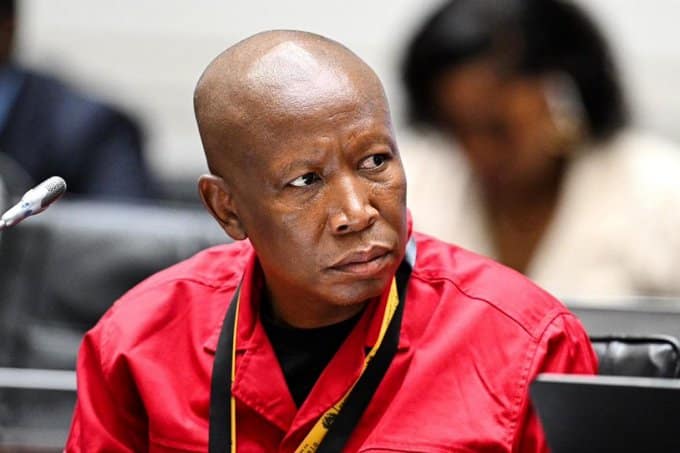
With the 2026 local government elections on the horizon, political maneuvering has begun in earnest. However, one potential partnership has been unceremoniously shut down before it could even gain traction. Economic Freedom Fighters (EFF) leader Julius Malema has delivered a definitive and characteristically blunt dismissal of any speculation suggesting a merger or electoral alliance between his red berets and the uMkhonto weSizwe Party (MKP), branding the idea not just unlikely, but fundamentally impossible.
Addressing a gathering of party supporters and the media, Malema did not mince his words, treating the rumors with a mix of scorn and finality. He framed the suggestion as a fantasy peddled by political opponents and idle commentators who fail to grasp the ideological chasm between the two organizations.
“There will be no alliance, no coalition, no ‘marriage of convenience’ with the MKP. Let that speculation die here and now,” Malema stated, his tone leaving no room for ambiguity. “You cannot merge a revolutionary, radical movement with a faction that represents the very counter-revolution we seek to destroy. The people who float these ideas do not understand our politics; they are simply projecting their own anxieties about the 2026 elections.”
The rumors of a potential EFF-MKP pact had been swirling for months, fueled by overlapping voter demographics and a shared posture of fierce opposition to the African National Congress (ANC). Both parties draw significant support from disillusioned former ANC members and young South Africans frustrated with unemployment, service delivery failures, and what they perceive as the ruling party’s abandonment of its liberation movement roots.
The MKP, formed in 2023 and named after the ANC’s former armed wing, has experienced a meteoric—if turbulent—rise, positioning itself as the true heir to the struggle legacy. This has put it on a direct collision course with the EFF, which has long dominated the space of radical economic transformation. Political analysts had suggested that a tactical alliance between the two could create a formidable bloc capable of dislodging the ANC in key metropolitan municipalities like Johannesburg, Tshwane, and eThekwini, where coalition governments have become the norm.
However, Malema argued that beneath the superficial similarities lies an irreconcilable ideological divide. He accused the MKP leadership of lacking a coherent policy platform beyond opportunism and of being a “holding company” for remnants of the old ANC order he has spent over a decade trying to dismantle.
“We are not a pressure group; we are a political home with a clear, published radical economic transformation agenda,” Malema elaborated. “What is the MKP’s agenda? To protect the interests of a few generals and former intelligence operatives who have been cast out by the ANC? We are not going to dilute our revolution to accommodate people who don’t know what they stand for.”
The EFF leader’s dismissal also carries deep personal and historical undertones. The personal rivalry between Malema and MKP leader Jacob Zuma is well-documented. Malema, once a staunch ally of Zuma during his tenure as ANC Youth League president, has since become one of his most vocal critics. The animosity reached a peak during Zuma’s incarceration and the subsequent political fallout, with Malema consistently arguing that the former president represents a politics of nostalgia and personal grievance rather than structural economic change.
For the MKP, which has been actively recruiting across the country and positioning itself as a kingmaker in hung municipalities, Malema’s statement is a significant setback. It forces the party to look elsewhere for coalition partners, most likely back toward the very ANC it broke away from—a prospect that could complicate its anti-establishment brand.
Malema concluded his remarks by reiterating the EFF’s confidence in going it alone. He announced that the party would be intensifying its voter registration drive, aiming to achieve an outright majority in several key municipalities without the need for post-election coalitions, which he derided as “unstable and undemocratic.”
“We are preparing for total control,” he said. “We are not preparing to beg for positions. The EFF will stand on its own revolutionary legs. Let MKP go and find their own path. It will not be with us.”
As the 2026 local government elections approach, Malema’s declaration effectively redraws the coalition landscape, confirming that the anticipated battle for municipalities will be a three-way contest between the ANC, the EFF, and the MKP—with no bridge between the two primary challengers.
About The Author