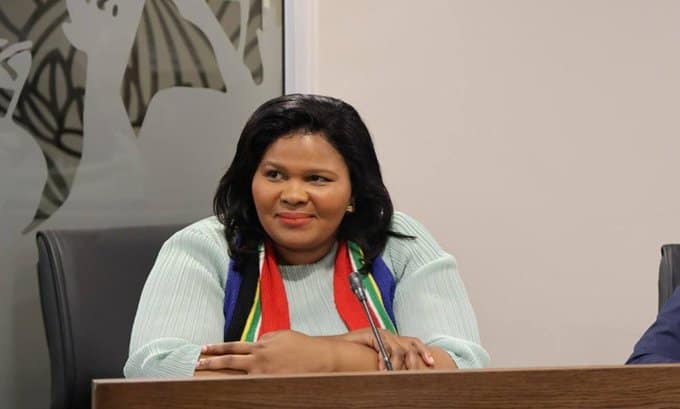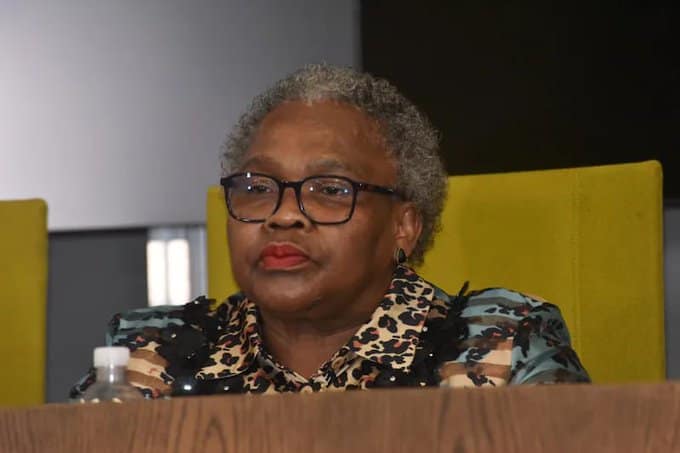
In a striking and politically embarrassing turn of events, Social Development Minister Sisisi Tolashe has been formally accused of being “uncooperative” and “evasive” during an official forensic investigation – an inquiry that she herself commissioned into the irregular appointment of her own director-general.
The findings, which have been seen by this publication, paint a damning picture of a senior Cabinet minister obstructing a process designed to ensure accountability within her own department. According to sources close to the investigation, Tolashe repeatedly refused to answer straightforward questions regarding the hiring process of the department’s top civil servant, offering vague responses, deflecting blame, and, in some instances, simply declining to provide information that fell squarely within her knowledge as the political head of the ministry.
The forensic probe was initially launched by Tolashe amid growing internal whispers of procedural violations, favoritism, and possible violations of public service regulations. However, rather than clearing the air, the investigation appears to have backfired spectacularly. While the report’s primary focus was the alleged irregular appointment of the director-general – a position that carries enormous responsibility over South Africa’s most vulnerable populations, including child welfare, social grants, and disability services – the investigator’s notes reveal that the minister’s own conduct became a significant secondary finding.
One passage from the report, paraphrased by a source, reportedly states: “Throughout the engagement, the Minister exhibited a pattern of avoidance. Direct questions regarding the sequence of events leading to the DG’s appointment were met with either claims of forgetfulness, redirection to other officials, or flat refusals to answer. This behavior constitutes uncooperativeness by any reasonable standard.”
Opposition parties have seized on the findings with predictable fury. Democratic Alliance (DA) spokesperson for social development, Bridget Masango, described the situation as “a mockery of accountability.” Speaking outside Parliament, Masango said: “Minister Tolashe commissioned this investigation to prove her innocence, and instead it proves her evasiveness. The question now is simple: what is she hiding? If the appointment of her director-general was above board, why could she not answer basic questions about it?”
The Economic Freedom Fighters (EFF) went further, calling for Tolashe to appear before the Portfolio Committee on Social Development to explain not only the irregular appointment but also her conduct during the inquiry. “A minister who cannot answer simple questions is a minister who either does not know her own department or does not respect the law,” said EFF MP Nqabayomzi Kwankwa. “Either way, she is unfit to hold the portfolio.”
Even within the African National Congress (ANC), there are rumblings of discomfort. A senior ANC source, speaking on condition of anonymity, conceded that the findings were “unhelpful” and “politically damaging,” particularly with the 2027 national elections looming. “She brought this investigation herself,” the source said. “You don’t commission a forensic probe and then refuse to engage with it. It makes you look either incompetent or guilty.”
Tolashe’s office has not yet issued a formal statement in response to the leaked findings. However, a close advisor told this publication that the minister maintains she was “fully cooperative” and that the investigator may have misinterpreted “ministerial discretion” as evasion. “There is a difference between being uncooperative and choosing not to be drawn into operational matters that belong to officials,” the advisor argued. “The minister answered what she believed was appropriate.”
Legal experts disagree. Public law attorney Michael van der Merwe explained: “When a minister commissions a forensic investigation – especially into an irregular appointment within her own department – she is morally and practically bound to participate fully. Refusing to answer ‘simple questions’ undermines the entire purpose of such an inquiry and can itself become evidence of an attempt to obstruct oversight.”
The Department of Social Development, meanwhile, has remained largely silent, though insiders suggest that morale has taken a hit. “You cannot have a minister who won’t answer direct questions about how her DG got the job,” said a mid-level official who requested anonymity for fear of retaliation. “We are supposed to be the department that protects the vulnerable. How can we do that when our own leadership won’t be transparent?”
The forensic report is now expected to be submitted to the Public Service Commission and possibly the office of the Public Protector. Whether President Cyril Ramaphosa will take any action against Tolashe remains unclear. The president has previously spoken sternly about accountability and “consequences for those who flout the rules,” but he has also been cautious about firing ministers during an election cycle.
For now, Minister Tolashe finds herself in an unenviable position: the author of a report that accuses her of obstructing a report she herself ordered. As one parliamentary observer put it: “In politics, you either control the narrative, or the narrative controls you. Right now, the narrative has Tolashe running from questions. And the more she runs, the worse it looks.”
About The Author