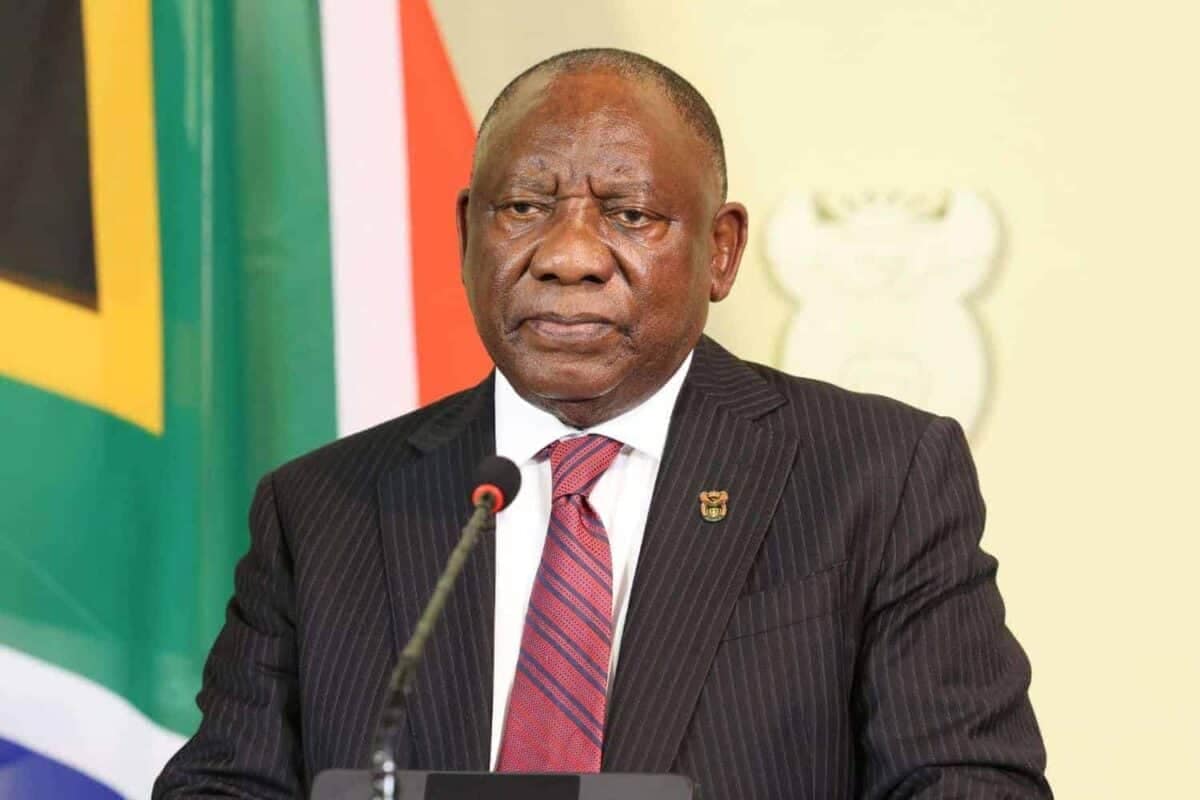
In a dramatic and defiant address from the Union Buildings on Tuesday morning, President Cyril Ramaphosa announced that he will formally challenge the Constitutional Court’s recent judgment on the Phala Phala matter by taking it on review, while emphatically stating that he will not resign from office. The president described the court’s findings as containing “material flaws” and insisted that he had done nothing to warrant stepping down.
The announcement plunges South Africa into uncharted political and constitutional waters. For the first time in the democratic era, a sitting president has declared his intention to challenge the country’s highest court on a judgment that found he may have violated his oath of office. The move is certain to ignite fierce debate among legal experts, opposition parties, and the governing African National Congress (ANC), which has so far remained publicly divided on the matter.
Speaking to a packed media briefing, Ramaphosa appeared calm but resolute, his tone measured yet carrying an undercurrent of frustration. He was flanked by his legal team, including senior advocate Vincent Maleka, who confirmed that papers would be filed with the Constitutional Court within days.
“I have noted the judgment of the Constitutional Court with the seriousness it deserves,” Ramaphosa began. “However, after careful consideration and consultation with legal experts, it has become clear that the judgment contains material flaws – both in its factual findings and in its legal reasoning. I have therefore instructed my legal team to pursue a review of this judgment in an expeditious manner.”
The president did not go into granular detail about which specific aspects of the judgment he believes are flawed, but sources close to his legal strategy have indicated that the challenge will focus on three key areas: the court’s interpretation of what constitutes a violation of the executive oath, the admissibility of certain evidence presented during the proceedings, and what the president’s team describes as “procedural irregularities” in the way the matter was fast-tracked to the apex court.
‘I Will Not Resign’ – A Firm Rejection of Opposition Demands
Perhaps the most striking moment of the address came when Ramaphosa directly addressed calls for his resignation – demands that have grown louder since the Constitutional Court’s ruling last week. Opposition parties, including the Economic Freedom Fighters (EFF) and the Democratic Alliance (DA), have led chants of “Step down” outside Parliament, while some civil society groups have launched a petition calling for his immediate removal.
“Let me be clear,” Ramaphosa said, pausing for emphasis. “I will not resign. I was elected by the people of South Africa through a democratic process. I have served this nation with integrity and dedication. A judgment that I believe to be flawed does not erase the mandate given to me by the citizens of this country. I will continue to lead, and I will continue to serve.”
His words drew immediate reactions. Inside the Union Buildings auditorium, a small group of ANC officials and presidential aides applauded. Outside, however, a handful of protesters had gathered with placards reading “Ramaphosa Must Fall” and “No One Is Above the Law.” Police maintained a visible presence but reported no incidents.
The Phala Phala Judgment: A Recap
The Constitutional Court’s judgment, delivered on 4 May 2026, arose from a complaint by former Public Protector Busisiwe Mkhwebane – and later pursued by the EFF – regarding the theft of an undisclosed amount of foreign currency from Ramaphosa’s Phala Phala game farm in 2020. The court found that the president may have violated his oath of office by failing to report the theft to police in a timely manner and by potentially exposing himself to a conflict of interest involving proceeds from game sales.
While the court stopped short of ordering Ramaphosa’s impeachment, it referred the matter to Parliament for further action under Section 89 of the Constitution – the provision governing the removal of a president. The judgment was widely interpreted as a stinging rebuke of Ramaphosa’s conduct, even if it did not compel his exit.
The president has consistently denied any wrongdoing, maintaining that the currency in question was from legitimate game sales and that the matter had been properly handled by his security detail. His decision to seek a review marks a significant escalation in his legal counter-offensive.
Legal Experts Divided on Prospects of Success
The announcement has sparked immediate debate among constitutional law experts. Some argue that a sitting president has every right to challenge a court’s findings, particularly on matters of fact and law. Others contend that the Constitutional Court is the final arbiter in constitutional matters and that a review – essentially asking the same court to revisit its own decision – is unlikely to succeed unless new evidence or a clear error of law is presented.
“The Constitutional Court does not lightly revisit its own judgments,” said legal scholar Professor Cathy Powell of the University of Cape Town. “A review application would need to demonstrate a patent error or a newly discovered fact of such significance that it would have changed the outcome. That is a very high bar. The president’s legal team will have their work cut out for them.”
However,另一位 legal expert, advocate Mpumelelo Zulu, offered a different perspective. “The president is not saying the court is wrong because he disagrees with it. He is saying there are procedural flaws and evidentiary problems. That is a legitimate grounds for review. Whether he succeeds is another matter, but he is well within his rights to try.”
Political Fallout: ANC Allies and Opponents React
Within the ANC, reactions have been carefully calibrated. Party spokesperson Mahlengi Bhengu-Motsiri released a brief statement saying the ANC “notes the president’s decision and respects his right to exhaust all legal remedies available to him.” Notably, the statement did not explicitly endorse Ramaphosa’s characterization of the judgment as flawed, nor did it repeat the party’s earlier expression of “full confidence” in his leadership.
Opposition parties were far less restrained. EFF leader Julius Malema, speaking outside the party’s Johannesburg headquarters, dismissed Ramaphosa’s announcement as “the desperate thrashing of a wounded animal.” He continued: “The highest court in the land has spoken. Cyril Ramaphosa is a president who broke his oath. Now he wants to review the judges? He wants to review the Constitution? He must go. He must go now.”
DA leader John Steenhuisen echoed those sentiments, calling the review application a “delay tactic” and warning that it would exacerbate the political crisis. “South Africa needs leadership, not litigation. The president is putting his own interests ahead of the nation’s stability. If he had any honor left, he would resign today.”
Smaller parties, including ActionSA and the United Democratic Movement, have also called for Ramaphosa to step aside pending the review process, arguing that a president under such a cloud cannot effectively govern.
Public Reaction: A Nation Polarized
On the streets of Pretoria and across social media, the public reaction has been deeply polarized. Supporters of Ramaphosa see the review as a necessary defense against what they call an overreach by the judiciary. Critics see it as an act of defiance unbecoming of a president sworn to uphold the Constitution.
“I voted for Ramaphosa because I believed he would clean up the corruption from the Zuma years,” said Thabo Mokoena, a small business owner from Soweto. “Now he’s fighting the courts? It looks bad. It looks like he has something to hide.”
But a different view emerged from Nomsa Dlamini, a retired teacher from KwaZulu-Natal. “The courts are not God. They can make mistakes. If the president believes he is innocent, let him fight. Would we rather have a president who just rolls over and resigns every time there’s an accusation?”
What Happens Next
The coming days and weeks will be critical. Ramaphosa’s legal team is expected to file its review application by Friday at the latest. The Constitutional Court will then decide whether to hear the application – a process that could take weeks or months. If the court agrees to hear the matter, a full panel of judges will reconsider their original findings. If the court dismisses the application, Ramaphosa will face the stark choice of accepting the judgment or escalating the matter – though no further appeal would be available.
In the meantime, Parliament’s Section 89 independent panel – tasked with assessing whether there is prima facie evidence for Ramaphosa’s removal – has indicated it will continue its work regardless of the review application. That panel’s findings are expected by the end of June.
For now, President Cyril Ramaphosa remains in office, defiant and unbowed. But the political and legal storms swirling around him show no sign of abating. As one veteran political journalist put it outside the Union Buildings: “The president has drawn a line in the sand. The question now is whether the courts will erase it – or whether the sand itself will shift beneath his feet.”
About The Author