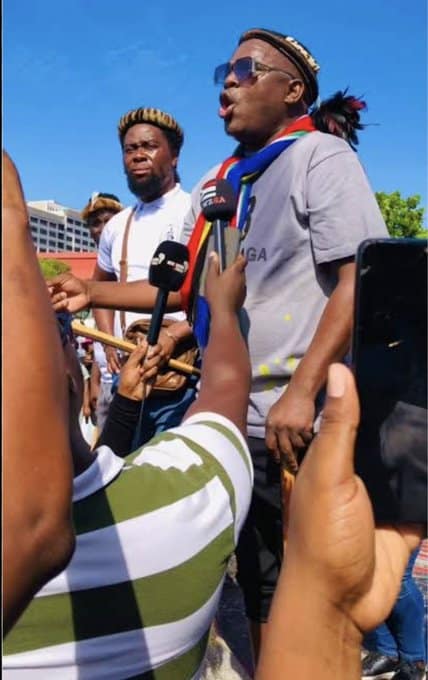
The simmering tensions over the control of Johannesburg’s most densely populated inner-city neighborhoods boiled over on Wednesday as controversial former radio presenter and self-styled activist Ngizwe Mchunu led hundreds of demonstrators on a winding, high-decibel march through the bustling streets of Hillbrow and Yeoville. Brandishing placards and singing struggle songs repurposed for a new target, the crowd declared that these cosmopolitan suburbs, long known as melting pots of pan-African migration, “cannot be owned by foreign nationals” and vowed to “take back” the areas for South Africans.
The march, which began shortly after 10 AM at the intersection of Twist Street and Claim Street in Hillbrow, quickly gathered momentum as Mchunu—dressed in a signature black beret and a t-shirt emblazoned with the words “Mzansi First”—led a column of roughly 500 to 700 protesters past high-rise apartment blocks, spaza shops, and street-side vendors who hastily pulled down their shutters. By midday, the crowd had snaked through the steep, narrow roads of Yeoville before converging at the famous Yeoville Water Tower, where Mchunu addressed his followers from the back of a hired flatbed truck.
“These streets were built by South African hands,” Mchunu thundered into a portable megaphone, his voice echoing off the faded facades of apartment buildings. “These pavements were walked by our mothers. These corners were where our fathers bought newspapers. And now? Now we walk here and we hear French. We hear Portuguese. We hear Swahili. We hear everything except isiZulu and Sesotho. That ends today. We are taking back our areas. Not tomorrow. Not next week. Today. Now.”
The crowd erupted in cheers, punctuated by the toyi-toyi dance and the raising of clenched fists. Some carried handwritten signs reading “Foreigners Must Go,” “Our Children Are Sleeping in Shacks While Immigrants Live in Flats,” and “Housing for South Africans First.” Others wore balaclavas or had their faces covered despite the mild autumn weather—a detail that would later draw criticism from police oversight groups.
The Man at the Center of the Storm
Ngizwe Mchunu is no stranger to controversy. A former Ukhozi FM presenter with a massive Zulu-speaking following, he first gained national notoriety in 2021 when he was accused of inciting violence during the July unrest that rocked KwaZulu-Natal and Gauteng. While those charges were eventually dropped due to insufficient evidence, Mchunu has since reinvented himself as a populist activist, focusing his rhetorical fire on what he calls “the takeover” of Johannesburg’s inner city by foreign nationals—particularly those from Zimbabwe, Nigeria, Pakistan, Bangladesh, and Ethiopia.
Critics accuse Mchunu of xenophobia pure and simple, pointing to his frequent use of dehumanizing language and his habit of naming specific nationalities as “problem groups.” Supporters, however, see him as a truth-teller willing to speak about issues that mainstream politicians and civil society groups have allegedly ignored for decades: crumbling infrastructure, overcrowded hijacked buildings, and the genuine economic despair felt by many South Africans who believe they have been left behind in their own neighborhoods.
“When I look at Hillbrow, I don’t recognize my home anymore,” said Martha Dlamini, 54, a domestic worker who joined the march from her flat in Berea. “I am not a hater. I am not violent. But I am tired. I pay rent to a Nigerian landlord who doesn’t fix the pipes. I buy bread from a Pakistani shopkeeper who doesn’t speak my language. I walk past street vendors who are not South African. Where are we supposed to go? Mchunu is the only one who says it out loud.”
A Neighborhood of Fault Lines
Hillbrow and Yeoville have long been Johannesburg’s most visible symbols of both African cosmopolitanism and urban decay. Once the glittering white middle-class playground of the 1970s, these neighborhoods became the first “grey areas” where black residents defied apartheid pass laws. In the post-apartheid era, they evolved into ports of entry for migrants from across the continent—Ghanaian traders, Ethiopian restaurant owners, Congolese musicians, Zimbabwean domestic workers, Nigerian businessmen.
Today, the demographic reality is complex. While foreign nationals certainly own many businesses and lease many properties (often through middlemen in complex subletting arrangements), South Africans still make up the majority of residents in both suburbs. However, the perception of “loss” is powerful—fueled by visible changes in shop signage, language on the streets, and the prevalence of informal economic activity dominated by non-South Africans.
“The tragedy is that the real enemy is not the foreign shopkeeper,” said Professor Thabo Mogotsi, an urban geographer at the University of Johannesburg who has studied migration patterns in the inner city for fifteen years. “The real enemy is building hijacking, landlord neglect, municipal failure to enforce bylaws, and the hollowing out of public housing stock. But those are complex, boring issues. It’s much easier to point at a Somali cashier and say, ‘He doesn’t belong here.’ Mchunu knows this. He is exploiting legitimate grievances for political gain.”
The March: Order and Edge
Despite the charged rhetoric, Wednesday’s march remained largely peaceful—though the atmosphere carried an unmistakable undercurrent of menace. A heavy contingent of Johannesburg Metropolitan Police Department (JMPD) officers, supported by visible SAPS members in armored vehicles, shadowed the procession at a distance. No major confrontations were reported, though witnesses described tense moments when marchers attempted to enter a building on Raleigh Street believed to house primarily foreign tenants; police intervened, redirecting the crowd back onto the main road.
“We are here to ensure the right to peaceful protest is exercised within the law,” said JMPD spokesperson Superintendent Xolani Fihla in a brief statement. “To date, no arrests have been made, and we have no reports of violence, looting, or property damage. We continue to monitor the situation.”
Mchunu himself appeared careful to avoid direct incitement to violence, repeatedly instructing his followers to “remain disciplined” and to “win with our feet, not with our fists.” In his Water Tower address, he explicitly warned against attacking businesses or individuals. “If I see any of you smashing a window or taking something that is not yours, you are not with me. You are a criminal. We are not criminals. We are reclaiming our dignity. Let them see that we can march without breaking.”
Nevertheless, human rights organizations expressed alarm at the undertones. The South African Human Rights Commission (SAHRC) issued a midday statement reminding all citizens that hate speech and xenophobic incitement are crimes under the Prevention and Combating of Hate Crimes and Hate Speech Act. “While the right to protest is constitutionally protected, calls to ‘take back areas’ targeting specific nationalities cross a dangerous line,” the statement read.
Political Echoes and Silences
Notably absent from Wednesday’s march were any overt political party symbols. Mchunu has insisted that his movement—loosely organized under the banner “Operation Dudula 2.0” (a nod to the earlier vigilante-style anti-immigrant group)—is a grassroots civil society initiative, not a political party. However, political analysts note that the timing is ripe for exploitation. With national elections looming in 2027, several parties on both the left and right have begun testing anti-immigrant rhetoric as a wedge issue.
The African National Congress (ANC) has been conspicuously silent, issuing no official response to the march by late Wednesday afternoon. The Democratic Alliance (DA) condemned the march as “xenophobic grandstanding,” while the Economic Freedom Fighters (EFF) issued a more nuanced statement acknowledging “the crisis of housing and jobs” while rejecting “any form of Afrophobia or xenophobia.” The newly formed uMkhonto weSizwe (MK) Party, meanwhile, offered tepid support, calling for “orderly migration management” without endorsing Mchunu’s tactics.
“Mainstream parties are terrified of this issue,” said political analyst Lukhanyo Vangile. “They know there is genuine anger among poor South Africans who feel overwhelmed by migration. But they also know that xenophobic violence has a horrific history in this country—2008, 2015, 2019—and that being seen as endorsing it could lead to international condemnation and economic fallout. So they prevaricate. That leaves space for figures like Mchunu, who have no such political constraints, to own the narrative.”
Voices from the Ground
On the streets of Hillbrow and Yeoville, reactions were predictably divided. Among South African residents who joined the march, there was a palpable sense of catharsis. “We have been quiet for too long,” said 32-year-old unemployed construction worker Thabo Nkosi, who carried a flag draped over his shoulders. “Every corner I turn, there is a foreigner selling something. I cannot compete. I cannot even find a room to rent because they pack ten people into one flat and pay cash, no questions asked. I am not saying burn anything. I am saying: give us a chance.”
But among foreign nationals, the mood was one of fear and resignation. A Zimbabwean street vendor who gave his name only as “Patrick” watched the march pass from behind the barred window of a friend’s shop. “I have been here since 2012,” he said, his voice trembling slightly. “I pay my taxes. I send money to my mother in Bulawayo. I have never committed a crime. But when I see this, I think: today they march. Tomorrow, maybe they break. I have a suitcase ready. I always have a suitcase ready.”
A Nigerian shopkeeper in Yeoville, who declined to be named, told this publication that he had closed his electronics repair business early. “Every few years, this happens,” he said, shaking his head. “A politician or a radio man needs attention. He whips up the people. We suffer. The police do nothing. Then after two weeks, it quiets down, and we open our shops again. We have no choice. This is home now. But home should not be this frightening.”
What Comes Next?
As the march dispersed around 2 PM, Mchunu addressed his followers one final time, promising that Wednesday was “only the beginning.” He announced plans for a follow-up “inspection” of buildings in the area on Saturday, during which he claims his movement will identify “hijacked properties” and “illegal tenancies” and present evidence to the City of Johannesburg.
“We are not the police,” Mchunu said. “We are not the home affairs department. But if those institutions refuse to do their jobs, the people must do it themselves. On Saturday, we walk again. We will go door to door. We will document. We will expose. And then we will hand our findings to the mayor and say: ‘Now you act. Or we will.'”
The City of Johannesburg has not yet responded to Mchunu’s Saturday proposal. However, a source within the mayor’s office, speaking on condition of anonymity, expressed concern that even a peaceful “inspection” could escalate into unlawful evictions or confrontations.
“Once you have crowds of angry people entering buildings under the guise of ‘inspecting,’ you lose control,” the source said. “We have seen this movie before. It ends badly. We are urgently seeking a meeting with Mchunu to de-escalate.”
Whether Mchunu will accept such a meeting remains unclear. As night fell over Hillbrow, the streets returned to their usual chaotic hum. Foreign-owned shops reopened cautiously. South African residents walked home, some buoyed by the day’s events, others uneasy. And in the gaps between high-rise buildings, the city’s oldest tension lingered, unresolved: who belongs here, and who decides?
For now, the only certainty is that Ngizwe Mchunu is not finished. And neither, it seems, is the debate over who holds the keys to Johannesburg’s inner city.
About The Author