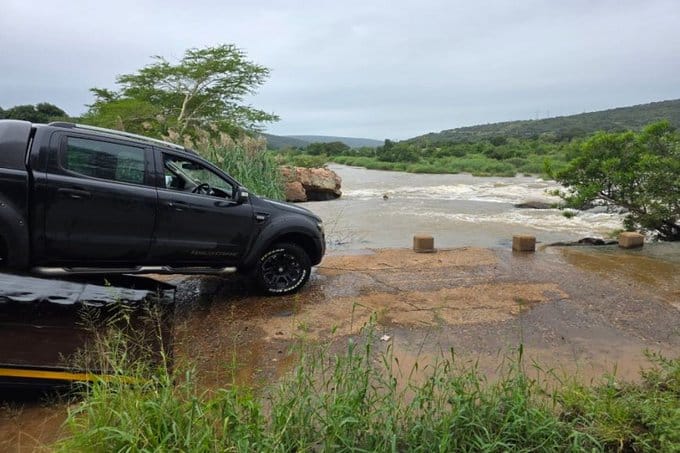
The oppressive heat of the Lowveld did little to deter the grim determination on the riverbanks of the Komati on Thursday, as police divers and search-and-rescue teams pressed on with their relentless hunt for a 59-year-old businessman who vanished beneath the churning brown waters three days ago. The man, identified by family as Mr. Johan van der Merwe (59), a well-known livestock trader and farmer from the Komatipoort district, was swept away while attempting to cross a flooded low-water bridge on the R571 during a sudden and violent thunderstorm on Monday afternoon.
Despite exhaustive search efforts covering more than 12 kilometers of the treacherous river system—from the crossing point downstream toward the Mozambique border—there has been no sign of the missing man. As the sun rose on Thursday, the fourth day of the operation, the mood among rescue workers shifted from urgent rescue to solemn recovery. His family, huddled under a makeshift tent on the riverbank, clung to a thin thread of hope even as their faces betrayed the weight of growing despair.
“A man does not simply disappear,” said his eldest son, Pieter van der Merwe (31), his voice cracking as he addressed a small gathering of reporters. “My father has lived on this river his whole life. He knows its moods. He knew that bridge like the back of his hand. Something went terribly wrong. We need to find him. We need to bring him home. Whether he is alive or… we need to know. The not-knowing is a different kind of drowning.”
The Crossing That Turned Fatal
The incident occurred at approximately 3:45 PM on Monday, when a violent lowveld thunderstorm—the kind that appears suddenly, dropping curtains of rain and turning calm rivers into raging torrents within minutes—caught motorists off guard. Mr. van der Merwe had been returning from a cattle auction in Malelane and was reportedly aware that the Komati was rising. However, witnesses say the low-water bridge still appeared passable when he approached.
Low-water bridges, common in rural Mpumalanga, are designed to be submerged during high-flow events, but they remain a notorious killer during the rainy season. The Komati River, which forms part of the border between South Africa and Mozambique before flowing into the Indian Ocean, is particularly dangerous due to its unpredictable currents, submerged rocks, and deep scour holes created by previous floods.
“He drove onto the bridge, and about halfway across, the water was already lapping at his车门,” recounted Thabo Shabangu, 43, a security guard at a nearby lodge who witnessed the incident from higher ground. “I was shouting. I was waving my arms. I think he saw me. He stopped the bakkie. He tried to reverse. But the current was too strong. The water lifted the back of the vehicle. It turned sideways. And then… everything was gone. The bakkie. The man. Just like that. In seconds.”
The white Toyota Hilux was found two hours later, overturned and partially buried in silt nearly 800 meters downstream, its cab crushed and windows shattered. Mr. van der Merwe was not inside. Divers believe he was pulled from the vehicle as it tumbled through a series of rapids known locally as “Die Draai”—The Bend—where the river narrows and accelerates dramatically.
A Community Rallies, Then Fears the Worst
The search operation, coordinated by the South African Police Service (SAPS) Dive Unit based in Nelspruit, has been a massive undertaking for a town of Komatipoort’s size. More than twenty divers have been rotated through the murky waters, some using sonar equipment to scan the riverbed, others conducting manual line searches in areas where visibility is reduced to less than a meter. A helicopter from the Department of Water and Sanitation has conducted low-level flyovers, while ground teams have walked the riverbanks, scanning for debris or any sign of the missing man.
But the challenges are immense. The Komati’s current remains strong even on sunny days, and recent rains upstream in the Crocodile River catchment have kept water levels unusually high for late April. Divers report underwater obstacles—submerged trees, car wrecks from previous accidents, and jagged rocks—that make systematic searching perilous.
“Every hour that passes, the chances diminish,” said SAPS Dive Unit Commander, Captain Andries Malan, speaking from the command post set up at the river’s edge. “We are dealing with a river that does not want to give up its secrets. But we have not given up. We will continue searching as long as there is any possibility. The family deserves that. The man deserves that.”
By Wednesday evening, the search had expanded into Mozambican territory, with local authorities in the town of Ressano Garcia notified to monitor their stretch of the river. There has been no confirmed sighting across the border, though rumors of debris—a shoe, a piece of clothing—have all proven false alarms.
A Life Lived on the Land
For those who knew Johan van der Merwe, the tragedy has sent shockwaves through the tight-knit farming community of Komatipoort. Born and raised in the area, he was the third generation of his family to work the land, running a mixed operation of cattle, citrus, and macadamia nuts. He was known as a fair man—someone who extended credit to struggling workers, who never turned away a neighbor in need, who spoke Afrikaans, English, and passable Shangaan to greet everyone with the same warmth.
“He was not a rich man by city standards, but he was the richest man I knew in the things that matter,” said his friend and fellow farmer, Gert van Wyk (62), who has been at the family’s side since Monday. “Johan would give you the shirt off his back. He employed over fifty people from the local community. He paid school fees for his workers’ children. He was building a clinic on his farm for the community. This… this is a loss not just for his family. This is a loss for every person in Komatipoort.”
News of the disappearance spread quickly through the town’s WhatsApp groups and community radio stations. On Tuesday evening, more than 200 residents gathered at the Komatipoort NG Kerk for a prayer vigil. Candles were lit. Hymns were sung in Afrikaans, English, and Tsonga. A local pastor, Thabo Nkuna, led the congregation in a prayer that captured the collective anguish: “Lord, the river is deep. But your love is deeper. Bring him back to us. Or give us the grace to say goodbye.”
The Dangers of Low-Water Bridges
Wednesday’s tragedy is not an isolated incident. Across South Africa, low-water bridges claim dozens of lives each year, particularly in the summer rainfall regions of Mpumalanga, Limpopo, and KwaZulu-Natal. Despite repeated calls for better signage, guardrails, or the replacement of crossings with raised bridges, many rural municipalities lack the budget or political will to prioritize the upgrades.
According to data from the Road Traffic Management Corporation (RTMC), there were at least 47 fatalities at low-water bridges between 2020 and 2025. The Komati River crossing where Mr. van der Merwe disappeared has been the site of three previous deaths: a young mother in 2018, a livestock herder in 2021, and a motorcyclist in 2023.
“We have been warning the local municipality for years,” said Komatipoort Ratepayers’ Association chairperson, Susan Prinsloo. “That bridge is a death trap. When the river rises, it becomes invisible. There are no lights. There are no barriers that automatically close. There is nothing but a small sign that says ‘Caution.’ It is not enough. And now a good man has paid the price.”
The Ehlanzeni District Municipality, responsible for the road, issued a brief statement expressing condolences and promising a review of safety measures at all low-water crossings in the region. However, critics note that similar promises have been made after previous tragedies, with little tangible change.
A Family’s Vigil
As the search continues, the van der Merwe family has refused to leave the riverbank. Johan’s wife, Elsa van der Merwe (57), has been receiving pastoral counseling and medical attention for exhaustion, but she remains adamant that she will be there when her husband is found.
“He loved this river,” she said quietly, staring at the water as the afternoon light began to fade. “He fished here as a boy. He taught our sons to swim here. He always said the Komati was the heartbeat of our farm. He never feared it. Maybe that was the problem. Maybe he respected it too much to fear it. I don’t know. I just know I need him back. I am not ready to live in a world where the Komati has taken him from me.”
Pieter van der Merwe told reporters that the family has been overwhelmed by the support from the community—meals delivered, offers of labor, financial contributions toward the search effort. But he also issued a plea to the public: “If you are on the river, on the Mozambican side, or if you see anything—a piece of clothing, a shoe, anything—please call the police. Do not try to retrieve it yourself. The river is still dangerous. We do not want another family to feel what we are feeling.”
What Comes Next?
The SAPS Dive Unit has indicated that the active search will continue through the end of the week, after which a decision will be made about scaling back to periodic sweeps. In similar cases, missing persons in fast-moving rivers are often recovered downstream, sometimes weeks later, when water levels drop or when the body becomes snagged on a visible obstacle. The family has been prepared for this grim possibility.
A grief counselor has been stationed at the van der Merwe farm, and local churches have opened their doors for anyone needing support. The community has also started a memorial fund to assist with search costs and, should the worst be confirmed, funeral expenses.
For now, though, the waiting continues. The divers descend. The helicopter drones overhead. The family watches. And the Komati River flows on, indifferent as ever, carrying its terrible secret toward the sea.
As the sun set over the Lowveld on Thursday evening, Pieter van der Merwe walked to the edge of the water one last time. He knelt down, touched the surface, and whispered something that the rushing water immediately swallowed.
Then he stood up, turned his back on the river, and walked back to his mother. Behind him, the search lights flickered on, casting long shadows across the water.
Somewhere out there, in the dark, the Komati still holds its silence.
About The Author