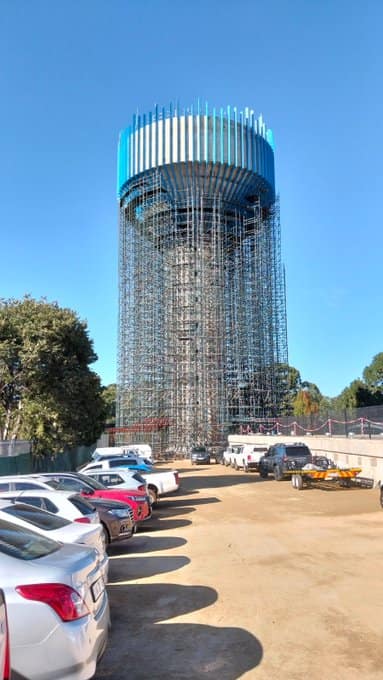
In a city long haunted by the specter of dry taps, sporadic outages, and the dreaded “low water pressure” alerts that have become a grim part of daily life, a significant dawn broke on Thursday. The City of Johannesburg officially inaugurated the new Brixton Reservoir and Water Tower, a state-of-the-art infrastructure project that officials have hailed as a “game-changer” in the decades-long struggle to secure water stability for the often-parched economic capital of South Africa.
The unveiling, which took place under a crisp autumn sky on the crest of the Brixton Ridge—affording a panoramic view of the city’s sprawling northern suburbs—was a deliberately symbolic affair. For years, the aging reservoir infrastructure in this area had become a textbook case of municipal decay: leaky pipes, insufficient capacity, and a chronic inability to keep up with the relentless vertical growth of nearby high-density suburbs like Melville, Auckland Park, and the bustling Johannesburg CBD.
Now, after nearly three years of construction delays, budget overruns, and engineering hurdles, a gleaming new concrete giant sits embedded into the hillside, capable of holding an additional 45 million liters of potable water. When combined with the refurbished historical Brixton Water Tower—a familiar landmark that has stood silent and underutilized for nearly two decades—the total新增 capacity pushes the area’s storage to over 70 million liters.
“This is not just concrete and steel,” declared Johannesburg Mayor Dada Morero at the ribbon-cutting ceremony, his voice amplified across a crowd of councilors, engineers, and local residents. “This is a lifeline. We are turning the page on an era where ‘water shedding’ entered our vocabulary. The days of waking up at 3 AM to fill a bathtub because you know the morning rush will kill the pressure? We are declaring war on that reality. Today, Brixton fights back.”
The Anatomy of a Crisis Averted?
To understand the significance of the Brixton opening, one must first revisit the near-catastrophe of recent years. Johannesburg, unlike coastal cities blessed with immediate access to raw water sources, relies on a complex and aging system of pumps, towers, and pipelines to lift water from Rand Water’s bulk supply. The Brixton zone, specifically, has been a notorious pressure “shadow”—a hydraulic dead zone where gravity fails and pumps struggle.
The previous Brixton reservoir, built in the 1930s, was a relic of a smaller city. By 2023, it was operating at 140% of its designed capacity, held together by patchwork repairs and the grim determination of municipal workers. During the intense load-shedding bouts of 2024 and early 2025, the Brixton zone was often the first to go dry and the last to recover.
Residents recall the “Great Dry Week” of November 2024, when taps ran dry for six consecutive days. Businesses in the Brixton and Westbury areas lost hundreds of thousands of rands in perishable stock. Clinics had to cancel surgeries. Schools sent children home early because toilets could not be flushed.
“No one who lived through that week will ever forget it,” said Riana van der Merwe, a 45-year-old resident of nearby Hurst Hill who attended the opening. “We had water tankers on the corners, but the queues were four hours long. Elderly people cried. Young mothers got into fights. It was chaos. This new reservoir… I will believe it works when my tap doesn’t stutter during peak hour. But seeing it here? It gives me a little bit of hope.”
Engineering Marvel Meets Modern Challenges
The new facility is not merely a larger bathtub. City engineers have equipped the Brixton site with a suite of modern monitoring technology that would have seemed like science fiction when the original tower was built nearly a century ago.
The reservoir is fitted with real-time flow meters, automated pressure control valves, and a chemical dosing system that adjusts chlorine levels based on demand. A central control room, linked to the City’s new “Smart Water Operations Center” in Braamfontein, allows a handful of technicians to monitor levels, detect bursts, and reroute flows remotely—a far cry from the days when a team had to physically drive to the site to open or close a manual valve.
“We have also implemented a scada-driven predictive algorithm,” explained City of Johannesburg’s Head of Infrastructure, Mpho Nakedi. “The system learns usage patterns. It knows that in Auckland Park, pressure drops around 6 PM when students return to residences and shower. It anticipates that need and pre-pressurizes the system. It sounds small, but these are the details that separate a third-world water system from a world-class one.”
Furthermore, the Brixton site has been designed with the reality of Eskom’s unstable grid in mind. A dedicated solar array, covering the entire roof of the reservoir building, provides backup power to the monitoring systems and the critical pumping station. While the main pumps still require grid power, the solar backup ensures that the site never loses the ability to communicate data or maintain basic pressure.
“The dark days of load-shedding killing our water systems are ending, municipality by municipality,” said Deputy Minister of Water and Sanitation, David Mahlobo, who attended the event as a special guest. “We have encouraged metros to look at off-grid solutions for critical water infrastructure. Brixton is a pilot. If it works, this becomes the template for Lenasia, Soweto, and Diepsluit.”
The Skeptics and the Shadows
For all the ribbon-cutting optimism, the Brixton project opens under a cloud of civic skepticism—a sentiment hard-earned by years of broken promises and unfinished maintenance.
The Democratic Alliance’s shadow MMC for Environment and Infrastructure Services, Cllr. Nicole van Dyk, issued a statement warning that while the reservoir is welcome, “it does not fix the leaking pipes that lose 30% of our water before it even reaches a tap.”
Indeed, Johannesburg’s non-revenue water—water that is pumped but lost to leaks, theft, or faulty metering—hovers above 40% in some districts. Critics argue that building more storage without fixing the arteries that carry the water is akin to buying a bigger fuel tank for a car with a punctured fuel line.
“We are celebrating a bathtub while ignoring the hole in the floor,” van Dyk told journalists after the ceremony. “What happens when this reservoir is full but the pipe feeding Brixton—the old, fragile main from the Hursthill Tower—explodes, as it does every few months? We will have 70 million liters of water sitting on a hill that nobody can access. The real work remains undone.”
The City has countered that the Brixton project was always part of a phased approach. Phase Two, scheduled for 2027, involves replacing the 8-kilometer trunk main linking Brixton to the Rand Water supply, a project budgeted at R450 million. Phase Three will focus on smart metering for high-consumption households in the area, shifting from flat-rate billing to usage-based charging to disincentivize waste.
“We cannot do everything at once,” Mayor Morero admitted. “But you have to start somewhere. We chose to start with storage because when the system fails, storage is what buys you time. It gives us a cushion. It lets us keep taps running while we repair a burst pipe down the line. Without Brixton, we were living without a safety net. Today, the net is installed.”
A View to the Future
The opening of the Brixton Reservoir was not without its moments of genuine community warmth. Local primary school children sang a song composed for the occasion, with lyrics in English, Zulu, and Afrikaans that roughly translated to “Water flows, life grows.” A group of elderly residents, many of whom had campaigned for years for the upgrade, were given a guided tour of the facility, their wheelchairs navigating the smooth new access ramps.
Among them was 82-year-old Mr. Samuel “Bra Sam” Ndlovu, a retired teacher who has lived in Brixton since 1974. He stood at the edge of the main reservoir chamber, staring down at the vast, mirror-like surface of the water 15 meters below.
“You know, when they built the old tower in the ’30s, my father was a laborer here,” Bra Sam said, his voice soft. “He carried bricks on his head. He never owned a house, but he helped build this neighborhood. Now I am here, an old man, watching them build again. My father always said, ‘Brixton is a place that refuses to die.’ Maybe he was right. Maybe we are finally learning to live again.”
As the ceremony concluded and the crowds dispersed, a City technician climbed a ladder to the top of the refurbished water tower—a classic structure that has been repainted in fresh white and blue. For the first time in nearly twenty years, the tower began to fill. The sound of rushing water echoed down the access shaft.
In the homes below, nothing happened yet. The taps remained silent for a few more hours as the system pressurized. But just before 6 PM, as the sun began to set behind the ridge, a young mother in a flat on Claremont Avenue turned on her kitchen tap to start cooking dinner.
Water came out. Immediately. Strong. Cold.
She did not know about the ceremony, the speeches, or the engineering. She only knew that for the first time that week, she did not have to boil water from a storage drum. She smiled, filled her pot, and got on with the business of life.
In Johannesburg, that small, quiet moment is perhaps the truest measure of success. The Brixton Reservoir is open. Now, the city waits to see if the promise holds.
About The Author