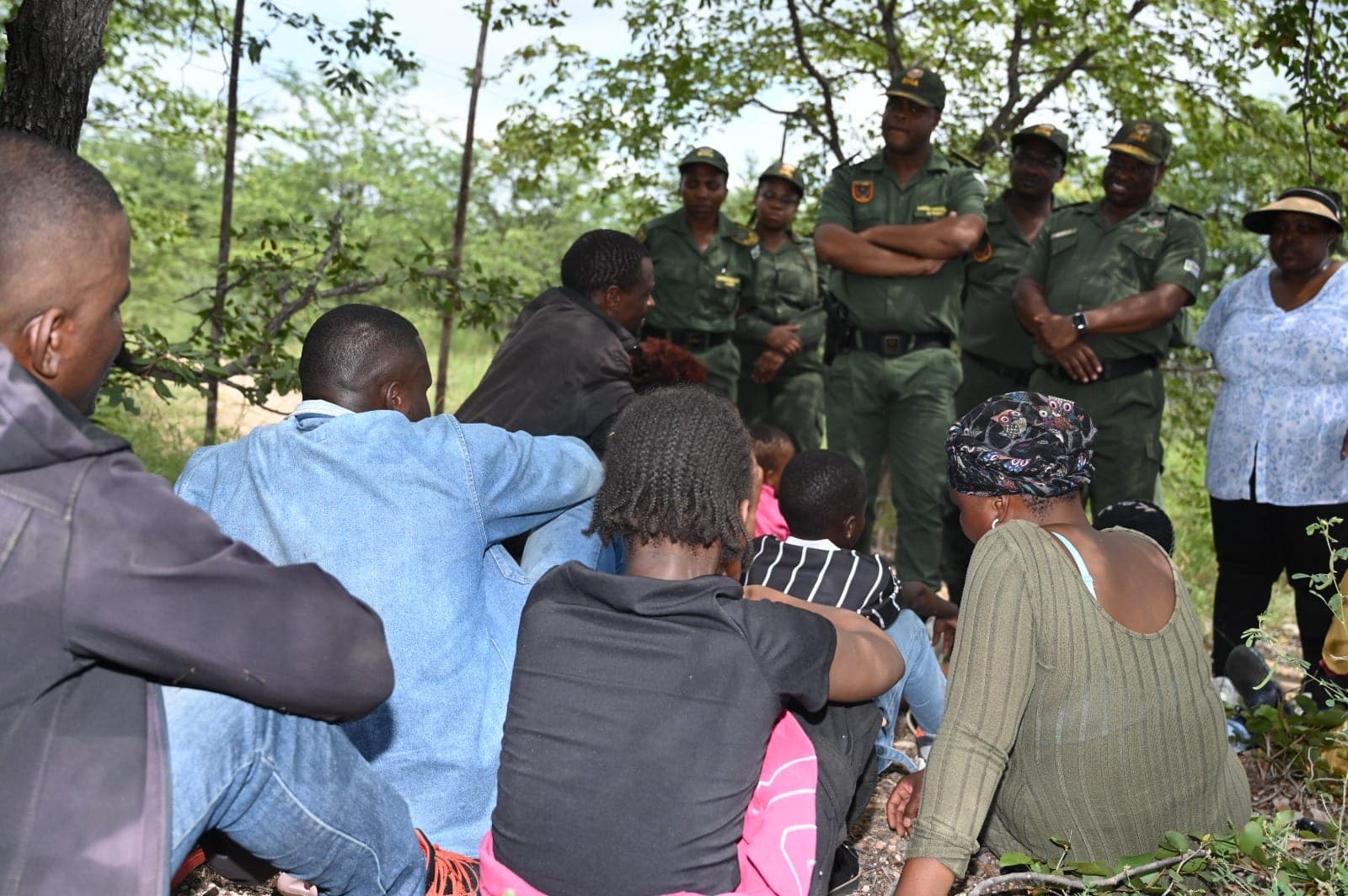
In the pre-dawn darkness of Wednesday morning, a routine patrol along the rugged, fence-line border between Zimbabwe and South Africa took a dramatic turn when Border Management Authority (BMA) officers stumbled upon a group of 23 people hiding in dense thorny bush, waiting for a smuggler who never came.
Among those found shivering in the cold were seven unaccompanied minors, the youngest just nine years old, according to BMA officials on the scene.
The interception occurred approximately four kilometers west of the official Beitbridge border post, an area notorious for criminal syndicates that charge desperate migrants thousands of rand to be guided across the Limpopo River and transported to cities like Johannesburg, Durban, and Cape Town.
BMA regional commander, Assistant Commissioner Lindiwe Ndlovu, said the group had crossed the Limpopo River on foot during the night, guided by a “scout” who abandoned them after collecting an upfront fee.
“These individuals were found in a vulnerable state—dehydrated, exhausted, and clearly disoriented,” Ndlovu told reporters at the BMA’s Musina holding facility. “They had been instructed to wait in that bush until sunrise, when a vehicle was supposed to pick them up. That vehicle never arrived, either because the smugglers were spooked by our patrols or because this was a deliberate abandonment.”
Desperate Journeys, Broken Dreams
The group, comprising 16 adults and seven children, hailed from various parts of Zimbabwe, including Bulawayo, Masvingo, and rural Matabeleland North. According to initial interviews conducted by BMA social workers, most cited the same reasons for leaving home: economic collapse, hunger, and the complete absence of opportunity.
“I haven’t had a proper job in three years,” said one man, who gave his name only as Tinashe (34), a former teacher from Gwanda. “I used to teach mathematics. Now I sell airtime on the street. I make maybe R500 a month. My wife and two daughters are staying with my mother. I came here to find construction work. I didn’t want to cross illegally. But I cannot afford a passport, and the visa process takes months. What was I supposed to do?”
The seven unaccompanied minors presented an even more heartbreaking picture. Among them were two brothers, aged 11 and 13, who told officials they were traveling to Johannesburg to find their father, a man they had not seen in four years. The eldest child in the group, a 16-year-old girl, claimed she was fleeing an arranged marriage to a man three times her age.
“We have seen a sharp increase in unaccompanied minors attempting this crossing,” said Thabo Mokoena, a senior BMA official based in Musina. “That tells you how desperate families have become. No parent sends a nine-year-old across a crocodile-infested river with strangers unless they believe the alternative is worse.”
The Smuggling Economy
The Beitbridge border is one of the busiest land ports in Africa, but it is also the epicenter of a thriving illegal smuggling economy. According to the BMA, criminal facilitators—often referred to as omalayitsha—charge between R3,000 and R8,000 per person to guide migrants across the border and transport them to major cities.
The journey is perilous. Migrants must evade not only BMA and South African Police Service patrols but also criminal gangs who rob, kidnap, and sometimes murder those who cannot pay additional “fees.”
“We have seen cases where people are held for ransom in safe houses in Musina,” said Ndlovu. “They are forced to call family members back home and beg for more money. If the family cannot pay, the consequences are brutal. This is not migration. This is human trafficking, plain and simple.”
BMA’s Response
The Border Management Authority, established in 2023 to consolidate border control functions previously spread across multiple departments, has ramped up patrols along the Limpopo River corridor. Drone surveillance, motion sensors, and increased foot patrols have led to a 40% increase in interceptions over the past six months, according to internal BMA data.
“We are not here to criminalize desperation,” said BMA Commissioner Dr. Michael Masiapato in a separate statement. “But we have a duty to protect our borders and to protect vulnerable people from those who would exploit them. Every child we find in that bush is a child who was nearly lost to a system of exploitation.”
The BMA has since handed the seven unaccompanied minors over to the Department of Social Development, which will place them in temporary safe care while efforts are made to locate relatives both in South Africa and Zimbabwe. The adults are being processed for deportation at the Musina Holding Facility, pending verification of their identities and backgrounds.
Human Rights Concerns
However, the interception has also reignited debate about South Africa’s approach to irregular migration. Advocacy groups have criticized the BMA for what they describe as a “catch-and-deport” strategy that fails to address the root causes of migration.
“These are not criminals. These are human beings fleeing impossible circumstances,” said Sharon Khumalo, a spokesperson for the Musina-based legal aid organization Lawyers for Human Rights. “Deporting them back to Zimbabwe without any pathway to seek asylum or work permits simply means they will try again, and next time they might not be so lucky. They might end up in the back of a truck with no air, or at the bottom of the Limpopo.”
Khumalo also raised concerns about the treatment of the unaccompanied minors, noting that South African law requires that children not be detained or deported without a best-interests assessment.
A Broader Crisis
The interception near Beitbridge is not an isolated incident. According to the United Nations High Commissioner for Refugees (UNHCR), an estimated 30,000 to 50,000 people cross into South Africa irregularly from Zimbabwe each year. Many are economic migrants, but a growing number are asylum seekers fleeing political persecution, gender-based violence, and environmental disasters such as Cyclone Idai, which devastated parts of eastern Zimbabwe in 2019.
South Africa currently hosts an estimated 3 to 4 million foreign nationals, including refugees, asylum seekers, and undocumented migrants. The country’s immigration system, plagued by backlogs, corruption, and underfunding, has struggled to keep pace.
What Happens Next?
For the 23 people found hiding in the bush near Beitbridge, the dream of a better life in South Africa has ended—at least for now. The adults will likely be deported within two weeks, their names added to a database of “undesirable persons” that could bar them from legal entry for up to five years.
The seven children face a more uncertain future. Social workers will attempt to trace their families in Zimbabwe, but in a country where phone networks are patchy and addresses are often informal, that process can take months.
“We will do everything we can to reunite these children with their families or place them in appropriate care,” said a Department of Social Development official who spoke on condition of anonymity. “But the honest truth is that the system is overwhelmed. We have hundreds of unaccompanied minors in our care right now. We need more foster homes, more social workers, more resources. And we need a regional solution to a regional problem.”
As the sun rose over the Limpopo River on Wednesday morning, the bush where the group had hidden was already being swept clean by BMA patrols. But by nightfall, another group of desperate migrants would likely be wading across the same shallow waters, hoping that their journey would end differently.
For the Border Management Authority, the challenge remains the same: how to secure a 3,000-kilometer border without losing sight of the humanity of those who cross it.
About The Author