It began, as all great capers do, in the quiet pre-dawn hours of March 28. Somewhere in the rolling countryside of northern Italy, outside a Nestlé factory that smelled perpetually of cocoa and sugar, a truck driver made a fatal error: he left the engine running while he stepped inside for a morning espresso.
By the time he returned, the truck was gone. And with it, twelve tons of KitKat bars.
The numbers are staggering enough to make a confectioner weep. Four hundred and fourteen thousand individual KitKat fingers. Hundreds of thousands of dollars in wholesale value. Enough chocolate to circle a small football stadium—or to fuel a nation’s coffee breaks for a solid decade. Italian police launched an immediate investigation, scouring highways and ports, but as of this writing, no arrests have been made. The truck, presumably, has been stripped, repainted, or hidden in a warehouse somewhere between Milan and Naples, its sweet cargo melting slowly into the black market.
“It’s the heist of the year,” one Carabinieri source told local media, speaking on condition of anonymity. “But instead of diamonds or gold, they’ve taken something far more traceable: chocolate. They’ll have to move it fast, or eat it faster.”
Social media, predictably, erupted. Memes flooded Twitter: grainy surveillance footage set to the Mission: Impossible theme. Jokes about the thieves needing a “break.” A fake Interpol alert warning citizens to be suspicious of anyone selling suspiciously large quantities of wafer bars from the back of a van. Nestlé itself issued a terse statement confirming the theft and pledging cooperation with authorities. But while Italian detectives combed through CCTV footage, a far more unexpected response was brewing—6,500 kilometers away, in Canada.
Someone at KitKat Canada’s marketing department clearly has a sense of humor. And a flair for the dramatic.
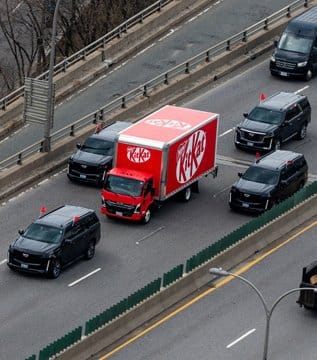
Just one week after the Italian heist made global headlines, the people of Toronto witnessed an absurdly delightful spectacle: a high-security armored convoy rolling through the downtown core, led by sleek black luxury SUVs with tinted windows, followed by a reinforced security truck emblazoned with the KitKat logo. Flanking the vehicle were men in dark sunglasses and earpieces, speaking into wrist-mounted microphones, walking with the kind of synchronized intensity usually reserved for presidential motorcades or the transport of nuclear launch codes.
The cargo? A single, ordinary shipment of KitKat bars destined for local retailers.
“We cannot confirm nor deny any connection to recent international chocolate-related incidents,” a deadpan security lead told a small crowd of bewildered onlookers, adjusting his earpiece. “What we can say is that KitKat Canada takes the safety of its ‘break’ very seriously. From this point forward, all shipments will receive presidential-level protection.”
The stunt was the brainchild of a rapid-response marketing team that clearly recognized a golden opportunity. Instead of shying away from the embarrassing Italian theft, KitKat Canada leaned into it—hard. They hired professional security actors, borrowed luxury vehicles, and mapped out a route that passed directly by the city’s busiest intersections. But the masterstroke was enlisting content creator Shawn Molko, a Toronto-based comedian and filmmaker known for his sharp, observational street interviews.
Molko, who was given exclusive access to film the convoy, played his role perfectly. Dressed in a hoodie and holding his phone like a concerned citizen, he approached the motorcade with mock alarm.
“Excuse me, sir, is this… is this because of what happened in Italy?” he asked one of the security agents.
The agent glanced around nervously. “I’m not at liberty to say. But let’s just say… we’re not taking any chances. These breaks stay unbroken.”
In the video, which Molko posted to Instagram and TikTok within hours, the convoy slowly rolls past a lineup of morning commuters, all of whom are visibly delighted. One woman cups her hands to her mouth and shouts, “Protect the chocolate!” Another office worker in a suit raises his coffee cup in a salute. A child on a school trip waves a handmade sign that reads: “GIVE ME A BREAK.”
Molko’s voice-over, delivered in the solemn tone of a true-crime narrator, sealed the deal. “We’re here on the streets of Toronto, where an elite team of security professionals is ensuring that no Italian thief gets their hands on Canadian KitKats. These are dangerous times. The wafer bars must be protected at all costs. I’ve been told I cannot get too close to the vehicle, for my own safety—and for the safety of the chocolate.”
The video racked up millions of views within 48 hours. Comments ranged from “This is the most Canadian thing I’ve ever seen” to “I would die for that security team” to “KitKat just won marketing forever.” Even the Italian news outlets, initially chagrined by the theft, picked up the story with a tone of amused admiration. La Repubblica ran a headline: “I ladri rubano i KitKat in Italia, il Canada risponde con un blindato. Geniale.” (Thieves steal KitKats in Italy, Canada responds with an armored vehicle. Genius.)
But beyond the viral metrics and the laughs, the stunt accomplished something genuinely rare in modern marketing: it turned a real crime into widespread smiles, without trivializing the victim (Nestlé Italy, which still lost hundreds of thousands of dollars) or mocking law enforcement. Instead, KitKat Canada positioned itself as the heroic, slightly absurd defender of the public’s right to a peaceful coffee break. The implicit message was clear: The world might be chaotic. Thieves might be out there. But we will move heaven and earth—and deploy an unnecessary number of SUVs—to get you your chocolate.
As the convoy pulled into its final destination—a downtown convenience store where the driver unloaded the boxes with a straight face while security agents scanned the rooftops—Shawn Molko signed off with one last line.
“No KitKats were harmed in the making of this video,” he said. “But somewhere in Italy, twelve tons of them are still missing. If you see a suspiciously well-stocked break room… you didn’t hear it from me.”
The camera lingered on a single red KitKat wrapper, blowing across the empty street. Then the convoy drove away, leaving behind a city that couldn’t stop smiling—and a marketing lesson that would be studied for years to come.
Sometimes, the best way to respond to a crisis is to have a sense of humor. And sometimes, you just need a break.
About The Author