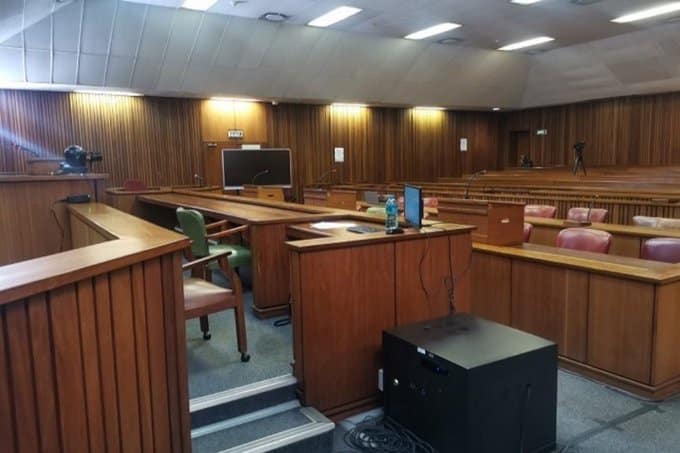
The heavy doors of the Free State High Court in Bloemfontein groaned open this morning under a pale winter sky, welcoming back a case that has become a litmus test for South Africa’s resolve against high-level corruption. After a four-week adjournment that felt to many like an eternity, the sprawling R255 million asbestos roof removal trial is finally set to resume.
For twenty-eight days, the proceedings sat in suspended animation—a “justice on pause” that frustrated prosecutors, fatigued witnesses, and gave the accused a prolonged breath of relief. The delay, officially attributed to scheduling conflicts and the need for additional document disclosures, had been met with thinly veiled impatience by anti-corruption watchdogs, who feared that each passing week eroded public faith in the system’s ability to deliver timely accountability.
But today, the gears of justice grind forward once more.
The Case So Far
At the heart of the trial lies a staggering sum: R255 million of public money, ostensibly earmarked for the safe removal of asbestos roofing from low-cost homes across the Free State. The contracts, awarded between 2014 and 2019, were meant to protect vulnerable communities from the well-documented health risks of asbestos exposure—lung disease, mesothelioma, and other fatal conditions that take decades to manifest but mere moments of negligence to enable.
Instead, according to the state’s charge sheet, the tenders became a feeding frenzy. Sixteen accused—including former government officials, businesspeople, and intermediaries—stand before the court facing a combined 117 counts of fraud, corruption, money laundering, and contravention of the Public Finance Management Act. Among them are names that once carried significant bureaucratic weight: former MEC for Human Settlements in the Free State, Olly Mlamleli, and former head of the provincial human settlements department, Nthimotse Mokhesi.
The state’s case, painstakingly assembled by the Hawks’ Serious Corruption Investigation unit and the National Prosecuting Authority’s Investigating Directorate (ID), alleges that the asbestos contracts were a carefully constructed mirage. Work was either grossly overpriced, poorly executed, or in some cases, never performed at all. Invoices were paid on the strength of falsified completion certificates. Middlemen with no discernible expertise in asbestos removal pocketed millions in “consultancy fees.” And the people of the Free State? Many of them still live beneath the very asbestos roofs that were supposedly stripped away.
The Four-Week Pause
The adjournment, granted in late March, came at a delicate juncture. The state had just concluded the testimony of its first major witness, a whistleblower from within the provincial human settlements department whose evidence had painted a damning picture of “rubber-stamped payments and vanished oversight.” The defense teams, representing a constellation of accused with sometimes conflicting interests, had requested time to review a fresh batch of bank statements and email trails—documents the state said had always been available, but which the defense claimed were “recently discovered.”
Judge Joseph Mhlambi, presiding over the matter, granted the break with a stern warning. “This court is mindful of the public interest in the speedy resolution of this matter,” he said on that last day of hearings. “But it is equally mindful of the accused’s right to a fair trial, which includes adequate time to prepare. We will reconvene in four weeks. There will be no further postponements for document review.”
Those words now hang in the air like a promise—or a threat.
What to Expect Today
As lawyers shuffle into Courtroom 4A, the atmosphere is noticeably tauter than it was a month ago. The public gallery, largely empty during the preliminary hearings, has begun to fill with civil society observers, journalists from as far as Johannesburg and Cape Town, and a smattering of residents from the affected townships of Botshabelo and Thaba Nchu. They have come to see whether the state can sustain its momentum.
The prosecution, led by Advocate Jannie Lubbe, is expected to call its second key witness: a forensic auditor from the Auditor-General’s office who analyzed the flow of funds through no fewer than seventeen shell companies linked to the accused. Legal insiders suggest this testimony could be the backbone of the money-laundering charges, tracing digital breadcrumbs from the provincial treasury to luxury vehicles, undeclared property purchases, and overseas transfers.
Meanwhile, the defense is likely to renew its argument that the tenders, however flawed, followed existing provincial protocols—shifting the blame from individual greed to systemic dysfunction. It is a familiar refrain in South African corruption trials, and one that Judge Mhlambi has already signaled he views with skepticism.
“We are not here to try the system,” the judge noted in a previous ruling. “We are here to try the people who operated within it. The system did not sign the invoices. The system did not deposit R4 million into a private account two days after a contract was approved. People did that.”
The Stakes Beyond the Courtroom
This trial is more than a ledger of alleged crimes. It is a proxy for a larger national reckoning. The asbestos scandal first erupted in the Zondo Commission’s state capture reports, which identified the Free State as a “laboratory for corruption” during the Jacob Zuma era. For many residents of the province, the R255 million stolen from asbestos remediation is not an abstract figure—it is the equivalent of 8,500 new houses, or five fully equipped clinics, or a decade’s worth of school feeding schemes.
“The money was taken from the poorest of the poor,” said Tshidi Mokoena, a community activist who has attended every hearing. “People here are dying of asbestos-related diseases they didn’t even know they had. And while they suffer, the accused drive German cars and sleep in gated homes. We need to see justice. Not just on paper. In handcuffs.”
As the clock ticks toward 10 a.m., the accused take their seats in the dock. Some appear composed, even bored. Others shuffle through papers with visible anxiety. One former official, whose name is familiar to anyone who followed Free State politics in the mid-2010s, catches the eye of a journalist in the gallery and quickly looks away.
The clerk of the court rises. “All rise,” she calls out, her voice cutting through the murmurs.
Judge Mhlambi enters in a swirl of black robes. He settles behind the bench, adjusts his glasses, and gazes across the courtroom—at the accused, at the lawyers, at the public gallery, at the small cluster of asbestos victims who have traveled hours to be here.
“Good morning,” he says. “The State versus sixteen accused. We are back on record. Let us proceed without further delay.”
The four-week pause is over. The trial of the asbestos billions has resumed. And for the people of the Free State, who have waited years for this moment, the question is no longer whether justice will come—but whether it will come fast enough to matter.
This is a developing story. Further updates will follow as testimony unfolds.
About The Author