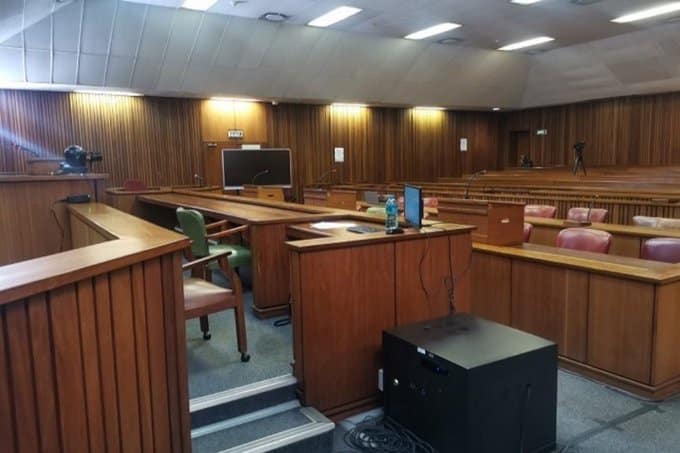
In a packed courtroom in Mpumalanga, a 44-year-old man sat motionless as the magistrate delivered a verdict that would remove him from society for the rest of his natural life. Two life terms. Two daughters. One unspeakable betrayal.
The Nelspruit Regional Court has sentenced the biological father to life imprisonment on each of two counts of rape—one for each of his minor daughters, ages 13 and 11 at the time the abuse began. The National Prosecuting Authority (NPA) announced the outcome in a strongly worded statement on [current date], condemning the sexual abuse of children and reaffirming its commitment to pursuing the harshest penalties for those who violate the most vulnerable.
The accused’s identity has been withheld by court order—not to protect him, but to shield his daughters from the secondary victimisation that so often follows when survivors are identified publicly. For the rest of this report, he will be referred to only as “the father.”
The abuse: Weekends that became nightmares
Between 2015 and 2017, in the small community of Lehawu Trust near Pienaar in the Mbombela district, a custody arrangement became a hunting ground.
According to Monica Nyuswa, the Mpumalanga NPA spokesperson, the father had separated from the victims’ mothers—both of them, separately—but continued to arrange weekend visits with his daughters. On the surface, these were ordinary access visits: a father fetching his children from their homes, taking them to his residence, promising a weekend of bonding.
But at night, after the doors were locked and the small house fell silent, the father would enter their rooms. The first victim was 13 years old when the rapes began. The second was just 11.
“The accused would fetch them from their parental homes and take them to his residence, where he raped them at night,” Nyuswa said in a detailed statement following the sentencing. The abuse continued, repeatedly, over a period of at least two years.
A suicidal note breaks the silence
The crimes might never have come to light had it not been for the first victim’s desperate act of courage. At 13—an age when most children worry about homework and friendships—she wrote a suicidal note to her grandmother.
In handwriting that prosecutors would later describe as “a cry trapped on paper,” the girl revealed that her father had been sexually violating her. She wrote that the pain had become unbearable, that she had contemplated taking poison, and that she no longer wanted to live.
The grandmother did not hesitate. She alerted authorities, and a formal investigation was launched. It was during that process that the second victim, then 11 years old, was found to have a visible mark on her neck. When asked about it—gently, by a trained social worker—the child disclosed that her father had also sexually abused her.
Both girls were immediately referred to the Themba Thuthuzela Care Centre—a one-stop facility designed to support survivors of sexual violence with medical care, psychosocial support, and forensic services. There, they received counselling and medical examinations that would later become critical evidence in court.
The arrest and trial
The father was arrested in 2020, three years after the last known assault. He pleaded not guilty to both counts of rape, forcing his daughters to relive their trauma on the witness stand.
But State Prosecutor Lazarus Rabothata built a case that left little room for doubt. Two key pillars of evidence secured the conviction:
- The testimonies of the two victims. Despite the emotional toll, both girls testified in court, their accounts consistent, detailed, and corroborated by other evidence. The court found them to be credible witnesses.
- J88 medical reports. These standard forensic forms, completed by doctors who examined the children, confirmed the presence of sexual injuries consistent with penetration. The medical evidence directly contradicted the father’s claims of innocence.
“The accused pleaded not guilty,” Nyuswa confirmed, “but was convicted on both counts of rape following strong evidence presented by the State.”
No mercy: The sentencing argument
In aggravation of sentence, Prosecutor Rabothata did not hold back. He laid out four devastating points for the court’s consideration:
- The prevalence of the offence. Rape, particularly child rape, remains alarmingly common in South Africa. The courts have repeatedly stated that deterrence must be a primary goal.
- A horrific breach of trust. This was not a stranger in a dark alley. This was a father—a figure children are taught to trust unconditionally. He used weekend visits, a privilege granted by the mothers, as cover for systematic abuse.
- The severe trauma inflicted on his daughters. Beyond the physical injuries, both children suffered psychological damage that will require years, possibly a lifetime, of therapy. The suicidal note alone was evidence of how close the system came to losing one of them forever.
- The absence of remorse. By pleading not guilty and forcing his daughters to testify, the father compounded their suffering.
Rabothata argued that life imprisonment was the only appropriate sentence on each count. The court agreed.
The judgment
The magistrate found no substantial and compelling circumstances to deviate from the prescribed minimum sentence. Under South African law, rape—especially of a minor—carries a mandatory minimum sentence of life imprisonment unless exceptional circumstances exist. The court ruled that none did.
The father was sentenced to life imprisonment on each of the two counts of rape. Because the sentences were ordered to run concurrently, he will effectively spend a single life term behind bars—but the judgment made clear that each of his daughters’ ordeals was worthy of a lifetime of punishment on its own.
Additional court orders
Beyond the prison sentence, the court imposed several ancillary orders designed to ensure the father can never again harm a child through any institutional channel:
- Declared unfit to possess a firearm. He may never own or hold a gun license.
- Declared unsuitable to work with children. Any future application for employment involving minors will flag this order.
- Name entered into the National Register for Sex Offenders. This registry is used by employers, schools, and volunteer organisations to screen individuals working with vulnerable groups.
The NPA’s message
Following the sentencing, the NPA issued a statement that left no room for ambiguity.
“We strongly condemn the sexual abuse of children,” the statement read. “We reaffirm our commitment to ensuring that such heinous crimes are met with the full force of the law.”
Monica Nyuswa added: “Children are not objects to be used for the gratification of adults. The fathers who abuse them are not protectors—they are predators. The NPA will continue to pursue justice for every child who has been silenced by fear, and we commend the bravery of these two young survivors who spoke out.”
A community left to heal
In Lehawu Trust, the sentencing has brought a measure of closure, but the scars remain. Neighbours who once saw the father fetching his daughters for weekend visits now grapple with the knowledge of what happened behind closed doors. The mothers, who entrusted their children to him, are left with a different kind of pain: guilt, anger, and the slow work of rebuilding trust.
For the two daughters, now older and safer, the road ahead is long. The Themba Thuthuzela Care Centre will continue to offer counselling, but some wounds do not fully heal. What the sentence offers is not erasure of the past, but assurance: the man who broke their childhood will never walk free to do it again.
As one community member, speaking on condition of anonymity, put it: “Two life terms will not give them back their innocence. But it means he will never take another child’s.”
If you or someone you know has experienced sexual abuse, please contact the GBV Command Centre at 0800 428 428 or the Childline emergency number 116. Help is available, and you are not alone.
About The Author