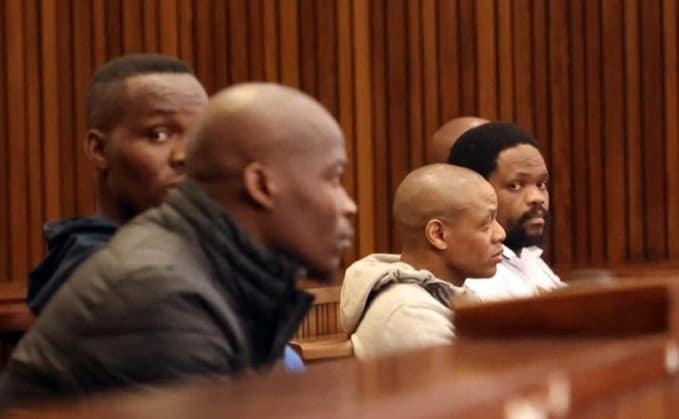
The atmosphere inside Courtroom 4D at the Gauteng High Court in Pretoria was thick enough to cut with a knife. On one side of the polished oak benches sat the accused—five men charged with the murder of a national icon. On the other side sat the family of Senzo Meyiwa, the former Orlando Pirates and Bafana Bafana goalkeeper whose death ten years ago sent shockwaves through South Africa. Between them, in the well of the court, lawyers and advocates circled like sharks, each looking for the weakness, the inconsistency, the fatal flaw that could tip the scales.
Wednesday, 15 April 2026, marked yet another chapter in a trial that has already stretched for years, consumed countless hours of court time, and generated more headlines than any murder case since that of Reeva Steenkamp. But on this day, something felt different. The cross-examination of a key state witness had taken an unexpected turn. The defence had introduced new arguments. And the presiding judge, Tshifhiwa Maumela, had made several rulings that could shape the final outcome of the case.
“These are the moments that trials are made of,” said legal analyst Professor Kelly Phelps, watching from the public gallery. “Not the opening statements, not the closing arguments, but the grind of cross-examination. The slow, painstaking testing of evidence. That is where cases are won or lost. And today, we saw significant movement.”
The Case So Far
For those who have not followed every twist and turn of the Senzo Meyiwa murder trial, a brief recap is necessary. The beloved goalkeeper was shot and killed on the night of 26 October 2014 at the Vosloorus home of his girlfriend, singer Kelly Khumalo. He was 27 years old, at the peak of his career, and a father of two.
For years, the case went cold. No arrests were made. Theories proliferated—a botched robbery, a love triangle, a hit. Then, in 2020, police arrested five men: Muzikawukhulelwa Sibiya, Bongani Ntanzi, Mthobisi Mncube, Mthokoziseni Maphisa, and Sifisokuhle Nkani Ntuli. They have pleaded not guilty to charges of murder, attempted murder, robbery with aggravating circumstances, and the illegal possession of firearms and ammunition.
The state’s case has relied heavily on the testimony of three eyewitnesses who were inside the Khumalo home on the night of the shooting: Kelly Khumalo, her sister Zandie Khumalo-Gumede, and their mother Ntombifuthi Khumalo. Their accounts have been hotly contested by the defence, which has argued that the witnesses are unreliable, inconsistent, and potentially untruthful.
Wednesday’s Proceedings
When court convened at 10 a.m. on Wednesday, the atmosphere was immediately charged. The lead defence counsel, Advocate Malesela Teffo, was back on his feet, continuing his cross-examination of a state witness whose identity remains protected by a court order. The witness, a neighbour who arrived at the scene shortly after the shooting, had previously testified about seeing two men fleeing the Khumalo home.
But under Teffo’s relentless questioning, cracks began to appear.
“You told the court earlier that you saw two men running away,” Teffo said, his voice calm but insistent. “But in your original statement to police, you said you saw three men. Which is it? Two or three?”
The witness shifted in the stand, glancing at the prosecutor for reassurance that did not come.
“I… I was confused,” the witness said. “It was dark. It was chaotic. I may have made a mistake.”
“May have made a mistake?” Teffo pressed. “Or are you lying?”
“Objection!” The state prosecutor, Advocate George Baloyi, was on his feet. “The defence is badgering the witness.”
Judge Maumela leaned forward, peering over his glasses. “Overruled. The witness will answer the question.”
The witness swallowed hard. “I am not lying. I may have been mistaken. There is a difference.”
It was a small exchange, but in the world of criminal trials, small exchanges can have large consequences. The defence had planted a seed of doubt about the witness’s credibility—a seed that would be watered and tended over the coming days.
The Phone Records
Later in the morning, the state introduced new evidence that it hopes will strengthen its case: cellphone tower records showing the movements of the accused on the night of the murder. According to the data, which was subjected to forensic analysis by an independent expert, several of the accused were in the vicinity of the Khumalo home at the time of the shooting.
“These records do not lie,” Baloyi told the court, holding up a thick binder of evidence. “They show, with scientific precision, that the accused were not where they claimed to be. They were at the scene of the crime.”
But the defence was ready. Teffo called his own cellphone expert, a private forensic analyst who testified that the tower records were “not as precise as the state suggests.”
“Cellphone towers cover large areas,” the expert explained. “Being connected to a particular tower does not put you at a particular address. It puts you somewhere within a radius of several kilometres. That is not the same as being at the crime scene.”
The exchange highlighted a central tension in the trial: the state’s reliance on circumstantial and technological evidence versus the defence’s demand for direct, undeniable proof. Judge Maumela listened intently, taking notes, asking occasional questions, but revealing nothing of his thinking.
The Defence’s New Argument
Perhaps the most significant development on Wednesday came in the afternoon session, when Teffo introduced a new line of defence: that the shooting was an accident that occurred during a struggle over a firearm, not a premeditated murder.
“Nobody denies that Senzo Meyiwa was shot and killed,” Teffo told the court. “The question is: who pulled the trigger? And under what circumstances? Our submission is that the evidence suggests a struggle, a scuffle, a tragic accident—not a cold-blooded execution.”
The argument was a strategic shift. Previously, the defence had focused on attacking the credibility of the state’s witnesses and challenging the chain of evidence. Now, they were offering an alternative narrative—one that could reduce the charges from premeditated murder to culpable homicide, a much lesser offence with a far lighter sentence.
The state reacted with visible frustration. Baloyi argued that the “accident” theory was not supported by the evidence, pointing to the testimony of witnesses who said they heard no struggle before the gunshot.
“You cannot have it both ways,” Baloyi said. “Either the witnesses are lying, as the defence has suggested, or they are telling the truth. If they are telling the truth, there was no struggle. If there was no struggle, the shooting was intentional. The defence cannot pick and choose which parts of the evidence to believe.”
Judge Maumela reserved his ruling on whether the “accident” theory could be formally introduced as a defence. But the seed had been planted, and legal observers noted that it could resonate with the court if the state’s case continued to show weaknesses.
The Meyiwa Family’s Vigil
Outside the courthouse, a small but determined group of supporters had gathered, holding placards with Senzo’s face and the words “Justice for Senzo” and “Ten years is too long.” Among them was Senzo’s mother, Ntombifuthi Meyiwa, who has attended every day of the trial, her grief undimmed by the passage of time.
“They say they want to confuse the court,” she told reporters during a brief break in proceedings. “They want to make excuses. But we know the truth. They killed my son. They must pay. That is all. They must pay.”
Senzo’s brother, Sifiso Meyiwa, was more measured but equally resolute. “We have waited ten years,” he said. “We can wait a little longer. The truth will come out. We believe in the court. We believe in justice.”
The Meyiwa family has been a constant presence throughout the trial, their dignity and restraint earning them widespread sympathy. But behind the scenes, sources say, the frustration is profound. Ten years is a long time to wait for answers. Ten years is a long time to sit in a courtroom, listening to lawyers argue over cellphone towers and witness statements, while the man who was your son, your brother, your father, remains a memory.
The Khumalo Question
No discussion of the Senzo Meyiwa trial is complete without mentioning the elephant in the courtroom: Kelly Khumalo. The singer, who was Senzo’s girlfriend at the time of his death, has been a constant presence in the trial—both as a witness and as a subject of intense public speculation.
Khumalo has testified that she was in the house on the night of the shooting and that she saw two of the accused enter the home. But her testimony has been inconsistent, and she has been accused by some of withholding information or even of being involved in the murder herself. She has denied any involvement and has not been charged with any crime.
On Wednesday, Khumalo was not in court. Her lawyer told the judge that she was “unwell” and unable to attend. But her absence did not stop the defence from referencing her testimony, which Teffo described as “unreliable” and “self-serving.”
“The state has built its case on the testimony of people who were in that house,” Teffo said. “But those people have changed their stories. They have contradicted themselves. They have motives to lie. You cannot send five men to prison for life based on such evidence.”
The state has pushed back, arguing that the inconsistencies in the witnesses’ accounts are minor and understandable given the trauma of the event. But the defence’s attacks have taken a toll. Public opinion, once firmly behind the state, has become more divided. Some now wonder whether the right men are on trial—or whether anyone will ever be convicted.
The Long Road
The Senzo Meyiwa murder trial has become a symbol of South Africa’s troubled relationship with justice. For a country that prides itself on its Constitution and its courts, the inability to resolve such a high-profile case for so long is a source of embarrassment and frustration.
Part of the problem has been the trial’s glacial pace. Procedural delays, changes in legal representation, and the COVID-19 pandemic have all contributed to a process that has stretched for years. The trial has also been plagued by leaks to the media, allegations of witness tampering, and even a bizarre incident in which an accused allegedly tried to escape from police custody.
“The wheels of justice turn slowly,” said legal analyst Phelps. “That is true everywhere. But in South Africa, they turn especially slowly. The Meyiwa case is a case study in the challenges of our criminal justice system: underfunding, backlogs, and a lack of resources for forensic investigation. It is a mess.”
Judge Maumela has tried to keep the trial on track, imposing strict deadlines and limiting adjournments. But the sheer volume of evidence and the complexity of the legal arguments mean that the trial is likely to continue for many more months.
What Comes Next
With the cross-examination of key witnesses continuing and the defence’s “accident” theory now on the table, the Senzo Meyiwa trial is entering a critical phase. The state will have an opportunity to rebut the defence’s arguments and to present additional forensic evidence. The defence will then present its own case, which may include calling its own witnesses and potentially putting the accused on the stand.
Then, after all the evidence has been heard, the lawyers will deliver their closing arguments—lengthy, carefully crafted speeches designed to summarize their cases and persuade the judge. Judge Maumela will then retire to consider his verdict, a process that could take weeks or even months.
If the accused are convicted, a separate sentencing hearing will follow. If they are acquitted, they will walk free—a prospect that fills Senzo’s family with dread.
“I try not to think about that,” Sifiso Meyiwa said. “I try to believe that the system works. I try to believe that justice will prevail. But after ten years, it is hard to believe in anything. We just have to wait. And hope. And pray.”
The Legacy of Senzo
As the trial continues, it is worth remembering why this case has captured the nation’s attention for so long. Senzo Meyiwa was not just a footballer; he was a symbol. A young man from a small town who rose to the heights of South African sport. A father who doted on his children. A teammate who inspired loyalty and affection.
His death was a tragedy. The failure to bring his killers to justice has been a compounding tragedy. And the long, painful trial has been a reminder that justice, when it comes at all, comes at a cost.
“Senzo was more than a goalkeeper,” said former Orlando Pirates teammate Happy Jele, who has attended several days of the trial. “He was a brother. He was a leader. He was the heart of our team. Losing him was like losing a part of ourselves. We just want to know who did it. We want to know why. And we want them to pay.”
As the sun set over the Gauteng High Court on Wednesday, the lawyers packed their briefcases, the journalists filed their stories, and the Meyiwa family walked slowly to their cars. Another day in the trial was over. Another step along the long road to justice had been taken.
But how much further the road stretches, no one can say. The trial continues. And South Africa watches, waits, and wonders whether, after ten years, the truth will finally emerge from the shadows.
Court adjourned until Monday, 20 April 2026. The cross-examination will resume. The arguments will continue. And Senzo Meyiwa, the man whose name has become a byword for justice delayed, will once again be present in every word spoken, every piece of evidence examined, every tear shed.
He is gone. But he is not forgotten. And for his family, for his fans, for a nation that still mourns, that is both a comfort and a curse.
About The Author