In a predawn operation that sent shockwaves through the illegal mining underworld of South Africa’s oldest gold rush town, police have arrested ten suspected zama zamas in a major crackdown on illicit mining activities in the historic Pilgrim’s Rest area. The arrests, which took place in the early hours of Tuesday morning, mark the most significant law enforcement action in the region since the provincial government declared war on illegal mining operations six months ago.
The operation, code-named “Operation Vala Umgodi” (Close the Hole), involved a coordinated team of 120 officers from the South African Police Service (SAPS) National Intervention Unit, the Hawks’ Serious Organised Crime Investigation unit, the Mpumalanga Provincial Traffic Police, and private security contractors hired by the historic mining site’s current lawful owners. Helicopters buzzed low over the forested hills as ground teams moved in on three separate shafts that had been illegally reopened by zama zamas over the past eighteen months.
“These are not small-time criminals scratching for leftover gold,” said Brigadier Selvy Mohlala, the Mpumalanga SAPS spokesperson, addressing journalists at a press conference held on the steps of the Pilgrim’s Rest Post Office—a building that dates back to 1898. “These are organised, armed, and dangerous individuals who have turned one of our most treasured heritage sites into a war zone. Today, we took back the high ground.”
The Target: Pilgrim’s Rest’s Abandoned Shafts
Pilgrim’s Rest is no ordinary town. Declared a National Heritage Site in 1986, it is a living museum of South Africa’s first gold rush, which began in 1873 when a prospector named Alec “Wheelbarrow” Patterson stumbled upon alluvial gold in the stream now known as Pilgrim’s Creek. For over a century, the town and its surrounding mountains yielded millions of ounces of gold from a network of underground shafts—the Transvaal Gold Mining Estates (TGME), which operated continuously from 1895 until its final closure in 1971.
For decades after the closure, the shafts sat silent, sealed by the government, their entrances barricaded with concrete and steel. But where there is gold, there are those willing to risk everything to reach it. Beginning around 2015, illegal miners—zama zamas—began breaching the seals, tunneling through collapsed sections, and reprocessing tailings dumps that still contained trace amounts of gold.
By 2024, the situation had spiraled out of control. According to intelligence gathered by the Hawks, at least 300 active zama zamas were operating in the Pilgrim’s Rest area, organized into syndicates that controlled specific shafts. Violence between rival groups had become routine, with shootings, stabbings, and even the use of homemade explosives. Legitimate businesses in the town—hotels, restaurants, souvenir shops—reported a sharp decline in tourism as visitors stayed away, frightened by reports of armed gangs in the hills.
“Pilgrim’s Rest should be a place where families come to learn about our history,” said Gugu Mthembu, the chairperson of the Pilgrim’s Rest Tourism Association. “Instead, it has become a no-go zone. The zama zamas have stolen not just gold but our livelihoods. We have been begging for action for years. Today, finally, someone listened.”
The Operation: Precision and Force
The decision to launch Operation Vala Umgodi followed months of surveillance, including the use of drones, informants, and undercover officers posing as gold buyers. The police identified three priority shafts: the Alpha Shaft (deepest, most productive, and most heavily defended), the Beta Tunnel (accessible via a hidden entrance behind a waterfall), and the Old No. 5 (a shallow incline that had become a staging area for supplies and weapons).
At 3:00 a.m., with the moon hidden behind clouds, the operation began. A team of 25 Special Task Force officers rappelled into the Alpha Shaft from a helicopter, catching the zama zamas inside by surprise. Simultaneously, ground teams sealed all known exits, cutting off escape routes into the surrounding forest. A third team intercepted a convoy of vehicles attempting to flee along the R533 road toward Sabie, seizing three bakkies loaded with tools, food supplies, and what appeared to be newly processed gold amalgam.
“I have never seen anything like it,” said Constable Thabo Nkosi, a young officer who participated in the ground assault. “They had built an entire underground camp. Generators. Sleeping quarters. A makeshift kitchen. They had been living down there for weeks, maybe months. The smell was awful. The heat was unbearable. But they were organised. This was not desperate poverty. This was a business.”
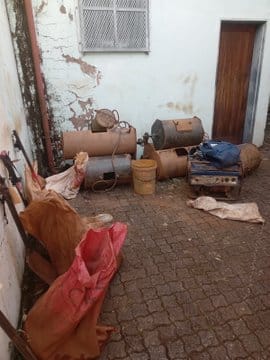
By 7:00 a.m., ten suspects had been taken into custody. Their ages range from 22 to 47. Among them are South African nationals, as well as foreign nationals from Lesotho, Mozambique, and Zimbabwe—a demographic profile typical of zama zama syndicates across the country. Police recovered six illegal firearms (including two AK-47 assault rifles), a substantial quantity of ammunition, gold-processing chemicals (mercury and cyanide), and an estimated 4.2 kilograms of unrefined gold, with a street value of approximately R4.5 million.
“This gold was stolen from the South African people,” said Brigadier Mohlala, holding up a sealed evidence bag containing a lumpy, dull-yellow nugget. “It belongs in the National Treasury, not in the pockets of criminals. We will trace where it was going to be sold and who was buying. This is just the beginning.”
The Suspects: Who Are They?
The ten suspects are currently being held at the Pilgrim’s Rest police station—a small facility that has been overwhelmed by the scale of the arrests. They are expected to appear in the Barberton Magistrate’s Court on Thursday, facing charges that include:
- Illegal mining (Contravention of the Mineral and Petroleum Resources Development Act)
- Trespassing on proclaimed heritage land
- Possession of unwrought gold (a Schedule 1 offence under the Precious Metals Act)
- Illegal possession of firearms and ammunition
- Contravention of the Immigration Act (for the foreign nationals)
- Potential additional charges related to environmental damage and water pollution
The state is expected to oppose bail, arguing that the suspects are flight risks with access to international smuggling networks. The Hawks have also indicated that they are building a case against the syndicate leaders—individuals who were not caught in the operation but who directed the mining activities from comfortable homes in nearby towns like Nelspruit and even as far away as Johannesburg.
“The foot soldiers are easy to catch,” said a senior investigator who spoke on condition of anonymity. “They are the ones underground, breathing the dust, risking their lives. The real criminals are above ground—the financiers, the gold buyers, the corrupt officials who look the other way. We know who they are. We are coming for them next.”
The Human Cost of Illegal Mining
While the arrests have been celebrated by the community and by law enforcement, the broader context of illegal mining in South Africa is deeply tragic. Zama zamas (the term is isiZulu for “those who try”) are often desperate men—and increasingly women—who have been pushed out of formal employment and see illegal mining as their only path to survival.
The working conditions are nightmarish. Deep underground, without any safety equipment, they dig with primitive tools, propping up tunnels with scavenged timber that could collapse at any moment. They breathe silica dust that destroys their lungs. They handle mercury with bare hands, slowly poisoning themselves and the environment. They sleep in narrow crevices, emerging only at night to sell their meager gold to middlemen who pay a fraction of its true value.
“We cannot simply arrest our way out of this problem,” said Dr. Phumzile Ndlovu, a sociologist at the University of Mpumalanga who has studied zama zama communities for years. “Yes, these men broke the law. Yes, they damaged heritage sites and polluted rivers. But they are also victims—of unemployment, of poverty, of a mining industry that closed down and left them with nothing. If we want a lasting solution, we need to offer alternatives: formalized small-scale mining, skills training, economic development in these rural areas. Otherwise, we will arrest ten today, and twenty will take their place tomorrow.”
The government has acknowledged the complexity of the problem. In his 2025 State of the Nation Address, President Cyril Ramaphosa announced a R500 million fund to support the formalization of artisanal mining, including the creation of licensed, regulated mining zones where small-scale miners can operate legally and safely. But implementation has been slow, and the fund remains largely unspent.
The Impact on Pilgrim’s Rest
For the town of Pilgrim’s Rest itself, the crackdown has brought a mixture of relief and residual fear. The historic main street—with its corrugated iron buildings, old-fashioned shopfronts, and vintage cars—has been eerily quiet for years. The Royal Hotel, which once hosted gold magnates and colonial officials, now struggles to fill its rooms. The gold-panning demonstrations for tourists have been canceled indefinitely. The museum’s visitor numbers have fallen by 70% since 2019.
“I used to employ fifteen people,” said Johan van der Merwe, who runs a curio shop and café on the main road. “Now it’s just me and my wife. The zama zamas scared away the tourists. They also scared away our suppliers. Even the SAPS struggled to patrol the area—there are only so many officers, and the mountains are vast. This operation gives me hope. But hope is not enough. We need sustained presence. We need to see police here every day, not just in a one-off raid.”
The local community has also been divided by illegal mining. While some residents despise the zama zamas for the violence and environmental damage, others have quietly benefited—selling food and supplies to the miners, renting them rooms, or even buying gold at discounted prices.
“It is not simple,” said Thandi Nkosi, a resident who lives on the outskirts of town. “Yes, the zama zamas bring trouble. But they also bring money. When the mines closed, this town died. The zama zamas brought it back to life—not in the way we wanted, but they put food on tables. If the government wants us to reject illegal mining, they must give us something else. A factory. A real mine. A reason to stay.”
Environmental Devastation
Beyond the human and social costs, illegal mining has inflicted severe environmental damage on the Pilgrim’s Rest area. The use of mercury to extract gold from ore has contaminated streams and groundwater, poisoning fish, livestock, and potentially the drinking water of downstream communities. Acid mine drainage from reopened shafts has turned some tributaries orange with iron oxide. Tunnels have collapsed, destabilizing hillsides and threatening roads and buildings.
The Department of Water and Sanitation has issued multiple directives to the provincial government to address the pollution, but cleanup efforts have been hampered by the ongoing presence of zama zamas, who actively sabotage remediation work.
“Every day that these illegal miners remain, the environmental damage compounds,” said Mpho Letsoalo, a water quality specialist who has conducted tests in the area. “Mercury does not disappear. It bioaccumulates. It moves up the food chain. The fish in these streams are already contaminated. If we do not act now, we will be dealing with the consequences for generations. The arrests are good. But we need remediation. We need the shafts permanently sealed. We need the water treated. That will cost tens of millions of rand—money the government does not have.”
Political Response
The arrests have been welcomed across the political spectrum. Mpumalanga Premier Refilwe Mtsweni-Tsipane issued a statement praising the police for “decisive action” and promising that the provincial government would “leave no stone unturned” in rooting out illegal mining.
“The days of zama zamas operating with impunity in Mpumalanga are over,” the Premier said. “We have given the police all the resources they need. We have empowered the Hawks. We have partnered with private security. The message is clear: leave our heritage, our environment, and our communities alone, or face the full might of the law.”
The Democratic Alliance’s shadow minister of police, Andrew Whitfield, struck a more cautious note. “Ten arrests is a start, but it is a drop in the ocean,” he said. “There are thousands of zama zamas across Mpumalanga, Gauteng, and the North West. The government needs a national strategy, not sporadic raids. It needs to secure the borders, because many of these miners are foreign nationals entering illegally. And it needs to address the corruption that allows these syndicates to thrive. Without those steps, Operation Vala Umgodi will be remembered as a headline, not a turning point.”
What Happens Next
The ten suspects will remain in custody until their court appearance on Thursday. The state is expected to request a remand for further investigation, as the Hawks continue to analyze the evidence seized during the raid—including cellphones, documents, and the gold itself.
Meanwhile, the police have left a contingent of 50 officers in Pilgrim’s Rest to prevent zama zamas from returning to the sealed shafts. Concrete and steel barriers are being installed at the entrances, and regular patrols will continue for the foreseeable future.
“We are not naive,” said Brigadier Mohlala. “We know that as soon as we leave, the zama zamas will try to come back. That is why we are not leaving. We will maintain a presence here for as long as it takes. Pilgrim’s Rest has suffered enough. It is time for this town to heal.”
Voices from the Community
As the sun set over the mountains that surround Pilgrim’s Rest—the same mountains that have drawn gold-seekers for 150 years—a small group of residents gathered at the old cemetery, where the original prospectors are buried beneath weathered headstones. They held candles. They sang hymns. They prayed for peace.
Among them was MmaKabelo Sebata, a 78-year-old woman who has lived in Pilgrim’s Rest her entire life. She remembers the town before the mines closed. She remembers the sound of the stamp mills, the whistle of the trains, the bustle of the streets. And she remembers the slow, painful decline that followed.
“My father worked underground,” she said, her voice soft but steady. “He came home with gold dust in his hair and stories in his heart. He was a miner, not a criminal. He had papers. He had a contract. He had dignity. These zama zamas—they have nothing. No papers. No contracts. No dignity. I do not celebrate their arrest. But I do hope that someone, somewhere, will ask why they had to become criminals in the first place. That is the question Pilgri m’s Rest asks tonight. That is the question no one has answered.”
She looked up at the darkening sky, where the first stars were appearing.
“We were a town of gold,” she said. “Now we are a town of ghosts. The zama zamas are not the ghosts. They are the haunted. And until we give them something better than a tunnel and a shovel, the ghosts will keep coming.”
Conclusion
The arrest of ten suspected zama zamas in Pilgrim’s Rest is a victory for law enforcement and a relief for a community that has been terrorized by illegal mining for years. But it is not the end of the story. It is, at best, a chapter—a turning of the page in a long and difficult book.
The gold remains in the hills. The poverty remains in the townships. The demand for cheap, unregulated gold remains in the international market. And as long as those three things are true, the zama zamas will return. They will dig new tunnels. They will bribe new officials. They will take new risks.
About The Author