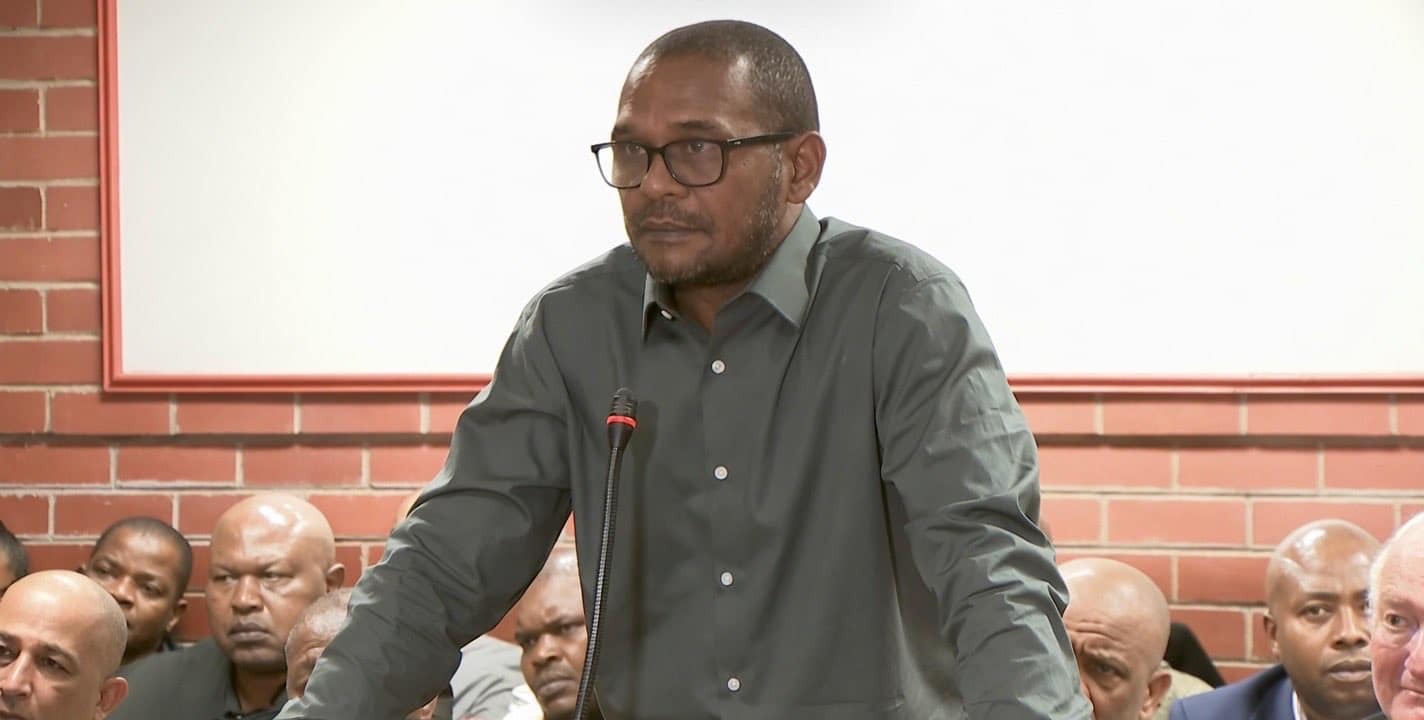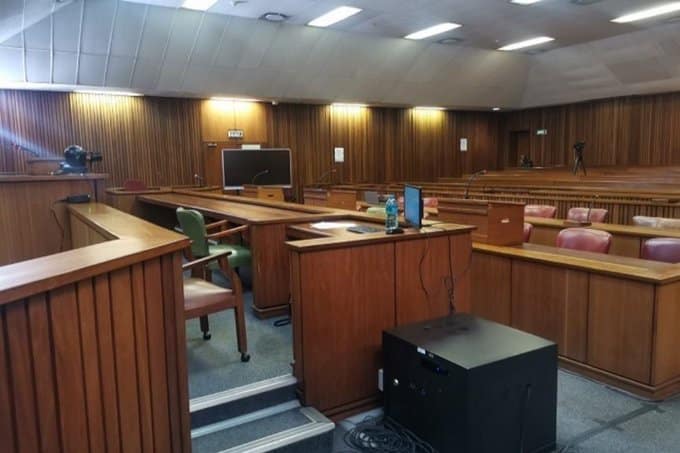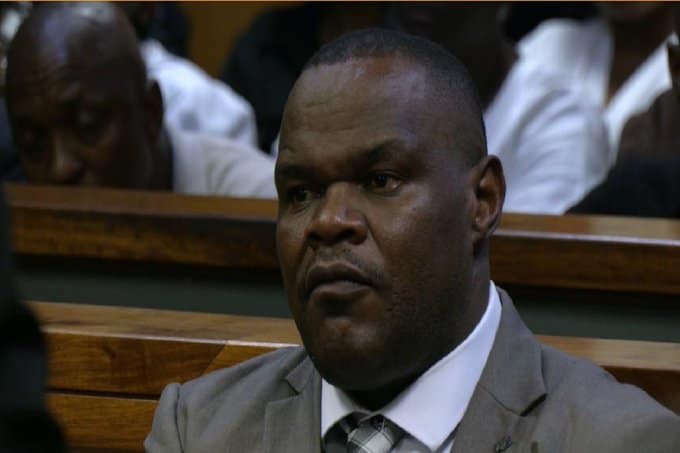
In a packed courtroom thick with tension and the weight of public expectation, suspended police sergeant Fannie Nkosi appeared before the Pretoria North Magistrate’s Court on Monday and formally pleaded not guilty to all 14 charges against him. The plea marks the official start of a trial that has already exposed alleged deep-rooted corruption, organised crime links, and systemic failures within the South African Police Service (SAPS), raising urgent questions about who polices the police.
Dressed in a dark navy suit rather than the uniform he once wore with pride, Nkosi, 47, stood ramrod straight in the dock as the charges were read out one by one by the court clerk. His jaw was set. His eyes, fixed on the magistrate, betrayed no emotion. When asked how he pleaded to the first count—extortion—his voice was clear and steady: “Not guilty, Your Worship.” The same response followed for each subsequent charge: kidnapping, assault with intent to do grievous bodily harm, defeating the ends of justice, corruption, possession of unlicensed firearms, and two counts of murder.
The courtroom, filled to its 120-person capacity, fell into a hushed silence after the final “not guilty” echoed off the wooden walls. Then, from the public gallery, a woman’s voice broke through: “Liar!” It was Letta Mokoena, the widow of Thabo Mokoena, one of the two men Nkosi is accused of murdering. She was escorted out by court orderlies, sobbing, as her family members held her arms.
Outside the courthouse, a crowd of over 200 people had gathered—some holding placards reading “Justice for Thabo” and “No Bail for Killer Cops,” others wearing T-shirts bearing Nkosi’s face and the slogan “Fannie is Innocent.” The two groups were separated by a line of riot police, their presence a reminder of the volatility of a case that has torn a community apart.
The Charges: A Catalog of Alleged Criminality
The indictment against Nkosi, which runs to 47 pages, paints a picture of a decorated police officer who allegedly used his badge as a shield for a sprawling criminal enterprise. According to the State’s case, which was summarized in court by prosecutor Adv. Lindiwe Mthembu, Nkosi is accused of:
- Extortion (6 counts): Between 2020 and 2025, Nkosi allegedly demanded protection payments from over 30 spaza shop owners, tavern operators, and informal traders in the Temba, Mabopane, and Soshanguve townships north of Pretoria. Those who refused were allegedly assaulted, had their businesses vandalized, or were threatened with arrest on fabricated charges. The State has identified 18 victims willing to testify.
- Kidnapping (3 counts): Nkosi and unnamed co-conspirators allegedly kidnapped three individuals believed to have provided information to independent investigators. One victim, a 34-year-old taxi driver, was allegedly held in a soundproofed room for five days and tortured with a rubber hose and electric shocks. He will testify via closed-circuit television to protect his identity.
- Assault with intent to do grievous bodily harm (4 counts): Separate from the kidnapping charges, Nkosi is accused of personally assaulting four individuals, including a 19-year-old university student who was allegedly beaten with a baton after being stopped at a roadblock.
- Defeating the ends of justice (2 counts): Nkosi allegedly tampered with police dockets, destroyed evidence, and intimidated witnesses. In one instance, he is accused of paying a police clerk R50,000 to delete computer records of a vehicle stop that later became relevant to a murder investigation.
- Corruption: The State alleges that Nkosi received over R1.2 million in bribes between 2022 and 2025, deposited into bank accounts held in the names of his wife and adult children.
- Possession of unlicensed firearms (2 counts): When Nkosi’s home was searched in January 2026, police found a 9mm Glock pistol and a .38 revolver, neither of which was registered to him. Ballistics testing has allegedly linked the Glock to the murder of Thabo Mokoena.
- Murder (2 counts): The most serious charges. Nkosi is accused of ordering and facilitating the murders of Thabo Mokoena (42) and Elias Dlamini (38), two key witnesses who had agreed to testify before the Madlanga Commission of Inquiry about Nkosi’s alleged activities. Mokoena was shot dead outside his home in Soshanguve in November 2024. Dlamini’s body was found in a shallow grave near the Moretele River in March 2025, with evidence of torture. The State alleges that Nkosi provided the firearm, the vehicle, and the intelligence that enabled the killings.
The Plea Explanation: ‘I Am a Scapegoat’
After entering his not-guilty plea, Nkosi’s defense attorney, Adv. Sarah Makhubela, read a lengthy plea explanation into the record—a statement in which the accused sets out his version of events. The statement, signed by Nkosi and dated the previous Friday, was a sweeping denial of all allegations.
“I am a professional police officer with 22 years of unbroken service,” the statement read. “I have received 14 commendations, including a Bronze Medal for Bravery for my actions during a hostage situation in 2016. I have never been accused of any misconduct before these charges were brought. I am being made a scapegoat for failures that are not my own. The real criminals are those who have turned the Madlanga Commission into a witch hunt against honest officers.”
Regarding the murder charges, Nkosi’s statement was emphatic: “I had no involvement in the deaths of Thabo Mokoena or Elias Dlamini. I did not know them. I never met them. I never ordered anyone to harm them. The ballistics evidence is flawed. The witness testimony is from convicted liars seeking to reduce their own sentences. I am innocent.”
On the extortion and kidnapping charges, Nkosi claimed that his interactions with township business owners were “routine police work” and that any payments made to him were “reimbursements for services rendered” or “voluntary contributions to a community policing fund.” He denied the existence of any soundproofed room or torture chamber.
The statement concluded with a plea for a fair trial: “I have spent 22 years serving the people of South Africa. I have bled for this country. I have watched colleagues die. Now I ask only for what every citizen is entitled to: a presumption of innocence, a fair hearing, and a chance to clear my name.”
The State’s Response: ‘A Pattern of Predatory Criminality’
Prosecutor Adv. Lindiwe Mthembu did not mince words in her response. In a brief but pointed address to the court, she characterized Nkosi’s plea explanation as “a tissue of lies” and “an insult to the intelligence of this court and to the families of the deceased.”
“The accused asks this court to believe that a police sergeant with 22 years of experience received over R1.2 million in ‘reimbursements’ and ‘voluntary contributions’—in cash, deposited into family members’ accounts—without once questioning the legality or propriety of those transactions,” Mthembu said. “He asks this court to believe that his fingerprints were found on the steering wheel of the vehicle used to transport Elias Dlamini to his place of execution because he ‘once sat in that car at a police function.’ He asks this court to believe that the Glock pistol registered to his name was ‘stolen and then returned without his knowledge.'”
Mthembu paused, letting the weight of her words settle over the courtroom.
“This is not a case of a good man falsely accused,” she continued. “This is a case of a predator in uniform, a man who used the authority of the state to enrich himself, to terrorize communities, and to silence those who dared to speak against him. The State will prove every charge beyond a reasonable doubt. And when we are done, there will be no question that Sergeant Fannie Nkosi is exactly where he belongs: in the dock, facing justice.”
The Madlanga Commission Connection: A Case Within a Case
The trial of Sergeant Nkosi is inextricably linked to the ongoing Madlanga Commission of Inquiry, which continues to hear testimony about alleged “death squads” and “rogue units” within the SAPS. Nkosi first came to the commission’s attention in September 2025, when a former colleague, Warrant Officer Peter Masemola, testified that Nkosi had boasted of “taking care of problems permanently.”
Masemola, who has since entered witness protection, is expected to be a key witness for the State. His credibility will be fiercely challenged by the defense, which has already labeled him a “disgraced fraudster” with a motive to lie. Masemola faces his own fraud charges unrelated to the Nkosi case, and the defense will argue that he implicated Nkosi to secure a lenient sentence.
The commission’s legal team has indicated that it will apply to have the commission’s hearings suspended pending the outcome of the criminal trial, to avoid prejudicing either the prosecution or the defense. Magistrate Thabo Maluleke has not yet ruled on that application.
The Bail Question: Awaiting a Decision
Monday’s proceedings were primarily focused on the plea, but the question of bail—which has been denied twice previously—looms over the case. Nkosi has been in custody at the Kgosi Mampuru II Correctional Centre since his arrest in January 2026, a period of nearly three months.
His legal team indicated that they would file a third bail application, citing new evidence about Nkosi’s deteriorating health (he suffers from uncontrolled hypertension and early-stage kidney disease) and arguing that the State’s case has not progressed as quickly as promised.
The State will oppose bail vigorously, arguing that Nkosi remains a flight risk (he allegedly holds three passports and has access to hidden funds) and a danger to witnesses (two additional witnesses have received threats since his arrest).
Magistrate Maluleke set a hearing for the bail application on Thursday, 16 April 2026. Until then, Nkosi will remain behind bars.
The Atmosphere: A Community Divided
Outside the courthouse, the two groups of protesters remained separated by police, but the tension was palpable. Among those supporting Nkosi was his wife, Margaret, who held a placard reading “My husband is innocent. 22 years of service. 22 years of sacrifice. Do not destroy him for lies.”
“I know Fannie,” she told a group of reporters, her voice trembling. “I have slept next to him for 25 years. He is not a killer. He is not a criminal. He is a good man who has been destroyed by a system that needed a fall guy. The Madlanga Commission needed a headline. They chose my husband. And now our family is paying the price.”
Nearby, Letta Mokoena, who had been ejected from the courtroom, stood with her arms wrapped around her teenage daughter. She did not speak to reporters. She did not need to. The pain on her face said everything.
The Broader Implications: Policing the Police
The Nkosi case has become a symbol of a much larger crisis within the South African Police Service. For years, civil society organizations have warned about the existence of “rogue units” and “criminal networks” operating within the SAPS, protected by a culture of silence and a dysfunctional internal accountability system.
“The Nkosi case is not an aberration,” said Advocate Paul Hoffman of the Institute for Accountability in Southern Africa. “It is a symptom. The question is whether the system is finally ready to confront the disease. The Madlanga Commission is a start. The prosecution of Nkosi—and anyone else implicated—is essential. But unless we also reform the police’s internal disciplinary processes, unless we create real, independent oversight, unless we protect whistleblowers and reward integrity, the next Fannie Nkosi is already out there, wearing a uniform, carrying a badge, and preying on the vulnerable.”
The SAPS has declined to comment on the case, citing the sub judice rule. However, National Commissioner General Fannie Masemola (no relation to the accused) has previously stated that “any officer found guilty of criminal conduct will face the full consequences, including dismissal and prosecution.”
What Comes Next: A Long Trial Ahead
The trial of Sergeant Fannie Nkosi is expected to last between four and six months, with the State indicating it will call over 40 witnesses, including forensic experts, police colleagues, alleged victims, and members of the Madlanga Commission’s investigative team.
The defense has indicated it will call its own experts to challenge the ballistics and digital evidence, as well as character witnesses, including several senior police officers who served with Nkosi.
If convicted on the murder charges, Nkosi faces a mandatory sentence of life imprisonment. If convicted on the other charges, additional sentences could be imposed consecutively, meaning he could effectively never be released.
For now, the wheels of justice turn slowly. The plea has been entered. The trial has begun. And a nation watches to see whether a suspended police sergeant will be held accountable—or whether the badge will protect him one last time.
The Final Word: Justice Delayed?
As the court adjourned shortly after noon, Nkosi was led back down the stairs to the holding cells. He did not look back at the public gallery. He did not acknowledge his wife or his supporters. He walked with the same ramrod posture he had maintained throughout the proceedings—a man determined to project dignity, whether innocent or guilty.
Letta Mokoena, still standing outside the courthouse, finally spoke to a small group of journalists. Her voice was raw, her eyes red.
“I don’t care about his pleas. I don’t care about his health. I don’t care about his 22 years of service,” she said. “My husband is dead. My children have no father. And the man who ordered his death is standing in a courtroom, wearing a suit, pleading not guilty, as if he has any right to walk free. I will be here every single day of this trial. I will watch him convicted. And I will watch him go to prison. That is the only justice I will accept.”
She turned and walked away, her daughter’s hand in hers. Behind her, the crowd slowly dispersed, but the case—and the questions it raises about the men and women sworn to protect—will not disappear anytime soon.
About The Author