In the vast, intimidating cauldron of the Wanda Metropolitano, where the red-and-white stripes of Atlético Madrid have become a fortress of fear for visiting teams, Barcelona faces the most daunting challenge of its season. Trailing 2-0 on aggregate after a catastrophic first leg at the Estadi Olímpic Lluís Companys—where Julián Álvarez and Alexander Sørloth scored and teenage defender Pau Cubarsí was shown a straight red card—Hansi Flick’s side must produce a Champions League miracle to keep their European dreams alive.
The numbers are brutal. No team in Champions League history has overturned a 2-0 first-leg home defeat to progress in the knockout stages. Barcelona’s own record away at Atlético Madrid is a catalog of misery: just one win in their last nine visits to the Metropolitano, with five defeats and three draws. And Diego Simeone’s side, the masters of defensive discipline and game management, have never lost a knockout tie at home after winning the first leg away.
But football, as the cliché goes, is not played on spreadsheets. It is played on grass, with hearts, lungs, and the kind of irrational, beautiful belief that turns impossible scorelines into legendary nights. And somewhere between the memes flooding social media, the quiet determination in the Barcelona locker room, and the haunting echoes of past comebacks, a seed of hope has been planted.
“The first leg was a disaster,” Barcelona captain Marc-André ter Stegen admitted in the pre-match press conference. “We know that. We have not hidden from it. But this team has character. This team has quality. And we have 90 minutes—maybe 120—to show the world what we are made of. We are not going to Madrid to make up the numbers. We are going to win.”
The First-Leg Collapse: How Barcelona Lost (and Lost Its Head)
To understand the scale of the task facing Barcelona, one must revisit the nightmare of the first leg on 9 April 2026. Barcelona had dominated possession (67%), created more chances (15 shots to Atlético’s 8), and looked the more likely side to score. But football is not won on statistics.
The first blow came in the 32nd minute. A routine Atlético counter-attack, launched from a Barcelona corner, saw Antoine Griezmann slide a perfectly weighted through ball into the path of Julián Álvarez. The Argentine World Cup winner, signed from Manchester City in the summer of 2025, showed his predatory instincts, driving into the box and firing low across Ter Stegen into the far corner. 1-0 Atlético. The Estadi Olímpic fell silent.
Barcelona pushed for an equalizer but were caught again in the 58th minute. This time, it was Alexander Sørloth—the towering Norwegian striker who has made a career of tormenting Barcelona—rising above Íñigo Martínez to power home a header from a corner. 2-0. The mountain was now a cliff.
Then came the moment that turned a difficult task into a near-impossible one. In the 71st minute, 17-year-old defender Pau Cubarsí—already on a yellow card for a tactical foul—lunged into a reckless challenge on Álvarez just outside the box. The referee had no choice. A second yellow. A red card. Barcelona would play the final 19 minutes plus stoppage time with ten men. They survived without further damage, but the damage had already been done.
“Pau is young. He is learning. He made a mistake,” Hansi Flick said after the match, his voice measured but his eyes betraying his frustration. “But we do not blame individuals. We win together. We lose together. And now, we must come back together.”
The Viral Movement: Memes, Messages, and a Club That Believes
In the days following the first-leg defeat, something unexpected happened on social media. Barcelona fans, instead of succumbing to despair, began creating memes—specifically, memes inspired by one of the most famous comeback stories in football history.
The reference point was James Rodríguez . In 2015, trailing 3-1 to Wolfsburg in the Champions League quarter-finals, Real Madrid’s Colombian star posted a now-legendary photo on Instagram with the caption “Confiamos en la remontada” (“We believe in the comeback”). Real Madrid went on to win 3-0 at the Bernabéu, advancing 4-3 on aggregate.
Barcelona fans took the template and ran with it. Images of Lamine Yamal —the 18-year-old wunderkind—and Pedri —the silky midfielder—were edited into the same pose: arms crossed, eyes intense, a look of quiet defiance. The caption: “Creemos en la remontada.”
The meme went viral. Within 24 hours, it had been shared over 500,000 times across X (formerly Twitter), Instagram, and TikTok. Barcelona’s own social media team took notice. On Sunday morning, the club’s official Instagram account posted a graphic: a black background, the word “BELIEVE” in bold white letters, and a line of arms reaching upward—the hands of Robert Lewandowski , Frenkie de Jong , Raphinha , João Cancelo , and Wojciech Szczęsny stretching toward an unseen prize.
Then came the moment that truly captured the locker room’s mood. Lamine Yamal , who has already become a cult hero despite his youth, changed his Instagram profile picture to the meme version of himself—crossed arms, steely gaze, no caption needed. The message was unmistakable: the players were not hiding from the pressure. They were embracing it.
“The fans have been incredible,” Pedri said in an interview with Barça TV. “We see the memes. We see the messages. We know that people believe in us. That gives us energy. That gives us hope. We will not let them down.”
The Tactical Puzzle: How Barcelona Can (Theoretically) Do It
Hansi Flick is a coach who has seen everything. He won the Champions League with Bayern Munich in 2020, destroying Barcelona 8-2 along the way. He has managed comebacks and suffered collapses. He knows that overturning a 2-0 deficit away from home against a Simeone team requires not just belief, but a perfect tactical plan.
The Cubarsí Void: With Pau Cubarsí suspended, Barcelona’s defense is even more vulnerable. Flick is expected to partner Íñigo Martínez with Andreas Christensen at center-back, with Jules Koundé shifting to right-back and João Cancelo on the left. The absence of Cubarsí’s composure on the ball is a significant blow, but Christensen’s experience and physicality may be better suited to dealing with Sørloth’s aerial threat.
The Midfield Battle: Atlético’s midfield trio of Koke , Marcos Llorente , and Pablo Barrios is engineered to disrupt, to foul, to break rhythm. Barcelona must match their intensity without losing their own identity. Frenkie de Jong will be key—his ability to carry the ball from deep and break lines is Barcelona’s best weapon against Atlético’s low block. Pedri will need to find pockets of space between the lines. And İlkay Gündoğan , the veteran who has seen it all, must provide the cool head in moments of chaos.
The Attack: Goals, Goals, and More Goals: Barcelona needs three unanswered goals to force extra time. Four to win outright in 90 minutes. That means Robert Lewandowski must recapture his ruthless best. The Polish striker has gone three Champions League matches without a goal—his longest drought in the competition since 2018. But he has a history of silencing doubters on big nights.
Flanking him will be Lamine Yamal on the right and Raphinha on the left—though both are comfortable switching flanks. Yamal’s dribbling in tight spaces could be Barcelona’s key to unlocking Atlético’s compact defense. Raphinha’s work rate and ability to arrive late in the box (he has 12 goals this season, a career high) make him a constant threat.
And then there is Marcus Rashford . The English forward, on loan from Manchester United after falling out of favor at Old Trafford, has been a revelation for Barcelona since his January arrival, scoring 7 goals in 12 appearances. His pace on the counter could be decisive if Atlético are forced to chase the game. Flick has hinted that Rashford may start on the bench and be deployed as a “chaos agent” in the second half.
The Goalkeeper: Wojciech Szczęsny , who replaced the injured Ter Stegen in February, has been in the form of his life. He has kept five clean sheets in his last seven matches, including a stunning save to deny Sørloth in the first leg that kept the scoreline at 2-0 rather than 3-0. If Barcelona is to keep a clean sheet at the Metropolitano—a prerequisite for any comeback—Szczęsny must be flawless.
The Simeone Factor: Master of the Dark Arts
No discussion of Atlético Madrid is complete without acknowledging Diego Simeone . The Argentine coach has transformed the club from perennial underachievers into European heavyweights. His teams are defined by defensive organization, physical intensity, tactical fouls, and an almost supernatural ability to manage games when ahead.
Simeone has never lost a Champions League knockout tie at home after winning the first leg away. That record spans 11 ties, including victories over Bayern Munich (2016), Liverpool (2020), and Manchester United (2022). He knows exactly how to suffocate a team that needs to chase the game: sit deep, absorb pressure, hit on the break, waste time, provoke opponents, and protect the lead with every legal (and semi-legal) means available.
“Atlético are the masters of the 1-0,” said former Barcelona midfielder Xavi Hernandez in a punditry appearance on Spanish television. “They are even better at protecting a 2-0. They will not give Barcelona anything. Every pass will be contested. Every run will be blocked. Every Barcelona player who shows frustration will be targeted. Simeone is a genius at that. Flick must prepare his players for psychological warfare, not just football.”
Locker Room Morale: ‘We Have Nothing to Lose’
Despite the daunting statistics, those close to the Barcelona squad describe an atmosphere of focused determination rather than nervous dread. The players have been here before—not this exact situation, but moments of crisis. They remember the 4-0 comeback against Roma in 2018 (though that was at home). They remember the 6-1 against PSG in 2017. They know that comebacks are possible because they have lived them.
“Pressure is a privilege,” said Raphinha , the Brazilian winger who has become a leader in the locker room despite only joining in 2023. “If there was no pressure, it would mean this game does not matter. It matters. It matters a lot. So there is pressure. Good. We will use it.”
Frenkie de Jong echoed the sentiment: “We have nothing to lose. Everyone expects us to lose. Everyone expects Atlético to go through. That takes the weight off our shoulders. We can play freely. We can take risks. We can attack with abandon. And sometimes, that is when magic happens.”
The Fans: A Journey of Faith
Thousands of Barcelona fans have made the 600-kilometer journey from Catalonia to Madrid, despite the long odds. They have filled the away section of the Metropolitano, a corner of the stadium that will be a sea of blaugrana amidst the red-and-white waves.
“We are not here because we think it is likely,” said Jordi Camps, 34, a season-ticket holder from Barcelona who drove six hours with three friends. “We are here because it is possible. Because football is about dreams. Because if we do not believe, then who will? I was at the PSG comeback in 2017. I was at the Bernabéu when we won 4-0 in 2016. I have seen miracles. I am ready to see another one.”
The club has organized a fan march to the stadium, starting three hours before kickoff, with banners reading “Fins al final” (Until the end) and “Creem en la remontada” (We believe in the comeback). The players, when they arrive on the team bus, will see the faces of thousands of supporters who have invested not just money, but emotion, in this impossible dream.
The Weight of History: Barcelona’s Poor Knockout Record Away at Atlético
The statistics that favor Atlético are not just abstract numbers; they are the accumulated weight of decades of disappointment for Barcelona. Consider:
- Barcelona’s last knockout win away at Atlético Madrid came in the 2016 Champions League quarter-finals, when they won 2-0 at the Vicente Calderón (the Metropolitano’s predecessor). But even that victory was not enough: Barcelona had lost the first leg 2-1 at home and advanced on aggregate only because of away goals—a rule that no longer exists.
- In the 2014 Champions League quarter-finals, Barcelona lost 1-0 at the Calderón after a 1-1 home draw. Atlético advanced.
- In the 2009 Champions League group stage, Barcelona lost 2-1 at the Calderón. In 2008, they lost 4-2. In 2006, they lost 3-1. The pattern is relentless.
But history is also a story of records being broken. Before 2017, no team had ever overturned a 4-0 first-leg deficit in the Champions League. Then Barcelona did it against PSG. Before 2019, no team had ever won a Champions League knockout tie after losing the first leg 3-0 away. Then Liverpool did it against Barcelona. Records are made to be shattered.
The XI: Who Will Flick Trust?
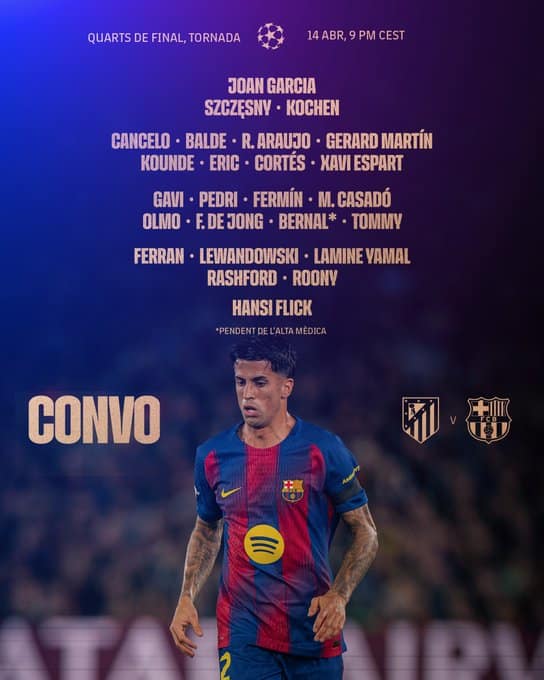
The expected Barcelona starting lineup (4-3-3): Szczęsny ; Cancelo , Christensen , Íñigo Martínez , Koundé ; De Jong , Gündoğan , Pedri ; Raphinha , Lewandowski , Yamal.
Flick has a decision to make in midfield: Fermín López has impressed in recent weeks and could provide more attacking thrust than Gündoğan, but the German’s experience in big games may win out. Oriol Romeu is another option if Flick wants more defensive solidity, but that seems unlikely given the need for goals.
Rashford is expected to start on the bench, with Flick hoping to unleash his pace against tiring Atlético legs in the final 30 minutes. Vitor Roque , the young Brazilian striker, is also an option if Lewandowski fades.
Atlético’s expected XI (5-3-2): Oblak ; Molina , Giménez , Savić , Hermoso , Lino ; Llorente , Koke , Barrios ; Griezmann , Álvarez. Sørloth may start on the bench after playing 90 minutes in the first leg.
The Narrative: More Than a Game
For Barcelona, this is more than a Champions League quarter-final. It is a test of identity. The club has been through years of turmoil: financial crisis, the departure of Lionel Messi, the “levers” of asset sales, the humiliating group stage exits of 2021 and 2022. Under Hansi Flick, there have been signs of recovery—a La Liga title in 2025, a Copa del Rey final appearance this season—but European glory remains the ultimate validation.
A comeback against Atlético, in their own stadium, against their nemesis Simeone, would be a statement to the continent: Barcelona is back. A failure, a tame 0-0 or a narrow 1-0 win that falls short, would be another chapter in a decade of European disappointment.
“The players know what is at stake,” Flick said in his final pre-match press conference. “Not just this tie. Not just this season. The identity of this club. Barcelona is about courage. Barcelona is about attacking football. Barcelona is about never giving up. Tomorrow night, we must show the world that those values are not just words on a museum wall. They are alive. They are in our hearts. And they will be on that pitch.”
The Final Word: A Night for Heroes
As the sun sets over Madrid on Tuesday evening, the floodlights of the Wanda Metropolitano will flicker to life. Sixty-eight thousand fans will fill the stands—the vast majority in red and white, a defiant pocket in blaugrana. The players will walk onto the pitch, some with nerves, some with fire, all with the knowledge that they are about to write a chapter in their club’s history.
It may be a chapter of glorious redemption. It may be a chapter of noble failure. But it will not be a chapter of indifference. Because Barcelona, for all its flaws, has never been a club that accepts fate. It is a club that fights fate. It is a club that believes.
And on Tuesday night, belief is all they have.
About The Author