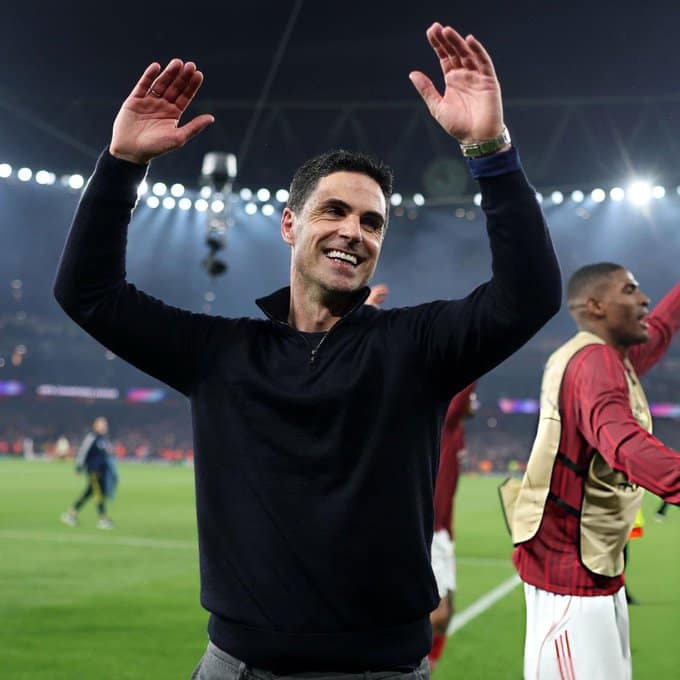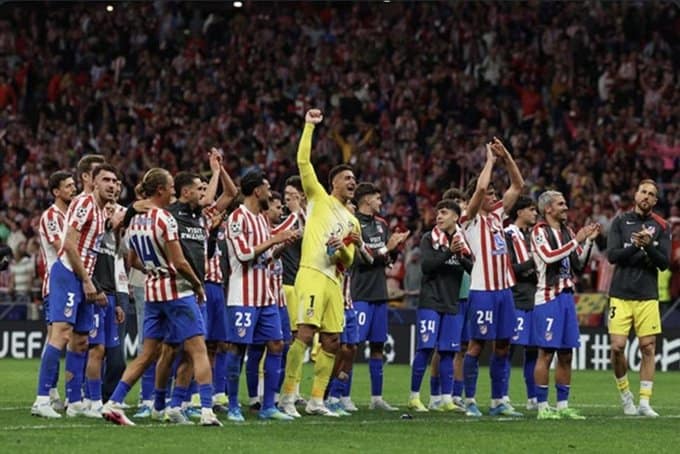
For 90 agonizing minutes, the Riyadh Air Metropolitano Stadium held its collective breath. The stands, a sea of red and white, oscillated between roaring defiance and hushed terror. When the final whistle finally pierced the Madrid night, the release was explosive—a volcanic eruption of joy, relief, and disbelief.
Atlético Madrid had done it. Barely. Just barely.
In a nerve-shredding Champions League quarter-final second leg on Tuesday night, Diego Simeone’s men clung to their aggregate advantage with the desperation of drowning sailors, absorbing wave after wave of Barcelona pressure to secure a 3-2 aggregate victory. The 2-1 defeat on the night was irrelevant. The math was all that mattered. And the math said: Atlético are in the semi-finals for the first time in nine years.
“We suffered. Of course we suffered,” said a visibly exhausted Simeone in his post-match press conference, his tie loosened, his shirt damp with sweat. “Barcelona are a great team. They pushed us to the limit. But my players showed their heart. They showed why this club belongs among the best in Europe.”
The First-Leg Advantage
The stage had been set a week earlier at the Estadi Olímpic Lluís Companys, where Atlético had produced a tactical masterclass to secure a 2-1 victory in the first leg. Goals from Antoine Griezmann and Marcos Llorente had given the visitors a precious advantage, despite Robert Lewandowski’s late strike that kept Barcelona’s hopes flickering.
That night, Simeone had done what Simeone does best: absorb pressure, strike on the counter, and leave the opposition frustrated and broken. The Argentine coach, now in his 14th year at the club, has built a dynasty on such performances. But he knew that 90 minutes at the Metropolitano would be a different beast entirely.
“Barcelona at home with nothing to lose is dangerous,” Simeone had warned before the match. “They have young players who do not know fear. We must be perfect.”
He was almost right. Atlético were not perfect. But they were just enough.
The Nightmare Start
The match had barely settled when the Metropolitano fell silent. In the 12th minute, Barcelona’s teenage sensation Lamine Yamal—daring, dazzling, and utterly unbothered by the occasion—picked up the ball on the right flank, cut inside past Reinildo Mandava, and curled a left-footed shot into the far corner. Jan Oblak, the Atlético goalkeeper who had been unbeatable in the first leg, could only watch as the ball kissed the inside of the post and nestled into the net.
1-0 Barcelona on the night. 2-2 on aggregate. The semi-final was slipping away.
“It was a terrible moment,” said Atlético captain Koke Resurrección after the match. “You could feel the tension in the stadium. Everyone was thinking the same thing: not again. Not against Barcelona. Not like this.”
Yamal, wearing glasses on the bench after the match but playing like a man possessed during it, had delivered on his pre-match promise to “face Simeone’s defense.” The 18-year-old had tormented Atlético’s backline all evening, his dribbling, his movement, his fearlessness a constant thorn in the home side’s side.
“Lamine is special,” Barcelona coach Hansi Flick said afterward. “He is not afraid of anyone. He proved that tonight. Unfortunately, it was not enough.”
The Hold
What followed was a masterclass in defensive resilience—the kind of performance that has defined Simeone’s Atlético for a decade and a half. The home side retreated into a low block, compressing space, denying Barcelona any room to operate. The visitors, sensing blood, pushed forward with increasing desperation. Pedri pulled the strings in midfield. Lewandowski lurked on the shoulder of the last defender. Yamal continued to dance and dart.
But the goal would not come.
“We knew they would come at us,” said Atlético defender José María Giménez, who put in a heroic shift at the heart of the backline. “We knew they would throw everything forward. We just had to survive. Block shots. Clear crosses. Stay organized. It was ugly. But it was effective.”
Atlético’s game plan was simple: absorb, frustrate, and hope. They created almost nothing going forward, content to kick the ball long and chase shadows. The statistics told the story: Barcelona had 72% possession, 18 shots to Atlético’s 4, and 9 corners to Atlético’s 1. But the only number that mattered was the scoreline.
The Suarez Moment
As the clock ticked past the 80th minute, the Metropolitano grew increasingly frantic. Every Barcelona attack brought gasps. Every clearance brought cheers. The home fans, famous for their ferocity, were living every kick as if it were their last.
Then, in the 87th minute, the hammer fell. Barcelona worked the ball wide to Yamal, who delivered a pinpoint cross to the back post. There, unmarked, was substitute Ferran Torres, who volleyed home with the composure of a veteran. 2-0 Barcelona on the night. 3-2 Barcelona on aggregate. The semi-final was now Barcelona’s to lose.
Or so it seemed.
But the goal had come too late. When the referee checked his watch and added six minutes of stoppage time, the Metropolitano braced for the worst. Barcelona poured forward. Lewandowski headed wide. Yamal shot straight at Oblak. Gündogan’s free-kick was cleared off the line by a desperate slide from Giménez.
And then, finally, mercifully, the whistle blew.
The Aftermath
The scenes at the final whistle were chaotic. Atlético players collapsed to the turf, exhausted and overwhelmed. Simeone, usually stoic, ran onto the pitch to embrace each of them individually. In the stands, grown men wept. Women held each other. Strangers hugged strangers.
Nine years. That was how long Atlético had waited for this moment. Nine years since their heartbreaking loss to Real Madrid in the 2017 semi-finals. Nine years of near misses, of group-stage exits, of watching their city rivals lift trophy after trophy.
“We have waited a long time for this,” Koke said, his voice thick with emotion. “This club has suffered. Our fans have suffered. But tonight, we showed that Atlético never gives up. Never.”
For Barcelona, the defeat was a bitter pill to swallow. They had dominated the tie for long stretches, outplaying Atlético in both legs. But football is not played on possession statistics. It is played on goals. And Barcelona had simply left themselves too much to do.
“We are proud of our performance, but proud is not enough,” Flick said. “We came here to win. We came here to reach the semi-finals. We did not. That is football. It is cruel sometimes.”
The Yamal Phenomenon
If there was one bright spot for Barcelona, it was the continued emergence of Lamine Yamal. The 18-year-old, who had dared Simeone to “face him” in the build-up, had more than backed up his words. His first-half goal was a thing of beauty—a moment of individual brilliance that reminded the world why he is already being compared to Lionel Messi.
“He is a phenomenon,” said Barcelona captain Marc-André ter Stegen. “To perform like that, at his age, in a quarter-final, away from home—it is incredible. He has a huge future ahead of him. But tonight, he is hurting. We all are.”
Yamal, who had spoken before the match about drawing inspiration from LeBron James and Neymar, was subdued after the final whistle. He sat on the pitch for several minutes, his head in his hands, before being helped to his feet by Pedri.
“We gave everything,” Yamal said quietly as he walked off the pitch. “It was not enough. But we will be back. I promise. We will be back.”
The Simeone Legacy
For Simeone, the victory was another chapter in his already legendary tenure at Atlético. The Argentine has now led the club to two Champions League finals, two Europa League titles, two La Liga crowns, and countless memorable European nights. But this one felt different.
“This was not about tactics or systems,” Simeone said. “This was about heart. This was about belief. This was about a group of players who refused to accept that their journey was over. That is what Atlético Madrid is. That is what we will always be.”
The victory also extended Simeone’s remarkable record in Champions League knockout ties. Since taking over in 2011, he has now led Atlético to the semi-finals on four separate occasions—an achievement matched only by the very elite of European coaching.
“He is the heart of this club,” Koke said of his manager. “When he speaks, we listen. When he demands, we give. He has built something special here. And we are not done yet.”
What Comes Next
Atlético will learn their semi-final opponent on Friday, when the draw is made in Nyon. The potential opponents include reigning champions Real Madrid, English giants Manchester City, and German powerhouse Bayern Munich. No matter who emerges from the hat, Atlético will face a daunting task.
But for now, the focus is on celebration. The Metropolitano emptied slowly after the match, fans lingering to sing, to dance, to soak in the moment. The players emerged for a lap of honor, waving to the stands, applauding the supporters who had willed them through the darkest moments.
“We will enjoy tonight,” Simeone said. “Tomorrow, we think about the next match. But tonight, we celebrate. This is what football is about. These are the nights we will remember forever.”
The Numbers Behind the Drama
The statistics from the tie tell a story of two very different philosophies. Over 180 minutes, Barcelona had 68% possession, 31 shots, and 14 corners. Atlético had 32% possession, 11 shots, and 4 corners. But the aggregate score was 3-2 to Atlético.
It was, in many ways, a perfect illustration of Simeone’s football: efficient, ruthless, and utterly devastating to opponents who believe that dominance on the ball should translate into dominance on the scoreboard.
“Possession is beautiful,” Simeone has often said. “But goals win matches. And winning is the only beauty that matters to me.”
The Fans’ Night
Outside the Metropolitano, long after the final whistle, the party continued. Thousands of fans spilled onto the surrounding streets, waving flags, setting off flares, and singing the club anthem. Police looked on with a mixture of wariness and understanding. This was a night for celebration, not confrontation.
“I was at the last semi-final, nine years ago,” said longtime season ticket holder Carlos Méndez, a 52-year-old electrician from Vallecas. “We lost to Real Madrid. It was devastating. I never thought it would take this long to come back. But tonight, I feel like a boy again. This is why we love this club. This is why we never stop believing.”
For the players, the adulation was overwhelming. Griezmann, the club’s all-time leading scorer, stood on the pitch long after his teammates had gone inside, soaking in the applause. He had been here before, in 2016 and 2017. He knew how rare these nights were.
“This is special,” he said. “This is why I came back. Not for money. Not for fame. For nights like this. For this feeling. For this family.”
A Final Word
As the Metropolitano finally fell quiet, the lights dimmed, and the last of the fans drifted home, Simeone stood alone in the center circle, looking up at the empty stands. He had been here for 14 years. He had seen the club grow, struggle, fall, and rise again. And on this night, he had delivered something that felt like vindication.
“People say our football is ugly,” he said later, sitting in the empty dugout. “They say we don’t play the right way. They say we are not worthy of the big stage. But look at the scoreboard. Look at the aggregate. Look at the result. We are in the semi-finals. And no one can take that away from us.”
He stood up, adjusted his suit jacket, and walked toward the tunnel. Behind him, the stadium was dark. But somewhere in the distance, a small group of fans was still singing.
“Aúpa Atlético,” they chanted. “Aúpa Atlético.”
The words echoed off the concrete and steel, a promise and a prayer. The semi-finals awaited. And for Atlético Madrid, after nine long years, the dream was still alive.
About The Author