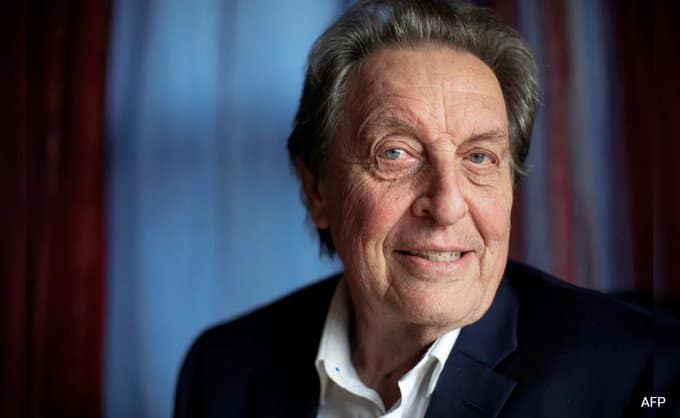
The Easter mass at the Cathedral of Christ the Saviour was a spectacle of golden light and ancient ritual. At the front of the congregation, standing just a few meters from President Vladimir Putin, was an unexpected guest: Errol Musk, the 79-year-old father of the world’s richest man, dressed in a dark suit and wearing an expression of quiet satisfaction.
For Musk, who has lived much of his life in the shadow of his famous son Elon, this was a moment of personal significance. But it was also something more. His presence in Moscow, confirmed just days after he attended the April 12 Orthodox Easter service alongside Putin, was part of a broader and highly controversial mission: to secure refugee status in Russia for white South African farmers .
In an interview with AFP on Tuesday, Errol Musk confirmed that he is actively working on a project to resettle 50 Afrikaner families from South Africa to Russia. The initiative, he said, would grant them “refugee status” and provide a new home in the Vladimir region, just east of Moscow .
“It’s about providing refugee status to South African farmers,” Musk told AFP from Moscow, declining to provide further details about the mechanics of the plan .
The announcement sent shockwaves through diplomatic circles, coming on the heels of a similar—and equally controversial—US programme that has already resettled nearly 5,000 white Afrikaners in America since Donald Trump returned to the White House in January 2025 . Together, the two initiatives represent an unprecedented international effort to relocate a community that, despite overwhelming evidence to the contrary, has been portrayed by some as facing “persecution” and even “genocide” in post-apartheid South Africa.
The 50 Families
The Russian project was first revealed last week by Alexander Avdeyev, the governor of the Vladimir region, which borders the Moscow region to the east. In a post on his official Telegram channel, Avdeyev announced that he had met with Errol Musk to discuss “the development of agriculture and the prospects for settling 50 Dutch-origin families from South Africa” .
“We discussed the development of agriculture and the prospects for settling 50 Dutch-origin families from South Africa,” Avdeyev wrote, adding that the families would be resettled in rural areas of the region, where they would be expected to engage in farming activities .
According to local media reports, Musk is prepared to invest approximately €3 million (around R60 million) in the project, which would not only help Afrikaner farmers acquire and cultivate land but also assist with housing construction and adaptation to local conditions .
“There will be a whole program to work not only on land, but also on housing construction. They will be investments or the relocated people’s own funds,” said Svetlana Goreva, curator of Musk’s project, according to Gubernia-33 television. “Some will need help with temporary housing and will later build their own homes” .
The project would add to an existing but small flow of Afrikaner emigration to Russia, which has been documented since at least 2018. However, Musk’s involvement represents a significant escalation, bringing the weight—and the controversy—of his family name to the endeavour .
The US Precedent
The Russian project closely mirrors an initiative launched by the Trump administration, which has offered refugee status to white South African farmers based on claims that they face systematic persecution under the country’s Black-led government .
Since Trump took office in January 2025, his administration has resettled nearly 5,000 Afrikaners in the United States, according to State Department figures cited by AFP. The programme has been implemented while the US has “all but halted refugee programmes for every other group,” raising questions about its racial motivations .
The South African government has strongly rejected the premise of both programmes, denying any discrimination against white citizens and describing the US initiative as “apartheid 2.0” . In August, South African Foreign Minister Ronald Lamola used that exact phrase to characterize the American resettlement effort, calling it based on “false claims of persecution” .
The US programme has been built on what experts describe as a deliberately manufactured narrative. For years, far-right commentators and politicians—including former Fox News host Tucker Carlson—have promoted the false claim that white farmers in South Africa are being subjected to a “white genocide” .
The numbers tell a different story. Over a 12-month period in 2023-2024, AfriForum, an Afrikaner civil rights organization, recorded 49 murders of Afrikaners—representing just 0.2% of the 27,621 murders recorded across South Africa during the same period. As the Institute for Security Studies in Pretoria concluded: “The idea of a ‘white genocide’ taking place in South Africa is completely false” .
Errol Musk has embraced this false narrative. In an interview with Russian media outlet Gubernia 33, he justified his project by claiming that white Afrikaner farmers are being “targeted for murder”—allegations that South African authorities have repeatedly and forcefully denied .
The Musk Family’s Complicated Role
The involvement of the Musk family in this controversy is far from coincidental. Both Errol and his son Elon have a long history of making inflammatory statements about South Africa’s racial politics.
In an interview with CNN late last year, Errol Musk made the stunning assertion that there had been “no oppression” under apartheid—the brutal system of racial segregation that denied the Black majority basic rights for nearly five decades . The comments drew widespread condemnation and revealed a worldview that aligns closely with the narratives underpinning both the US and Russian resettlement projects.
Elon Musk, who left South Africa in his late teens, has been even more vocal. The tech billionaire regularly accuses the South African government of “racism,” particularly over its failure to grant his Starlink internet provider a licence to operate in the country .
South African laws designed to rebalance apartheid-era discrimination require large companies to be at least 30% owned by people from previously disadvantaged communities—a measure intended to address the vast economic inequalities inherited from centuries of colonialism and apartheid. Elon Musk has characterized this requirement as discriminatory against him personally.
In a new outburst on social media this weekend, he wrote: “South Africa won’t allow Starlink to be licensed, even though I was BORN THERE, simply because I am not Black!” .
President Cyril Ramaphosa’s spokesman responded on X, accusing Elon Musk of peddling “lies and disinformation” .
The timing of Errol Musk’s Moscow visit has also raised eyebrows. It comes at a moment when Starlink’s restrictions on Russian use of its terminals in Ukraine have “significantly hindered” Russia’s military efforts, according to an analysis by the US-based Institute for the Study of War . Some observers have speculated that Errol Musk’s project could be an attempt to smooth relations between his son’s company and the Kremlin—though no direct evidence of such a link has emerged.
A Diplomatic Puzzle
The Russian project poses a unique diplomatic challenge for South Africa. On one hand, the government has strongly rejected the premise that white farmers are being persecuted, and it has condemned the US resettlement programme in the strongest terms .
On the other hand, South Africa and Russia have long enjoyed close ties that date back to the struggle against apartheid, when the Soviet Union provided crucial support to the African National Congress (ANC) and its military wing . The Ramaphosa government has been notably reluctant to criticize Russia on any issue, including its full-scale invasion of Ukraine.
“It could create tensions with Pretoria,” said Friedrich von Treskow, a former researcher at the South African Institute of International Affairs who has worked on Russian influence in southern Africa. “Pretoria has been very reluctant to criticise Russia on any issue whatsoever. I don’t think Russia expects the ANC to speak out openly about this” .
The strength of the Russia-ANC relationship was demonstrated in February, when Ramaphosa expressed “heartfelt gratitude” to Putin for agreeing to facilitate the return of more than a dozen South African men who had been lured into fighting alongside Russian forces in Ukraine. Fifteen of them have since been repatriated .
Just last month, the investigative media outlet Forbidden Stories reported that ANC secretary-general Fikile Mbalula had, in December 2024, thanked Russian influence agents for their “assistance” before South Africa’s general elections earlier that year. According to a memo of the meeting, Mbalula also “requested” $300,000 to fund an ANC party congress. Mbalula has rejected the claims as “unfounded” and “part of a disinformation campaign” .
The South African government’s response to Errol Musk’s project has been carefully measured. “The Russian authorities are best placed to explain the reasons for this collaboration with Mr Musk,” a spokesperson for the Foreign Minister told AFP, effectively sidestepping the issue .
The Historical Echoes
The claim that white South Africans are being persecuted—and the corresponding effort to resettle them in majority-white countries—is not new. As historian John Broich has documented, it is part of a “century-long effort to keep some English-speaking nations white” .
In the early 20th century, the United States, Canada, Australia, and New Zealand coordinated immigration policies explicitly designed to preserve their “white” character. The US Immigration Act of 1924, for example, was intended to preserve what its proponents called an “unadulterated” and “Nordic breed,” restricting immigration from southern and eastern Europe and barring most Asians entirely .
South Africa was part of this network. Eugenicists like Harold Fantham, who moved from Cambridge to South Africa in 1917, promoted racial immigration restrictions, arguing in 1924 for “safeguarding our nation from racial deterioration” .
Today, the Afrikaner resettlement programmes in the US and Russia reactivate this same logic. They treat whiteness as a refugee status and frame a former colonial ruling class as victims—while the majority of people suffering violence in South Africa remain Black South Africans, who are not invited to resettle in America or Russia .
The Vladimir Region Plan
For the 50 families who may eventually relocate to Russia’s Vladimir region, the reality of their new home is far removed from the grand cathedrals of Moscow. The region, known primarily for its medieval white stone monuments and its agricultural land, is a quiet, rural area with a shrinking population and a struggling economy.
Governor Avdeyev has framed the resettlement as an economic development opportunity, bringing skilled farmers to work land that has fallen fallow since the collapse of the Soviet Union. The Afrikaners, known for their expertise in large-scale agriculture, would bring not only labour but also capital and technical knowledge .
“The development of agriculture” was the focus of his discussions with Musk, Avdeyev said . According to local media, the relocated farmers would be expected to invest their own funds in land acquisition and housing construction, with Musk’s €3 million investment serving as seed capital .
But questions remain about how the families would be received by local Russian communities, which are among the country’s most ethnically homogeneous and where xenophobia towards non-Slavic migrants is common. And there are questions about the legal mechanism that would grant “refugee status” to people fleeing a country that does not, in fact, persecute them.
The Road Ahead
Neither Errol Musk nor the Russian authorities have provided a timeline for the project. Musk, who is now in his late 70s, has a history of making ambitious announcements that do not always come to fruition. But his presence at an Easter mass alongside Putin—and his brief meeting with the Russian president, which he confirmed to RIA Novosti—suggests that the project has been discussed at the highest levels .
For the South African government, the project is a headache it did not need. It forces Pretoria into an awkward position, caught between its principled rejection of the “persecution” narrative and its reluctance to alienate a powerful ally in Moscow.
For the Afrikaner families who may eventually make the journey to Russia, the decision would represent a dramatic upheaval—leaving the only country they have ever known for a land with a different language, a different climate, and a different culture, all based on a claim of victimhood that the majority of their fellow South Africans reject.
And for Errol Musk, the project offers something he has long sought: a role on the world stage, independent of his son’s vast shadow.
As he left Moscow after the Easter celebrations, Musk offered no further interviews, no additional details. But the signal had been sent. A new front had opened in the strange, ideologically driven campaign to relocate white South Africans to countries that welcome them not despite their whiteness, but because of it.
The 50 families, if they come, will find themselves in the Vladimir region—far from the highveld, far from the Karoo, far from everything they have ever known. Whether they will find the refuge they have been promised, or simply a different kind of isolation, remains to be seen.
About The Author