The convoy of black sedans, flanked by police outriders with flashing lights, snaked through the streets of the Nelson Mandela Metro on a crisp autumn morning. Inside, some of the most powerful figures in the African National Congress (ANC) — members of the party’s National Working Committee (NWC) — gazed out at a region that once symbolized hope, resilience, and the promise of liberation.
Today, that promise feels frayed.
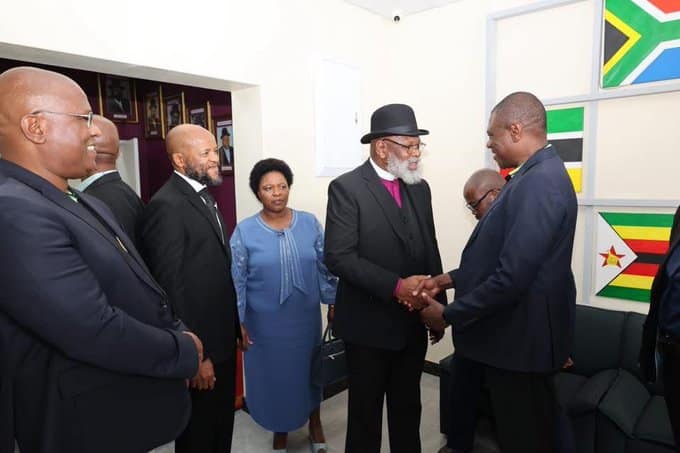
The NWC is in the Eastern Cape for a high-stakes assessment visit, tasked with evaluating two things: the state of the ANC’s own organisation in the region, and the real impact of service delivery on the communities that have long been the party’s bedrock. The visit began not at a government office or a municipal building, but at a place of spiritual and historical significance: the Bantu Church of Christ in Gqeberha (formerly Port Elizabeth).
From there, the delegation fanned out across the metro — visiting townships, informal settlements, hospitals, and roads — bearing witness to both progress and profound failure.
“We are here to listen, to learn, and to act,” said ANC Secretary-General Fikile Mbalula, who led the delegation. “The Nelson Mandela Region is not just any region. It is named after our greatest leader. It carries his legacy. We cannot allow that legacy to be buried under potholes, leaking taps, and broken promises.”
The Significance of the Bantu Church of Christ
The decision to begin the visit at the Bantu Church of Christ was deliberate and deeply symbolic.
The church, located in the heart of Gqeberha’s oldest black township, has been a spiritual and political anchor for the community for over a century. During apartheid, it served as a meeting place for anti-pass law campaigns, a sanctuary for activists fleeing security police, and a rallying point for the United Democratic Front (UDF) in the 1980s.
Nelson Mandela himself is said to have visited the church on several occasions during his clandestine travels before his imprisonment. After his release in 1990, he addressed a packed congregation here, urging them to “hold onto faith as we build a new South Africa.”
Today, the church’s roof leaks. Its walls are cracked. The surrounding streets are potholed and littered. But the congregation still gathers every Sunday, still sings the old hymns, still prays for a better tomorrow.
“We brought the NWC here to remind them what this struggle was about,” said Lulama Ngcukayitobi, the ANC’s Regional Chairperson for the Nelson Mandela Region. “It was not about positions. It was not about tenders. It was about people. Black people. Poor people. People who believed that the ANC would change their lives. We have to answer to those people.”
Inside the church, Mbalula addressed a small gathering of party elders, clergy, and community leaders. His tone was uncharacteristically subdued — no shouting, no finger-pointing, no theatrical flair.
“We are not here to blame anyone,” he said, standing at the pulpit where Mandela once stood. “We are here to take responsibility. The ANC governs this metro. The ANC governs this province. The ANC governs this country. If service delivery has failed, we have failed. And we must fix it.”
The State of the Nelson Mandela Region
The Nelson Mandela Metropolitan Municipality — which includes Gqeberha, Kariega (formerly Uitenhage), and surrounding towns — is the largest metro in the Eastern Cape. It is also one of the most troubled.
Once a thriving industrial hub, anchored by automotive manufacturing (Volkswagen, General Motors, Ford) and a busy port, the metro has suffered decades of deindustrialization, capital flight, and mismanagement. Today, the statistics are grim:
- Unemployment rate: 36.4% (official), over 50% when discouraged job-seekers are included.
- Youth unemployment: Exceeds 60%.
- Poverty rate: Over 40% of households live below the food poverty line.
- Housing backlog: Over 50,000 families on the waiting list for adequate housing.
- Water infrastructure: 38% of water is lost to leaks before it reaches homes.
- Electricity debt: The metro owes Eskom over R1.5 billion in unpaid bills.
- Municipal audit outcome: Disclaimed (worst possible) for three consecutive years.
The metro has been under ANC leadership since its inception in 2000, though the party lost outright majority in the 2021 local elections, governing through a fragile coalition with smaller parties. That coalition has been marked by infighting, budget deadlocks, and constant threats of collapse.
“The ANC cannot blame coalitions for problems that existed long before 2021,” said political analyst Dr. Nomsa Mkhize of Nelson Mandela University. “The decline of this metro began in the late 2000s. The coalition is a symptom, not the cause. The cause is a failure of leadership, planning, and accountability.”
The NWC’s Itinerary: A Week of Witnessing
The NWC’s visit to the region is scheduled to last four days, from May 4 to May 7, 2026. The itinerary is packed with site visits, community meetings, and internal party sessions.
Day 1: Bantu Church of Christ and Motherwell Township
After the church gathering, the NWC visited Motherwell, one of the largest townships in the metro. They walked through streets without proper drainage, saw homes without electricity (illegally connected, if at all), and spoke to residents who fetch water from communal taps.
“We have not had running water in three weeks,” said Nomathemba Mququ, 54, a grandmother of six. “I told Mbalula that. He wrote it down. I hope he remembers.”
Day 2: Kariega and the Uitenhage Hospital
Day two took the delegation to Kariega, former home of Volkswagen’s assembly plant, which has scaled back operations significantly. The NWC toured the Uitenhage Provincial Hospital, where patients reported long waits, medication shortages, and staff burnout.
“I showed them the maternity ward,” said nurse Thandiwe Mahlangu. “We have 40 beds but only 20 are usable because the others are broken. We share gloves. We reuse masks. This is not a hospital. This is a waiting room for death.”
Mbalula promised to “escalate” the hospital’s needs to Health Minister Aaron Motsoaledi. Nurses applauded, but their applause was tentative.
Day 3: Walmer Township and the Gqeberha CBD
Walmer Township, a dense informal settlement adjacent to wealthy, predominantly white suburbs, is a study in spatial apartheid — decades after apartheid ended, the geography of inequality remains.
The NWC walked through narrow alleys between shacks made of corrugated iron and plywood. They saw open sewers, illegal electricity connections, and children playing on piles of construction rubble.
“We need land,” said community leader Mzwandile Ntloko. “We need proper houses. We have been waiting for over 20 years. The ANC promised. Where are they?”
In the CBD, the NWC saw the other face of the metro: empty office buildings, shuttered shops, and homeless people sleeping in doorways. The city center, once bustling, now resembles a ghost town.
Day 4: Internal Session and Press Briefing
The final day will be devoted to internal party discussions — a closed-door session where the NWC will hear from regional leaders, assess their performance, and decide on any interventions. A press briefing is scheduled for late afternoon.
“We will not leave without concrete plans,” said Mbalula. “We will not leave and forget. This region will see action.”
The Service Delivery Crisis: What Has Gone Wrong?
To understand the NWC’s visit, one must understand the depth of the service delivery crisis in the Nelson Mandela Metro.
Water
The metro’s water infrastructure is collapsing. Pipes laid in the 1970s and 1980s are bursting regularly. The city loses 38% of its water to leaks — more than double the national average. Some areas have gone weeks without running water. Residents rely on tankers, but the tankers are often late, insufficient, or contaminated.
“We are in a first-world country with third-world infrastructure,” said water expert Professor Anthony Turton of the University of the Free State. “The Eastern Cape is in a hydrological crisis. But the crisis is not just natural — it is a crisis of maintenance, investment, and political will.”
Electricity
The metro owes Eskom over R1.5 billion. Payment plans have been signed and broken. The utility has threatened to disconnect the metro’s bulk supply — a move that would plunge the entire region into darkness.
The debt, like the water losses, is a function of non-payment by residents (many of whom cannot afford bills), municipal inefficiency (poor billing systems, no revenue collection), and political paralysis (council unable to agree on austerity measures).
“Houses in wealthy suburbs pay their bills. Townships do not,” said municipal finance expert Sibusiso Mthembu. “That is not a sustainable model. The metro needs to cut costs, increase collection, and invest in infrastructure. But those decisions are politically painful. So they don’t get made.”
Housing
The housing backlog in the metro is estimated at over 50,000 units. Thousands of families live in shacks without toilets, running water, or electricity. The provincial government has built few new houses in recent years, citing budget constraints and land availability.
“Every year they promise,” said housing activist Thobeka Mfene. “Every year we wait. My children are growing up in a shack. They have never known a real home. The ANC says it built millions of houses since 1994. Where are they? Not here.”
Roads
The metro’s roads are legendary in their disrepair. Potholes swallow tires. Traffic lights dangle from wires. During rain, some roads become impassable rivers of mud and debris.
“The roads are a metaphor for everything,” said transport economist Dr. Simphiwe Ngema. “They show neglect. They show decay. They show a government that has stopped caring about the basics. If you cannot maintain a road, how can you maintain a city?”
The Political Context: Why the NWC Is Really Here
While the official purpose of the visit is “service delivery assessment,” the political subtext is impossible to ignore.
The Nelson Mandela Region is a key battleground for the 2026 local elections, scheduled for November. The ANC lost outright control of the metro in 2021, winning only 41% of the vote. Its coalition partners have been unreliable, and internal factional battles have paralyzed council decision-making.
The NWC is here to:
- Assess the state of the ANC in the region — which has been weakened by factionalism, corruption scandals, and voter disillusionment.
- Identify candidates for the upcoming local elections, including the mayoral candidate.
- Devise a strategy to regain an outright majority or at least strengthen the coalition.
- Manage expectations — the NWC cannot fix the metro’s problems in four days, but it must convince voters that it is trying.
“The ANC is in survival mode in this region,” said political analyst Dr. Nomsa Mkhize. “If they lose the metro in November, it will be a devastating blow nationally. The NWC is here to stop that from happening. Whether they can succeed is another question.”
Internal party dynamics are also at play. The Eastern Cape has long been a battleground between ANC factions aligned with current President Cyril Ramaphosa and those aligned with former President Jacob Zuma (now of the MK Party). The Nelson Mandela Region has seen fierce contests for control of branches, wards, and the regional executive committee.
“The NWC is not just looking at service delivery,” Mkhize added. “They are looking at who is building branches, who is mobilizing voters, who is controlling party resources. This is an organizational assessment disguised as a community visit.”
Voices from the Ground: What Residents Told the NWC
During their walkabouts, the NWC heard from residents who were polite, angry, hopeful, and despairing — sometimes all at once.
Nomsa Mkhwanazi, 45, Motherwell
“I told them: we voted for you because we believed you would change our lives. Now my son is 24 years old, he has never had a job, and he sells airtime on the street to survive. Where is the change? Where is the freedom?”
Sipho Ndlovu, 32, Walmer Township
“I am an electrician. I have a trade. But there are no jobs. So I fix illegal connections in the township. I know it is wrong. But what am I supposed to do? Let my children starve? The ANC does not care about us. They come, they smile, they take photos, they leave. Nothing changes.”
Elder Mzuvukile Mfene, 71, Zwide
“I have been an ANC member since 1976. I was in exile. I fought for this country. And now I cannot get a proper house. I have to walk 500 meters to a communal tap. My grandchildren do not know who Nelson Mandela is because nobody teaches them. The ANC has forgotten the old people. We are dying without dignity.”
Not all voices were critical. Some remained loyal, even defiant.
Thandiwe Mahlangu, 56, NU2
“The ANC is not perfect. No party is perfect. But the ANC is our party. We built it. It is ours. We are not going to vote for the DA or the EFF or anyone else. The DA will sell the city to their rich friends. The EFF will burn everything down. The ANC is the only party that cares about black people. I told that to Mbalula. I said: ‘Fix the problems, but do not abandon us.'”
Mbalula’s Response: Promises and Pragmatism
Throughout the visit, Fikile Mbalula struck a measured, almost humble tone — a departure from his usual bombastic style. He took notes. He asked questions. He did not interrupt.
At each stop, he offered three consistent messages:
- “We hear you.” He acknowledged the failures, the frustration, the pain. He did not make excuses.
- “We are not running away.” He promised that the NWC’s visit would be followed by action, not just words. He mentioned specific interventions: a water task team, a housing summit, a revenue recovery plan.
- “We need you.” He appealed to residents not to abandon the ANC, even as he acknowledged their anger. “If you leave us,” he said in Motherwell, “who will fight for you? The DA? The EFF? The MK Party? They will take photos too. And then they will leave. At least we come back. At least we listen.”
Whether these messages will resonate with voters in November remains to be seen.
“Words are cheap,” said Nomathemba Mququ, after Mbalula’s address at the Bantu Church of Christ. “I have heard words for 30 years. I want water. I want a house. I want my children to have jobs. When those things happen, I will believe. Until then, they are just politicians talking.”
The Role of the Bantu Church of Christ: A Continuing Mission
The Bantu Church of Christ, where the visit began, is more than a historical landmark. It remains an active congregation, a community hub, and a moral compass.
Its current pastor, Reverend Sipho Mokoena, welcomed the NWC with a sermon that blended scripture, politics, and pointed critique.
“In the Bible, God sent Moses to Pharaoh to demand, ‘Let my people go,'” Mokoena preached. “Today, we do not need Moses. We need the ANC to let our people go — from poverty, from unemployment, from hopelessness. We have been in the wilderness for 30 years. When will we reach the promised land?”
The congregation responded with amens and murmurs of agreement. Mbalula, sitting in the front pew, nodded slowly.
After the service, Mbalula and the NWC joined the congregation for tea and bread — a simple meal, like the ones shared during the darkest days of the struggle.
“Mandela would have wanted it this way,” Mbalula said quietly, as he accepted a plastic cup of rooibos tea. “In the church. With the people. Not in a boardroom. Not behind a podium. Here. Where it started.”
What Comes Next
The NWC will leave Gqeberha on May 7. A press briefing will summarize their findings and announce a “turnaround plan” for the Nelson Mandela Metro.
But residents are skeptical.
“We have seen task teams before,” said Thobeka Mfene, the housing activist. “We have seen summits, plans, blueprints, roadmaps. They gather dust. The politicians move on to the next crisis. We stay here, in the same shacks, the same queues, the same darkness.”
For the ANC, the stakes could not be higher. If the party loses the Nelson Mandela Metro in November, it will not just lose a municipality — it will lose a symbol. A region named after Nelson Mandela, governed by a party that claims his legacy, falling to opposition.
That would be more than a political defeat. It would be a spiritual one.
As Reverend Mokoena said in his sermon: “Mandela taught us that it is always impossible until it is done. The ANC must remember that. The people will not wait forever. But they will wait a little longer. For Mandela’s sake.”
The question, as the NWC’s sedans depart and the outriders turn off their sirens, is whether the party will use that time wisely.
The Bantu Church of Christ will still be here, whether they come back or not. The congregation will still pray. The taps will still leak. The children will still play on rubble.
And in the quiet moments between the noise of politics, the words of a old hymn will echo through the cracked walls: “Lead us, Lord, from this wilderness.”
About The Author