The red dust of the Kalahari usually settles quietly over Olifantshoek by Sunday evening. The iron-ore trucks have stopped rumbling. The church bells have fallen silent. Families gather around braais, and children play late into the twilight under the watchful gaze of acacia trees.
But this past Sunday, 3 May 2026, the peace was shattered not by thunder from the distant Kuruman hills, but by gunfire.
By the time the last echo faded, two people were dead, a third was fighting for life in a Kimberley hospital, and an entire community of roughly 8,000 souls had lost something more precious than any mineral pulled from the earth beneath their feet: their sense of safety.
Northern Cape police have confirmed that two cases of murder and one of attempted murder are under active investigation following a shooting that erupted during what witnesses describe as a social gathering—a birthday celebration, according to neighbors—at a property on the outskirts of town.
What began as laughter, music, and the clinking of glasses ended in a scene that veteran police officers described as “harrowing.”
The Night of the Shooting
According to Colonel Katlego Motaung, the provincial police spokesperson, officers were dispatched to the scene at approximately 7:45 PM following multiple calls from panicked residents.
“When our members arrived, they found two adult victims with fatal gunshot wounds,” Colonel Motaung told reporters outside the Olifantshoek police station on Monday morning. “A third victim, also an adult, was found in critical condition and was airlifted by emergency medical services to a hospital in Kimberley for urgent surgical intervention. All three individuals are believed to have been attendees at the gathering.”
Authorities have not yet released the names of the deceased pending family notification, but sources close to the investigation have identified them as a man in his early forties and a woman in her late thirties. The injured victim, a male in his mid-thirties, remains in intensive care.
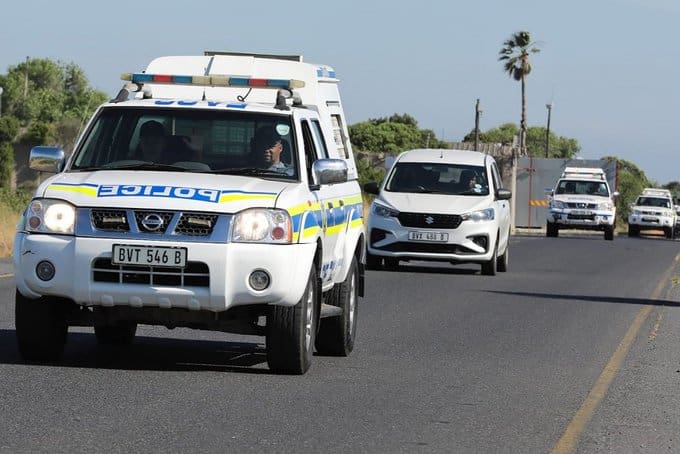
The suspected shooter, who police say was known to the victims, fled the scene before officers arrived. A manhunt is currently underway, with roadblocks established on the R31 and N14 highways leading out of the John Taolo Gaetsewe District Municipality.
Domestic Violence at the Heart
While the forensic investigation is still in its early stages, police have classified the incident as stemming from an apparent domestic dispute.
“This was not a random act of violence,” Colonel Motaung emphasized. “The individuals involved were known to each other. Evidence gathered at the scene suggests that an argument escalated rapidly, culminating in the discharge of a firearm. We are treating this as a domestic violence-related multiple homicide.”
The classification has struck a particular nerve in the Northern Cape, a province that has consistently recorded some of the highest rates of gender-based violence and femicide in South Africa. According to the latest quarterly crime statistics, the province saw a 12% increase in domestic violence-related murders compared to the same period last year.
“We are failing each other,” said Maria Klaaste, a community activist who runs a women’s shelter in nearby Kathu. “Every Sunday, somewhere in this province, a family is burying someone who died at the hands of someone who claimed to love them. Olifantshoek is no different—only this time, the whole town is bleeding.”
A Community in Shock
By Monday morning, Olifantshoek had transformed. The usual chatter outside the Spar supermarket was muted. At the Thusong Community Centre, a small crowd had gathered, clutching photographs of the deceased and whispering prayers into the dry air.
“I heard the shots from my house,” said Nomsa Dlamini, a 54-year-old grandmother who lives three streets from the scene. “I thought it was late fireworks. Then I heard screaming—a woman screaming like I have never heard in my life. I went outside, and people were running. Children were crying. In twenty years in this town, I have never seen such fear.”
The owner of the property where the shooting occurred, who asked not to be identified, stood outside the cordoned-off yard on Monday morning, staring at the police tape fluttering in the hot wind.
“It was supposed to be a happy day,” she whispered. “We were celebrating life. Now I have to look at that floor every day for the rest of my life.”
The Investigation Continues
Police have appealed to anyone with information about the whereabouts of the suspected shooter to come forward. A dedicated task team has been assembled, combining resources from the Olifantshoek Detective Unit, the provincial Serious and Violent Crimes unit, and the Family Violence, Child Protection and Sexual Offenses unit.
“We believe the suspect may still be in the broader John Taolo Gaetsewe District,” said Brigadier Riaan Smith, who arrived from Kimberley to oversee the investigation. “We are appealing to anyone who may be harboring him to reconsider. Assisting a fugitive is a criminal offense. We will find him.”
Meanwhile, the family of the deceased are preparing to travel from as far as Upington and Kuruman to identify the bodies—a journey no family should have to make.
“Two families have been destroyed in one night,” said local councilor Daniel Jantjies. “And for what? A moment of rage? A drink too many? A history of pain that no one spoke about? We need more than investigations. We need interventions. We need to ask ourselves, as men, as neighbors, as a community, why this keeps happening.”
A Grim Pattern
The Olifantshoek shooting is the third multiple-fatality incident in the Northern Cape in 2026, following a mass stabbing in De Aar in February and a shooting in Postmasburg in March. Premier Dr. Zamani Saul is expected to issue a statement later in the week, and the provincial government has offered counseling services to witnesses and affected families.
For now, the red dust of Olifantshoek settles once more. But the stains on the ground outside the cordoned home are not red from iron ore. They are red from blood. And the community knows, with a heavy and weary heart, that some stains do not wash away.
As dusk fell on Monday, a small group of women gathered at the scene. They lit candles—not in protest, not in politics—just in prayer. One of them, an elderly woman in a faded doek, held a handwritten sign made from a torn cardboard box.
It read: “Stop killing us. Stop killing each other. We have buried enough.”
The investigation continues. The manhunt continues. And in a small mining town on the edge of the Kalahari, a people continue to ask a question that has no easy answer: When will the violence end?
About The Author