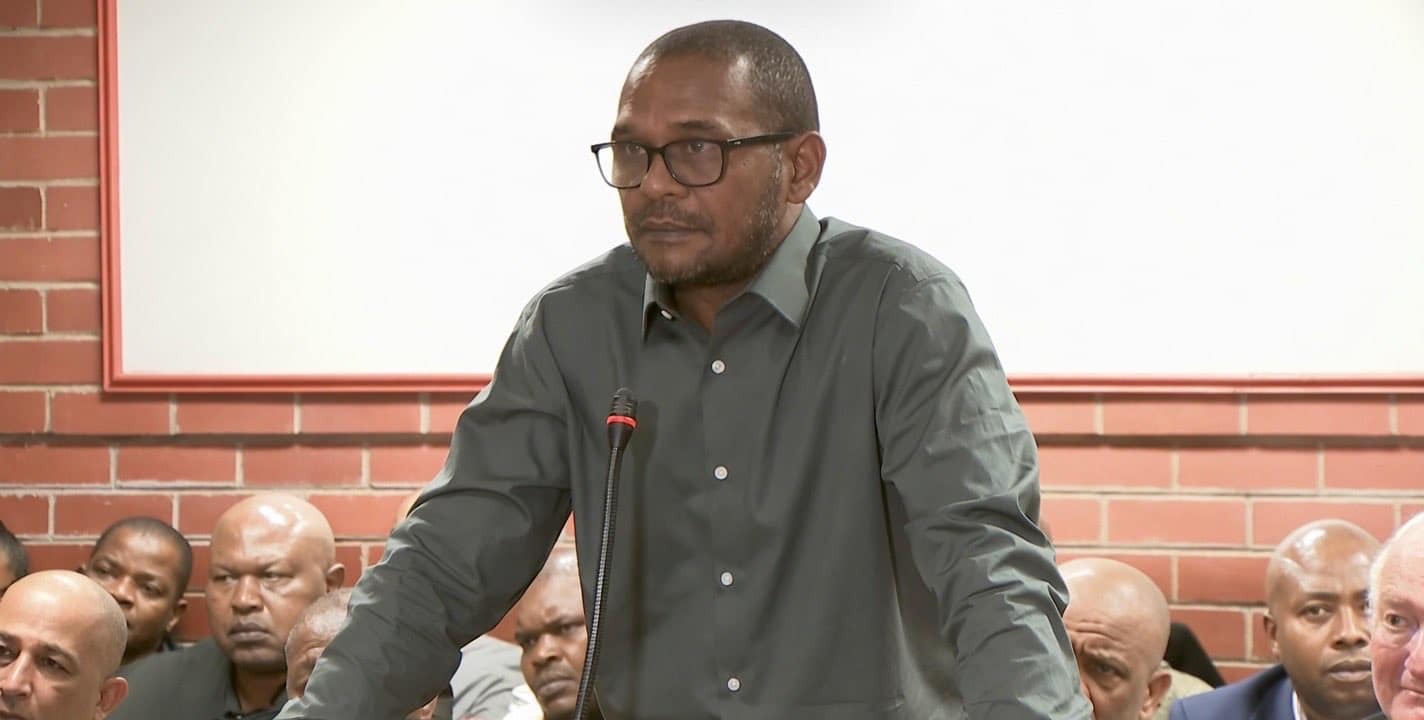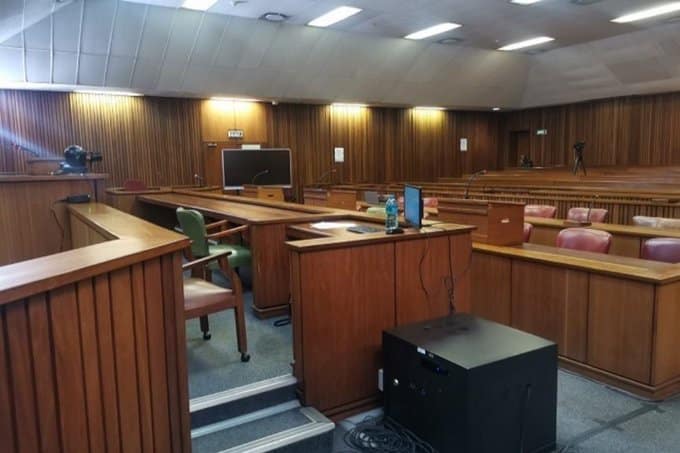
JOHANNESBURG – The heavy oak doors of the Johannesburg High Court, temporarily converted into the chamber of the Madlanga Commission of Inquiry, swung open on Thursday morning to a familiar, yet deeply unsettling, sight. Brigadier Julius Mkhwanazi, his posture rigid and his uniform stripped of the insignia that once commanded thousands of officers, took his place in the witness stand. For the second time this month, the suspended deputy chief of the Ekurhuleni Metropolitan Police Department (EMPD) was back in the hot seat.
But the air in the room was different this time. The preliminary pleasantries were over. The commission’s lead legal counsel, Advocate Thando Dlamini, had dispensed with the procedural questions. Today was about the blood.
At the center of the inquiry lies the ghost of Emmanuel Mbense, a 34-year-old father of two who vanished on a rainy Tuesday night in September 2022. His body was found five days later, floating face-down in the murky waters of the Blesbokspruit Dam, some 40 kilometers from where he was last seen alive. The post-mortem report, which has haunted the commission for weeks, described a catalogue of horrors: blunt-force trauma to the skull, ten broken ribs, defensive wounds on both forearms, and ligature marks around the wrists and ankles. The official cause of death was drowning—but the pathologist noted that Mbense was likely unconscious, if not already dead, when he hit the water.
“Brigadier Mkhwanazi,” Advocate Dlamini began, his voice echoing off the high ceilings, “let me be direct. Cell phone tower records place you at the Vosloorus police holding cells at 2:13 AM on the night Mr. Mbense disappeared. His cell phone last pinged a tower adjacent to those cells at 2:17 AM. Did you see him?”
Mkhwanazi, his jaw clenched, leaned into the microphone. “I was there on official EMPD business, a joint operation with SAPS. I saw no civilian detainees.”
The answer was crisp, rehearsed. But the commission had come armed with a witness.
That witness, a former Vosloorus constable now in protective custody under the alias “Mr. Zondo,” had testified via a video link the previous week. He claimed he saw Mkhwanazi personally remove a hooded figure from a holding cell, a man whose description matched Mbense. According to Mr. Zondo, Mkhwanazi handed the man over to three plainclothes individuals in an unmarked white Toyota Quantum—a vehicle later traced to a private security company with a history of unlawful arrests.
The commission’s screen flickered to life, displaying a grainy, black-and-white still from a municipal traffic camera. It showed a vehicle matching the Quantum’s description crossing the R554 highway at 3:45 AM, heading toward the industrial district where the dam is located.
“Brigadier, you have denied any involvement in the transfer, the torture, or the disposal of Mr. Mbense’s body,” Dlamini pressed, adjusting his glasses. “Yet your personal cell phone was switched off for precisely four hours—from 1:00 AM to 5:00 AM—on that night. The only gap in your digital footprint in six months. Why?”
For the first time, Mkhwanazi’s composure cracked. He shifted in his seat, the leather squeaking under his weight. “I… I was experiencing technical difficulties. A software update.”
A low murmur rippled through the public gallery, where Mbense’s widow, Nomsa, sat clutching a tattered photograph of her husband. She did not weep. She had run out of tears months ago. Instead, she stared at the back of the brigadier’s head with a cold, unwavering focus.
The commission then presented a new piece of evidence: a torn piece of fabric, still stained with a mixture of soil and blood, found snagged on a submerged rock at the edge of the dam. Forensic analysts had matched the fabric’s weave and dye lot to a batch of standard-issue EMPD tactical gloves—gloves that had been requisitioned by Mkhwanazi’s own unit three weeks before Mbense’s death.
Advocate Dlamini leaned forward, his voice dropping to a near whisper that still managed to fill the entire chamber. “The gloves you signed for, Brigadier. The van seen on your route. The four-hour blackout. And a dead man whose fingers were broken one by one before he was thrown into freezing water. Are you telling this commission that this is all just a ‘technical difficulty’?”
Mkhwanazi’s lawyer shot to his feet, objecting to the “inflammatory language.” But the commission’s chairperson, retired Justice Madlanga, waved him down. “Overruled. The witness will answer.”
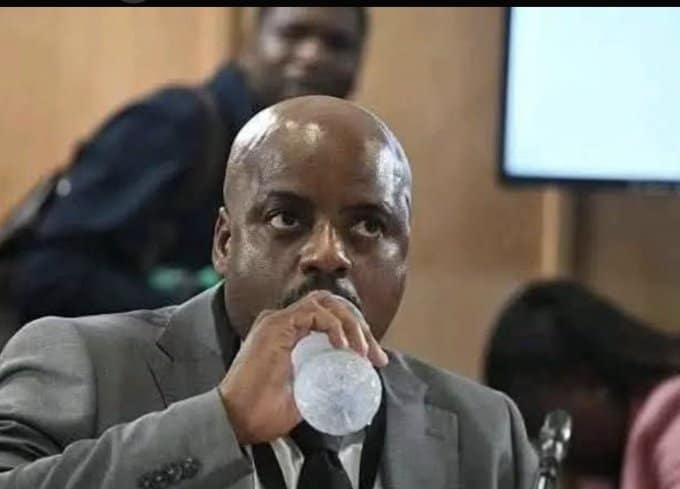
Mkhwanazi reached for a glass of water. His hand trembled, sloshing a few drops onto the polished wood. He drank, set the glass down, and finally met the advocate’s eyes.
“I am a decorated officer,” he said, his voice hoarse. “I have served this city for 22 years. I did not kill Emmanuel Mbense.”
He did not say he had no knowledge of the killing. He did not deny handing over a detainee. He merely denied the act of murder itself. It was a lawyer’s dodge, a narrow plank to stand on in a rising flood of evidence.
As the clock struck noon, Justice Madlanga called for a recess. Mkhwanazi was led out a side door, his shoulders hunched for the first time. In the gallery, Nomsa Mbense finally rose. She walked to the front row and laid the photograph of her husband on the edge of the advocate’s table.
Outside, a small crowd of protesters had gathered behind police barricades. They held signs that read: “Who Polices the Police?” and “Justice for Emmanuel.” A light rain began to fall, smearing the ink on the posters.
The commission will reconvene on Monday. But the question hanging over the courtroom, heavier than the storm clouds gathering over Johannesburg, is no longer whether Brigadier Julius Mkhwanazi was involved. It is whether the system he swore to protect will finally hold him accountable—or if Emmanuel Mbense’s drowning will become just another cold case, buried in a deep, dark dam of official silence.
About The Author