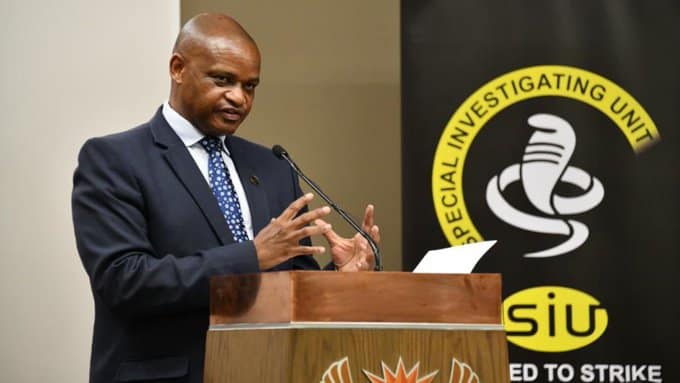
In a decisive move that underscores the Special Investigating Unit’s (SIU) widening crackdown on corruption in the skills development sector, the unit has issued a formal demand that Rubicon Communications repay R2.7 million in public funds that were misappropriated from a program intended to upskill 100 vulnerable learners.
The order, signed by SIU head Advocate Andy Mothibi and delivered to Rubicon Communications’ registered address earlier this week, represents the latest salvo in a broader investigation into the abuse of training grants administered by the Sector Education and Training Authorities (SETAs). In this case, the funds originated from the Media, Information and Communication Technologies Sector Education and Training Authority (MICT SETA), which had allocated the money specifically for the training of young South Africans in critical digital and communications skills.
“Public funds allocated for skills development are not a slush fund,” Mothibi said in a statement accompanying the repayment order. “They are an investment in the future of this country’s youth. When an entity diverts those funds for purposes other than training—whether through inflated invoices, phantom learners, or outright misrepresentation—the SIU will act decisively to recover every cent and, where appropriate, pursue criminal prosecution.”
The Training That Wasn’t
According to investigative reports obtained by the SIU and reviewed by this publication, Rubicon Communications was contracted by the MICT SETA in 2021 to provide a year-long training program for 100 learners. The curriculum was to include cloud computing fundamentals, digital marketing, network security, and data analytics—skills that are in high demand in South Africa’s growing digital economy but remain out of reach for many young people from disadvantaged backgrounds.
Each learner was to receive a combination of classroom instruction, online modules, workplace exposure, and a modest stipend to cover transport and meals. The total contract value was R3.2 million, of which R2.7 million had been disbursed by the time the SIU’s forensic auditors began their review.
The trouble, investigators discovered, began almost immediately after the funds were transferred.
“Rubicon Communications submitted attendance registers, assessment results, and completion certificates for 100 learners,” said a senior SIU investigator who spoke on condition of anonymity because the probe is ongoing. “But when we cross-referenced those names with the MICT SETA’s learner database, we found significant discrepancies. Some of the ‘learners’ had never enrolled in any training program. Others had been registered for completely different courses at different institutions. And in at least twelve cases, the identity numbers provided belonged to individuals who had died before the training period even began.”
Further forensic analysis revealed that the attendance registers appeared to have been forged. Signatures were duplicated across multiple dates. The same handwriting appeared under different names. And the venue where the training was supposedly held—a rented office space in Midrand—had no record of Rubicon Communications ever booking the facility.
“What we found was not a case of administrative sloppiness,” the investigator continued. “This was a deliberate, systematic scheme to claim public money for services that were never rendered. The learners—the 100 young people who were supposed to gain skills and find jobs—never existed. Or rather, they existed only on paper.”
The Phantom Learners
The SIU’s investigation identified a pattern: Rubicon Communications would submit a list of 100 learner names to the MICT SETA, receive the funding, and then either provide substandard training to a fraction of that number or, in some cases, no training at all. The balance of the funds was then funneled into accounts linked to directors, family members, and shell companies.
In one particularly egregious example, the SIU traced R450,000 to a luxury car dealership in Sandton, where a Rubicon Communications director had purchased a BMW sedan. In another, R280,000 was transferred to a company that listed its business address as a residential house in Soweto—a house that, upon inspection, had no computers, no training materials, and no evidence of any educational activity.
“We are not talking about a small business that made an honest mistake,” said Advocate Mothibi. “We are talking about a company that saw a government training contract as an opportunity to enrich itself at the expense of unemployed youth. The learners who should have received those skills are still waiting. Some of them may have given up on finding work entirely. That is the true cost of this fraud.”
Rubicon Communications’ Response
Reached for comment, Rubicon Communications issued a brief statement through its legal representatives denying any intentional wrongdoing and asserting that the company “acted in good faith throughout the duration of the contract.”
“The COVID-19 pandemic created significant disruptions to training delivery, and some of the record-keeping may have fallen below the required standard,” the statement read. “However, Rubicon Communications denies any fraudulent intent and will explore all available legal avenues to challenge the SIU’s findings and the repayment order.”
The company did not respond to specific questions about the phantom learners, the forged attendance registers, or the luxury car purchase.
Legal analysts note that challenging an SIU repayment order is difficult but not impossible. The company would need to demonstrate either that the SIU’s factual findings are incorrect or that the funds were, in fact, used for legitimate training purposes. Given the detailed forensic evidence presented in the SIU’s report, Rubicon Communications faces an uphill battle.
“The SIU does not issue these orders lightly,” said legal expert Nthabiseng Mokoena, a partner at a Johannesburg firm specializing in public finance litigation. “They have a team of forensic auditors, data analysts, and investigators who build a case over months. By the time the repayment order lands on the CEO’s desk, the SIU is usually very confident in its evidence. Rubicon Communications can fight this, but they will need more than a ‘good faith’ defense. They will need to produce the learners.”
The Broader Context: SETA Fraud Epidemic
The Rubicon Communications case is not an isolated incident. Over the past five years, the SIU has investigated more than R3 billion in irregular or fraudulent spending across South Africa’s 21 SETAs, which collectively disburse billions of rand annually in skills development levies collected from employers.
Notable cases include:
- The Estina Dairy Farm scandal (Free State), where R280 million in training funds were diverted to a politically connected project that delivered minimal training and zero sustainable jobs.
- The Ithuteng Training Academy case (Gauteng), where directors were arrested for claiming R47 million for training that never occurred.
- The multiple whistleblower complaints across the transport, manufacturing, and wholesale SETAs, alleging that training providers routinely inflate learner numbers, submit falsified portfolios of evidence, and pay kickbacks to SETA officials to approve fraudulent claims.
“We have a systemic problem,” said David van Wyk, a researcher at the Centre for Environmental Rights who has studied SETA corruption for years. “The skills development levy system was designed to address South Africa’s crippling unemployment and skills shortage. Instead, it has become a honey pot for fraudsters. Companies like Rubicon Communications know that SETAs are understaffed, overstretched, and often lack the forensic capacity to scrutinize claims in real time. So they submit plausible-looking paperwork, cash the cheque, and disappear. By the time the auditors arrive, the money is gone.”
The Learners Left Behind
Beyond the financial irregularities, the Rubicon Communications case raises a painful human question: what happened to the 100 learners who were promised training?
The SIU’s investigation has attempted to trace them, with limited success. Of the names provided by Rubicon Communications, only 23 could be definitively identified as real individuals. Of those, just 11 reported receiving any training at all—and those who did described it as “basic,” “unprofessional,” and “not what we were promised.”
One young woman, who asked to be identified only as Precious, told investigators that she had attended three “workshops” at a cramped office in Johannesburg. “They gave us photocopied slides and told us to read them,” she said. “There was no computer. No internet. No actual teaching. After the third session, they stopped calling me. I never got a certificate. I never got the stipend they promised. I just wasted my time.”
Another learner, a 24-year-old man from Tembisa named Thabo, said he had been recruited through a friend who knew someone at Rubicon Communications. “They said we would learn coding and get a job at the end,” he recalled. “I was so excited. I told my mother I would finally be able to help pay the rent. Then nothing. The phone numbers stopped working. The office was empty. I felt like a fool.”
For Precious, Thabo, and the dozens of other young people who were promised skills but received only disappointment, the SIU’s repayment order is cold comfort. The money may be recovered—though civil litigation against Rubicon Communications could take years—but the lost opportunity cannot be reclaimed.
“I don’t care about the R2.7 million,” Thabo said when reached by phone. “I care about the six months I wasted waiting for a call that never came. I could have been learning something else. I could have been working somewhere else. Now I am still at home, still unemployed, still trying to explain to my mother why I don’t have a job.”
What Happens Next
The SIU’s repayment order is legally binding. Rubicon Communications has 30 days to either repay the R2.7 million or provide a written undertaking, supported by evidence, that it will repay the amount in installments. Failure to comply will result in the SIU approaching the Special Tribunal—a dedicated court that hears SIU cases—to obtain a judgment against the company.
If the Special Tribunal rules in the SIU’s favor, the judgment can be enforced through asset seizures, bank account garnishments, or liquidation proceedings. Directors of Rubicon Communications could also be held personally liable if the SIU can demonstrate that they knowingly participated in or benefited from the fraudulent conduct.
Beyond the civil recovery, the SIU has confirmed that its investigation is ongoing and that a criminal referral to the National Prosecuting Authority (NPA) is being prepared. If the NPA decides to prosecute, directors of Rubicon Communications could face charges of fraud, theft, and money laundering—offenses that carry potential sentences of 15 years to life imprisonment.
“The SIU does not only recover money,” Mothibi emphasized. “We also build criminal cases. The repayment order is the first step. It tells the company: return what you stole. The second step, if the evidence warrants it, is handcuffs.”
A Call for Reform
Anti-corruption advocates have seized on the Rubicon Communications case to renew calls for structural reform of the SETA system. Proposals include:
- Real-time verification of learner registration, using biometric data or digital identity verification to ensure that funds are only released for real people.
- Independent, unannounced site visits to training venues, conducted by SIU or Auditor-General staff, to verify that training is actually taking place.
- Public blacklisting of fraudulent training providers, preventing them from bidding on any future government contracts.
- Whistleblower protections and rewards, encouraging insiders at training companies and SETAs to report suspicious activity.
“The Rubicon Communications case is a symptom, not the cause,” said Van Wyk. “Until we fix the underlying incentives and weak oversight, there will always be another company ready to exploit the system. The question is whether the government has the political will to act on the lessons of these investigations.”
For now, the SIU’s message to Rubicon Communications—and to every other training provider tempted to treat public funds as private loot—is clear: pay back what you stole, or face the full weight of the law.
As Advocate Mothibi put it in his closing remarks: “Skills development is not a favor to the unemployed. It is a constitutional obligation. Every rand stolen from a learner is a rand stolen from South Africa’s future. We will not look away.”
About The Author