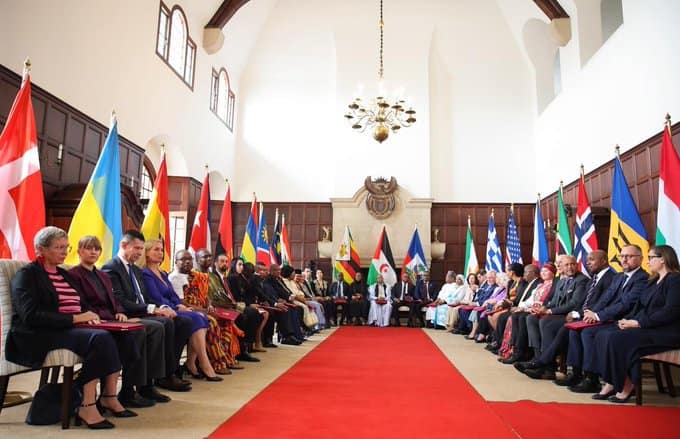
Against the backdrop of fluttering South African and Cuban flags, President Cyril Ramaphosa today formally received the Letters of Credence and Recall from Cuba’s newly appointed Head of Mission-Designate, His Excellency Fakri Rodriguez Pinelo, during a dignified credentials ceremony at the Sefako M. Makgatho Presidential Guesthouse in Pretoria.
The ceremony, steeped in diplomatic tradition, marked the official beginning of Ambassador Pinelo’s tenure as Cuba’s top diplomat to South Africa. It also served as a powerful reaffirmation of the decades-old bond between the two nations—a relationship forged not in boardrooms or trade agreements, but on the battlefields of southern Africa where Cuban troops fought alongside ANC liberation forces against apartheid-era colonialism.
“Your Excellency, you arrive in our country at a time when the historic ties of friendship and solidarity between South Africa and Cuba are as important as ever,” President Ramaphosa said as he accepted the credentials. “We welcome you not merely as a diplomatic representative, but as a bearer of a shared legacy of sacrifice, resistance, and the relentless pursuit of human dignity.”
A Ceremony of Symbolism
The credentials ceremony, while governed by strict protocol, was infused with moments of deep symbolism. Ambassador Pinelo, dressed in a dark suit with a small Cuban flag pin on his lapel, arrived at the guesthouse in a diplomatic motorcade shortly before 10 a.m. He was greeted by a guard of honour from the South African National Defence Force (SANDF) before being escorted inside for a private audience with the President.
During the private meeting, which lasted approximately 25 minutes, Pinelo formally presented two documents: his Letter of Credence, which authorizes him to represent the Cuban government, and his Letter of Recall, which formally ends the tenure of his predecessor, Ambassador Rodolfo Benítez Verson, who has returned to Havana after completing his diplomatic tour.
President Ramaphosa, in turn, accepted the documents with a warm handshake and a brief embrace—a gesture that, in diplomatic circles, signaled more than mere courtesy. It spoke of a relationship that transcends formalities.
“We do not need to read from scripts when we speak to our Cuban friends,” Ramaphosa later told the small gathering of officials and journalists. “We speak from the heart. We speak as comrades who walked a long and difficult road together. That road is not behind us—it continues ahead of us.”
Ambassador Fakri Rodriguez Pinelo: A Diplomat with Deep Roots
Ambassador Pinelo is no stranger to South Africa. A career diplomat with over two decades of service in Cuba’s Ministry of Foreign Affairs, he previously served as First Secretary at the Cuban Embassy in Pretoria between 2005 and 2009. Those who worked with him describe a man who understands South Africa’s complexities—both its triumphs and its ongoing struggles.
“Fakri knows South Africa,” said a senior official at the Department of International Relations and Cooperation (DIRCO) who spoke on condition of anonymity. “He knows our people. He knows our politics. He knows our pain. That is invaluable. He is not arriving as a stranger. He is coming home.”
Pinelo’s appointment comes at a critical juncture for Cuba. The island nation continues to endure the effects of the United States’ long-standing economic embargo, which was tightened significantly during the Trump administration and has only been modestly adjusted under President Joe Biden. The embargo, combined with the COVID-19 pandemic’s devastating impact on Cuba’s tourism-dependent economy, has left the country facing shortages of food, medicine, fuel, and basic goods.
In his brief remarks following the credentials ceremony, Pinelo acknowledged the challenges facing his homeland but struck a defiant and optimistic tone.
“Cuba does not break. Cuba does not beg. Cuba fights,” he said, his voice steady. “We have fought for over six decades against a blockade that has cost our people billions of dollars. We have fought against hurricanes, against pandemics, against those who wish to see us fail. And we have survived. We have survived because of the solidarity of friends like South Africa. I am here to deepen that solidarity, to build new bridges, and to ensure that the relationship between our two nations grows stronger, not weaker, in the years ahead.”
The Historical Bond: From Cuito Cuanavale to COVID-19
The relationship between South Africa and Cuba is unlike any other bilateral relationship Pretoria maintains. It is rooted not in trade or investment—though those exist—but in blood.
Between 1975 and 1991, Cuba deployed an estimated 375,000 soldiers to Angola in support of the MPLA government against South African-backed UNITA rebels and the apartheid-era South African Defence Force (SADF). The decisive Battle of Cuito Cuanavale in 1987-1988 is widely regarded as a turning point in southern African history, leading to the withdrawal of South African troops from Angola and paving the way for Namibia’s independence and, ultimately, the dismantling of apartheid.
Fidel Castro once famously said that Cuba’s intervention in Africa was “the most beautiful cause ever fought for.” Nelson Mandela, in his first international trip as a free man, traveled to Havana in 1991 to thank the Cuban people personally.
“What other country can point to a relationship like this?” asked Professor Adekeye Adebajo, director of the Institute for Pan-African Thought and Conversation. “South Africa and Cuba share a liberation narrative that is unique. It is not about money. It is about mutual respect, shared sacrifice, and a common vision for a world without colonialism and racial oppression.”
In recent years, that solidarity has been tested and proven again. During the COVID-19 pandemic, Cuba sent over 2,000 medical personnel to South Africa to help the country battle the virus—a gesture that Ramaphosa publicly described as “an act of true internationalism and human solidarity.”
“We will never forget that when the world turned inward, when wealthy nations hoarded vaccines and closed their borders, Cuba opened its heart and sent its doctors,” Ramaphosa said at a joint press conference in 2021. “That is not just friendship. That is family.”
What Lies Ahead: Challenges and Opportunities
Ambassador Pinelo’s tenure will not be without challenges. South Africa and Cuba share a number of pressing bilateral issues that will require careful diplomacy:
- Economic Cooperation: While political ties are strong, economic ties remain relatively underdeveloped. Two-way trade between South Africa and Cuba is modest, estimated at approximately R500 million annually. Pinelo is expected to push for increased South African investment in Cuban tourism, biotechnology, and renewable energy sectors, while also exploring opportunities for Cuban medical and educational professionals to work in South Africa.
- The US Embargo: South Africa has consistently voted at the United Nations to condemn the US embargo against Cuba, but Pretoria’s ability to influence US policy is limited. Pinelo will likely seek to mobilize South Africa’s diplomatic weight—particularly within the BRICS grouping and the African Union—to intensify pressure on Washington to lift sanctions.
- Debt and Development: Cuba owes South Africa an estimated R400 million in outstanding debt from various development projects. The Cuban government has requested restructuring or forgiveness, a sensitive issue for South Africa’s treasury. Pinelo will need to navigate this quietly while seeking new forms of cooperation that do not add to Cuba’s debt burden.
- Domestic Politics in South Africa: While the ANC government remains staunchly pro-Cuba, opposition parties have occasionally criticized the relationship. The Democratic Alliance (DA) has called for a “reassessment” of South Africa’s ties with Cuba, citing human rights concerns. Pinelo will need to build bridges across South Africa’s political spectrum to ensure that the relationship enjoys broad-based support.
A Warm Welcome from DIRCO
South Africa’s Department of International Relations and Cooperation (DIRCO) welcomed Pinelo’s arrival with a statement praising his “deep understanding of South Africa’s foreign policy priorities.”
“Ambassador Pinelo is a seasoned diplomat who has served his country with distinction in multiple postings across the world,” said DIRCO spokesperson Clayson Monyela. “We look forward to working with him to advance the shared interests of South Africa and Cuba, both bilaterally and on the global stage.”
The statement also noted that South Africa remains “unwavering in its call for an end to the economic, commercial, and financial blockade imposed by the United States against Cuba.”
The Ceremony’s Final Moments
After the private audience and the formal acceptance of credentials, President Ramaphosa and Ambassador Pinelo walked together into the guesthouse’s sunlit reception hall, where a small gathering of diplomats, government officials, and members of the Cuban community in South Africa had assembled.
The two men posed for photographs, their hands clasped in a firm handshake, before sharing what appeared to be a lighthearted private joke that drew smiles from both.
Speaking briefly to the gathering, Ramaphosa raised a glass of South African wine in a toast to the new ambassador.
“To Your Excellency, Ambassador Pinelo,” the President said. “May your time in our beautiful country be fruitful. May you find a second home among us. And may the ties between our two nations grow ever stronger, ever deeper, and ever more unbreakable.”
Pinelo responded in kind, raising his glass toward the President.
“To President Ramaphosa,” he said. “To the people of South Africa. And to a friendship that has weathered every storm and will weather every storm to come. Viva Cuba! Viva Sudáfrica!”
The room echoed with applause. For a brief moment, the weight of diplomatic protocol gave way to something warmer: two nations, bound by history, looking toward the future together.
Looking Ahead
Ambassador Pinelo will officially present his diplomatic credentials to the Department of International Relations and Cooperation in the coming days, after which he will begin a series of introductory meetings with South African cabinet ministers, business leaders, and civil society organizations.
His first public engagement is expected to be a wreath-laying ceremony at the Freedom Park Heritage Site, where he will honor the South Africans and Cubans who lost their lives in the struggle against apartheid and colonialism.
For now, however, the ceremony at Sefako M. Makgatho Presidential Guesthouse stands as a quiet but powerful reminder: some diplomatic relationships are built on treaties and trade. Others are built on something far more enduring.
South Africa and Cuba share the latter kind—and with Ambassador Pinelo now formally in place, that bond has found a new custodian.
About The Author