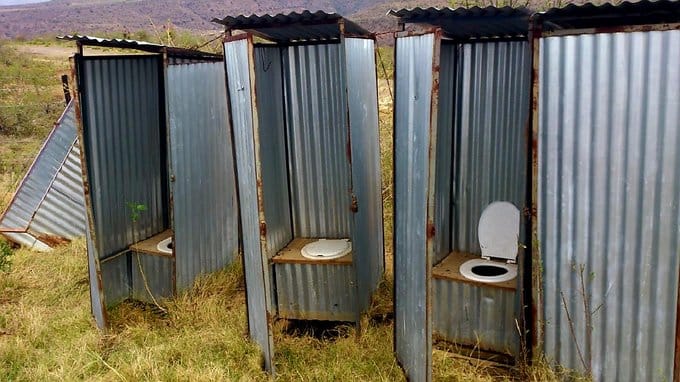
The children of Babheke Primary School used to know the drill. When nature called, they would walk carefully across the dusty playground to a row of crumbling concrete slabs, each one covering a dark, foul-smelling hole in the ground. They would hold their breath. They would try not to look down. They would finish quickly and run back to class. And every day, they would pray that the worn wooden plank beneath their feet would not snap.
For more than 50 years, that was the reality. Generations of learners—mothers, fathers, and now their children—had used the same pit latrines. Some had fallen in. Some had been pulled out by teachers. Some had simply stopped drinking water during the school day to avoid the ordeal altogether.
Today, those prayers have been answered.
Private sector organisations have stepped forward to help replace dangerous pit latrines at schools across the Eastern Cape, giving learners safer and more dignified toilet facilities after years of risk and discomfort. The latest school to benefit is Babheke Primary School in Lusikisiki, a rural town in the OR Tambo District, where new modern facilities have been built to end the use of unsafe pit toilets that have been in place for over half a century.
“We have waited so long for this,” said Babheke’s principal, Nokuzola Makhubalo, standing outside the new toilet block on a bright Wednesday morning. “Fifty years. Two generations of children. Some of our current learners are the grandchildren of children who sat in these same classrooms, using these same holes in the ground. That is not progress. That is neglect. But today, that neglect ends.”
The new facilities—a clean, tiled block of flush toilets connected to a septic system, with separate sections for boys, girls, and staff—represent more than just an infrastructure upgrade. They represent a shift in how the Eastern Cape’s rural schools are being supported, and a recognition that government alone cannot solve a crisis that has claimed too many young lives.
The Pit Toilet Crisis: A National Shame
South Africa’s pit toilet crisis is one of the most enduring and shameful legacies of apartheid-era infrastructure neglect. In 2025, despite decades of democracy and billions of rands spent on school infrastructure, hundreds of schools—the vast majority in the Eastern Cape and KwaZulu-Natal—still rely on basic pit latrines.
The dangers are not theoretical. Since 2014, at least six young children have died after falling into pit latrines at South African schools. The most famous case is that of five-year-old Michael Komape, who drowned in a pit toilet at Mahlodumela Primary School in Limpopo in 2014. His family fought for years for justice, and his name became a rallying cry for the “pit toilets must fall” movement.
But Michael is not alone. In 2018, five-year-old Lumka Mkhethwa died after falling into a pit toilet at Luna Primary School in the Eastern Cape. In 2020, three-year-old Thandolwami Hlobo died in a similar incident at a school in the same province. Each death sparked outrage. Each death prompted promises. And yet, years later, pit toilets remain.
“It is a national disgrace,” said education activist Hendrick Makaneta of the Pit Toilets Must Fall campaign. “We have the Constitution. We have the Basic Education Laws Amendment Act. We have court orders. We have millions in allocated budgets. And still, children are using holes in the ground. The government has failed. That is why the private sector had to step in.”
The Private Sector Response: A Partnership for Dignity
The intervention at Babheke Primary is part of a broader initiative launched in 2023 called “Dignity in Every Drop,” a partnership between several private sector organisations, including the Nelson Mandela Foundation, the DG Murray Trust, and a consortium of construction and engineering firms that have donated materials, labour, and expertise.
The initiative targets the most desperate schools—those with the oldest, most dangerous pit toilets and the least access to municipal water or sewage systems. Using a mix of corporate social investment (CSI) funding and individual donations, the partnership has so far built or upgraded toilet facilities at 34 schools across the Eastern Cape, with plans to reach 100 schools by the end of 2026.
“We realised that waiting for government was not working,” said Thabo Mogale, project coordinator for the initiative. “Budgets were being cut. Tenders were being delayed. Contractors were being paid but not delivering. And children were paying the price with their lives. So we asked ourselves: what can we do, right now, with the resources we have? And we got to work.”
At Babheke Primary, the work took six weeks. A team of 15 local contractors, hired and paid by the private sector partners, demolished the old pit latrines, filled in the holes with compacted earth, and built a new toilet block from the ground up. The new facilities include flush toilets, hand-washing stations with soap dispensers, and a small storeroom for cleaning supplies. Solar panels on the roof power a pump that draws water from a newly drilled borehole, ensuring that the toilets will remain functional even during the frequent municipal water outages that plague the area.
“These are not just toilets,” Mogale said. “They are a system. Water. Sanitation. Hygiene. All connected. All sustainable. That is the standard every school deserves.”
Babheke Primary: A School Transformed
Babheke Primary School, nestled among rolling green hills dotted with cattle and maize fields, serves 312 learners from Lusikisiki and surrounding villages. Many of the children walk more than an hour to reach the school, often arriving hungry and tired. The lack of safe toilets only added to their burden.
Before the new facilities were built, the school’s pit latrines were a source of constant anxiety for teachers and parents alike. The concrete slabs were cracked. The wooden covers were rotting. During heavy rains, the pits would overflow, sending foul water across the playground. Several children had slipped on the wet concrete, though miraculously, none had fallen in.
“I used to have nightmares about it,” said teacher Nomsa Dlamini, who has taught at Babheke for 12 years. “I would dream that a child had fallen, and I could not get them out in time. I would wake up sweating. I know I was not the only teacher who had those dreams. We all did. We all lived in fear.”
That fear is now gone. The new toilet block, painted a cheerful yellow and blue, stands at the edge of the playground, visible from every classroom. The doors have sturdy locks. The floors are non-slip. The windows have screens to keep out insects. Signs on the walls, illustrated with simple drawings, teach children how to wash their hands properly.
“My favourite thing is the soap,” said 10-year-old Thando Mkhwanazi, a Grade 4 learner, demonstrating the pump dispenser with obvious delight. “Before, we had no soap. Sometimes we had no water. Now we have both. And it smells nice in here. Not like before. Before, it smelled like… like bad things.”
His classmate, 11-year-old Zola Ntuli, added: “I used to wait until I got home. Every day. I would hold it all day. It was very uncomfortable. Now I don’t have to wait. I can go whenever I need to. It is a small thing, but it is a big thing for us.”
The Cost of Doing Nothing
While the new toilets at Babheke are cause for celebration, the broader picture remains troubling. According to the Department of Basic Education’s latest infrastructure report, over 3,000 schools across South Africa still rely on pit latrines, with the Eastern Cape accounting for nearly half of that number. At the current rate of government delivery—roughly 200 schools upgraded per year—it would take another 15 years to eradicate pit latrines entirely.
Fifteen more years of risk. Fifteen more years of fear. Fifteen more years of children holding their breath and hoping the planks do not break.
“We cannot wait 15 years,” said Makaneta. “Every day that passes, a child is at risk. Every day that passes, the government is failing in its constitutional obligation to provide a safe learning environment. The private sector is showing the way. But the private sector cannot do this alone. Government must step up. It must spend the money that has been allocated. It must hold contractors accountable. It must make this a national priority, not a side project.”
The Department of Basic Education has acknowledged the backlog but points to budgetary constraints and the immense scale of the challenge. In a statement responding to the private sector initiative, the department welcomed the partnerships but cautioned against “fragmented, uncoordinated interventions.”
“Sanitation in schools is a systemic issue,” the statement read. “It requires sustainable, long-term solutions, not one-off projects. The department is committed to eradicating pit toilets, but we must do so in a way that ensures ongoing maintenance, water supply, and waste management. Piecemeal solutions are not solutions.”
The private sector partners reject that criticism. “Piecemeal is better than nothing,” Mogale said. “Piecemeal saves lives. We are not waiting for the perfect, comprehensive, systemic solution. We are acting now, with what we have, where we can. And we are making a difference.”
The Community’s Response: Gratitude and Skepticism
In Lusikisiki, the reception to the new toilets has been overwhelmingly positive, but not without a note of caution. Residents have seen charitable projects come and go before—a borehole drilled that later broke, a computer lab donated that later fell into disrepair, a library built that later became a storage room. The fear is that the new toilets, too, might eventually fail if not properly maintained.
“We are grateful, very grateful,” said community elder Makhosi Ndlovu, who attended the opening ceremony. “But we also ask: who will fix the toilets when they break? Who will buy the soap when it runs out? Who will empty the septic tank when it fills? These are questions that must be answered. A toilet is not a once-off gift. It is a commitment.”
The private sector partners have anticipated this concern. Part of the “Dignity in Every Drop” initiative includes a two-year maintenance contract, funded by the same donors, to cover repairs, cleaning supplies, and septic tank servicing. The school governing body has also been trained in basic maintenance and has opened a small savings account, funded by small monthly contributions from parents, to cover long-term upkeep.
“We are not building and leaving,” Mogale said. “We are building and staying. At least for two years. After that, we hope the school and the department will be able to take over. But we are not naive. We know the system is weak. So we are putting in place as many safeguards as we can.”
The Bigger Picture: A Model for the Future?
The success of the Babheke project—and the 33 schools that came before it—has attracted attention from policymakers, philanthropists, and international development organisations. Some are asking whether the private sector partnership model could be replicated on a larger scale, not just for toilets but for other critical infrastructure: classrooms, libraries, laboratories, and admin blocks.
“It is a proof of concept,” said development economist Dr. Phumzile Ndlovu. “We have shown that with relatively modest funding, clear accountability, and strong community engagement, you can deliver high-quality infrastructure quickly and cost-effectively. That is a lesson for government. It is also a lesson for donors.”
However, Ndlovu cautioned against over-reliance on private charity. “The state has the primary obligation,” she said. “Private sector involvement should supplement, not substitute for, government delivery. The danger is that government uses these initiatives as an excuse to do less, not more. That cannot happen.”
For now, the children of Babheke Primary are not worrying about policy debates or funding models. They are using their new toilets, washing their hands with soap, and coming back to class a little lighter and a little cleaner. For them, the change is not theoretical. It is tangible. It is daily. It is dignity.
A Principal’s Prayer
As the opening ceremony drew to a close, Principal Makhubalo gathered the learners in front of the new toilet block for a photograph. The children smiled, some shyly, some broadly. A few made funny faces. A few held hands.
Makhubalo did not smile. She stood at the back, watching her learners, her eyes moist. When a reporter asked her what she was thinking, she paused for a long time.
“I am thinking about Michael Komape,” she said finally, her voice barely above a whisper. “I am thinking about Lumka Mkhethwa. I am thinking about Thandolwami Hlobo. Children who should be alive today. Children who would have loved these toilets—not because toilets are exciting, but because these toilets would have kept them safe. They never got that chance. But our children do. That is not nothing. That is everything.”
She wiped her eyes with the corner of her shawl and turned back to her learners. “Come, children,” she called out, clapping her hands. “Back to class. The toilets will still be there tomorrow. Today, we have lessons to learn.”
The children scattered, laughing, running across the playground. The new toilet block stood quietly in the afternoon sun, a small monument to what happens when private compassion meets public need. And in Lusikisiki, for one day at least, the future looked a little brighter—and a little less dangerous—than the past.
About The Author