The low-level bridge across the Komati River near the Mozambican border is a humble structure of concrete and steel, designed for dry-season crossings when the water is a gentle murmur. But on the afternoon of April 27, 2026, after three days of relentless rain had swollen the river into a churning, brown beast, that bridge became a grave.
A 59-year-old Gauteng businessman, whose name has been withheld pending positive identification, made a decision that would cost him his life. Behind the wheel of his silver Ford Ranger, he approached the submerged crossing. Witnesses later told police they saw him pause, then inch forward. The water was already lapping at his headlights. Then it was over his bonnet. Then the current took him.
The bakkie was swept sideways, tumbled once, and disappeared into the frothing torrent. The man never emerged.
What followed was a search unlike any other—a week-long battle against hippos, crocodiles, treacherous currents, and the unforgiving African bush. It ended not with a body recovered from the water, but with a helicopter, a rope, a lasso, and the dissection of a 4.5-meter Nile crocodile found basking suspiciously on a muddy bank, its belly holding a secret too grim to imagine.
The Disappearance: A Routine Trip Turns Fatal
The businessman, a married father of two from Centurion, had been returning from a weekend at a private game lodge in the Kruger National Park area. He knew the Komati crossing well—he had used it dozens of times. But April 27 was not a dry-season day. The Komati River catchment had received over 200 millimeters of rain in 72 hours, and flash floods had turned every low-water bridge between Malelane and the Mozambique border into a death trap.
His wife, speaking from their home in Gauteng, described the last phone call.
“He called me at 2:17 p.m.,” she said, her voice raw with grief. “He said the river was high but that he saw another vehicle cross. He said he would be careful. I told him to wait. I begged him to wait. He said, ‘I’ll be home for dinner.’ That was the last time I heard his voice.”
When he had not arrived by 8 p.m., she called the police. By midnight, search and rescue teams from the South African Police Service (SAPS) and the Lowveld Search and Rescue Association were on the scene. But darkness, floodwaters, and the presence of large predators made an immediate operation impossible.
The Search: A Week of Water, Wildlife, and Waiting
The search for the missing man began at first light on April 28. What unfolded over the following seven days was a logistical nightmare and a psychological ordeal for the rescue teams.
Day 1: Divers entered the murky water near the bridge but were forced to retreat when a 3-meter crocodile glided past them, uninterested but unperturbed. The current was too strong for underwater searches. Teams shifted to kayaks and boats, scanning the riverbanks downstream.
Day 2: A pair of hippos, territorial and aggressive, capsized a police inflatable boat. Two officers were thrown into the water but managed to swim to shore. Both were treated for hypothermia. No further boating was attempted.
Day 3: Pieces of the Ford Ranger began appearing. A door. A seat cushion. A tyre. But no sign of the driver. A spotlight was turned on the water at night, hoping to catch a reflection from clothing or a watch. Nothing.
Day 4: Local trackers found drag marks on a muddy bank about two kilometers downstream from the bridge—large indentations consistent with a heavy object being pulled from the water onto land. Nearby, a set of crocodile tracks, fresh and enormous. The trackers did not need to say what they suspected. The officers knew.
Day 5: An aerial drone spotted a massive Nile crocodile basking on a sandbar. The reptile, estimated at over four meters, did not move as the drone buzzed overhead. It simply lay there, belly full, jaw slightly agape. The search team took note.
Day 6: The crocodile had not moved from its sandbar. Police began discussing a grim possibility: the reptile had fed. And if it had fed, what remained of the missing man might be inside it.
The Hero: Captain Johan ‘Pottie’ Potgieter
Enter Captain Johan Potgieter—known to every officer in the province as “Pottie.” A 22-year veteran of the SAPS Air Wing, Potgieter is a man of few words and steady nerves. He has rappelled into hostage situations, extracted wounded officers from firefights, and once landed a helicopter on a moving train to rescue a kidnapped child. But even he hesitated when he heard the plan.
The operation, approved by provincial police commissioner Lieutenant General Semakaleng Daphney Manamela, was unprecedented: locate the crocodile, sedate it if possible, retrieve it, and search its stomach contents for human remains.
But the crocodile was not sedated. There was no dart gun capable of taking down an animal of that size without risking a fatal plunge into the water. Instead, Potgieter proposed something audacious.
“I said: let me fly over it. I will drop a rope. I will climb down. I will lasso the back legs and the snout. Then the helicopter lifts, and we drag it to shore.”
His commander stared at him. “You want to lasso a crocodile from a helicopter?”
Potgieter shrugged. “It’s either that or we shoot it in the water, and then it sinks, and we get nothing.”
Permission was granted.
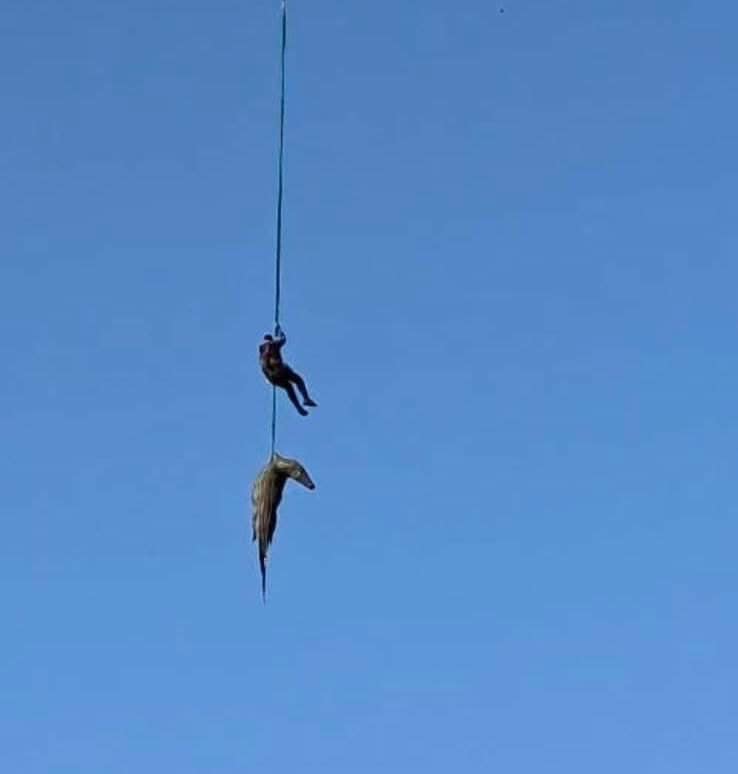
On the morning of May 4, a police helicopter hovered low over the sandbar. Potgieter, harnessed and helmeted, descended on a rope until his boots were inches above the crocodile’s back. The reptile did not move—it seemed lethargic, perhaps from a recent meal. With practiced hands, Potgieter looped a heavy nylon rope around the animal’s powerful back legs, then another around its tooth-studded snout. He signaled. The helicopter rose.
The crocodile, suddenly airborne, thrashed once—enough to break a man’s arm, but not enough to break the ropes. It was airlifted to a clearing on the riverbank, where a team of veterinarians and forensic specialists waited.
“I’ve done a lot of strange things in this job,” Potgieter said afterward, rolling a cigarette with steady hands. “But I’ve never played cowboy with a dinosaur before. That one will stay with me.”
Lieutenant General Manamela praised her officer’s heroism in a formal statement: “Captain Potgieter demonstrated extraordinary courage under perilous conditions. His actions ensured that a family may receive closure. The South African Police Service is proud to count him among our ranks.”
The Dissection: What the Crocodile Contained
Once the crocodile was secured, a veterinarian administered a lethal injection. Euthanasia, while controversial, was deemed necessary: the animal could not be released after human remains were found inside it, and it was too large and dangerous for relocation to a sanctuary.
The dissection was performed in a mobile forensic unit brought from Nelspruit. As the veterinary pathologist made the first incision, the officers present fell silent.
Inside the crocodile’s stomach: partial human remains, including bone fragments, tissue, and hair. Also found: multiple pairs of shoes—at least three, of different sizes—suggesting this was not the reptile’s first encounter with tragedy. The shoes were catalogued as evidence. It is possible the crocodile had scavenged on flood victims from previous seasons or even from across the border in Mozambique.
Forensic pathologist Dr. Elsa Venter, who oversaw the examination, described the scene as “heartbreaking but professionally necessary.”
“We cannot yet confirm the identity of the remains, but they are consistent with an adult male of approximately the missing man’s age and stature,” she said. “DNA testing will take approximately two to three weeks. The additional shoes suggest this crocodile has scavenged multiple times. That is not unusual for apex predators in flood conditions—they take what the water gives them.”
The Family’s Vigil
Back in Centurion, the missing man’s family has been living in a twilight zone between hope and despair. When news of the crocodile’s dissection reached them, his wife collapsed.
“I knew,” she told a family friend who spoke to the media. “From the third day, when they said there were drag marks, I knew. He was not coming back whole. I just want something to bury. Something to say goodbye to.”
His children, both in their twenties, have flown home from university. They have not yet spoken publicly. A family spokesperson said they are “waiting for the DNA results before making any statements.”
The community of Centurion has rallied around the family, raising over R80,000 for funeral expenses through a crowdfunding campaign. A memorial service has been tentatively scheduled for late May, but it may be postponed depending on when the remains are released for burial.
The Danger of Low-Level Bridges
The Komati River tragedy is not an isolated incident. South Africa’s low-level bridges—designed to be submerged during high water rather than washed away—are responsible for dozens of deaths each year. Drivers often misjudge the depth, the speed of the current, or their vehicle’s ability to ford floodwaters.
In the past five years, the Mpumalanga Department of Community Safety has recorded 23 fatalities at low-water crossings in the province. Most victims are local residents who know the roads but underestimate the conditions.
“There is a saying in the Lowveld,” said disaster management coordinator Piet van der Merwe. “If you cannot see the road, the road is not there. Turn around. Find another way. No appointment is worth your life.”
The South African National Roads Agency (SANRAL) has installed warning signs, barriers, and even automated gates at some high-risk crossings. But many low-level bridges remain unguarded, especially in rural areas and near the borders.
“Crocodiles are a fact of life here,” added van der Merwe. “But they are not the danger. The danger is thinking that a river is your enemy. It is not. It is simply indifferent. And indifference kills.”
The Crocodile: Apex Predator or Scapegoat?
News of the euthanized crocodile has sparked debate among conservationists and local residents. Some argue that the animal was simply behaving naturally—scavenging on an already-deceased victim—and did not deserve to be killed.
“The crocodile did not cause the accident,” said wildlife veterinarian Dr. Themba Nkosi. “The driver chose to cross a flooded bridge. The crocodile found a meal. That is nature. We should not punish an animal for being an animal.”
Police defended the decision, noting that the crocodile was too large and too dangerous to relocate safely, and that the recovery of human remains justified the euthanasia.
“This was not about revenge,” said Lieutenant General Manamela. “This was about giving a family the dignity of a burial. If that crocodile had not been feeding on a human being, it would still be alive. The circumstances are tragic for everyone—including the animal.”
The crocodile’s body has been donated to a nearby research facility, where it will be used for educational purposes.
The Hero’s Welcome
Captain Johan Potgieter returned to his base in Nelspruit to a hero’s welcome. Colleagues lined the tarmac, applauding as he stepped out of his helicopter. The provincial police commissioner pinned a commendation medal on his chest in an impromptu ceremony.
But Potgieter, a man who has seen too much death to enjoy the spotlight, deflected the praise.
“I just did my job,” he said. “The real hero is the wife who had to wait a week not knowing if her husband was dead or alive. She is the one who deserves the medal. I just caught a crocodile.”
He paused, then added: “And I hope I never have to do it again.”
What Comes Next
The DNA results are expected by late May. Once positive identification is confirmed, the remains will be released to the family. A funeral will follow.
The Ford Ranger has not been recovered. Police say the vehicle is likely buried in silt downstream and may never be found. The missing man’s family has accepted this.
“We don’t need the car,” his wife said. “We just need him. Whatever is left of him.”
In the meantime, the Komati River flows on—indifferent as ever. The low-level bridge remains closed, awaiting repairs that may take months. And somewhere in the murky waters, another crocodile has likely already taken the dead one’s place.
The cycle continues. The river does not mourn. And the police, the heroes, the heartbroken families—they are left to pick up the pieces, one lasso, one DNA test, one funeral at a time.
Epilogue: A Warning for All Seasons
If there is a lesson in the Komati tragedy, it is written in the flood markers on bridges across South Africa: Do Not Enter When Submerged. But human nature, stubborn and hopeful, ignores warnings.
“People think they are the exception,” said Potgieter, climbing back into his helicopter for another patrol. “They think, ‘It won’t happen to me.’ But the river does not know who you are. And the crocodile does not care.”
The helicopter blades began to spin. Potgieter lifted off, scanning the river below. The search, for him, is never truly over. There is always another missing person, another flood, another family waiting for answers.
And somewhere downstream, a new crocodile basks in the sun, belly empty, patience infinite.
About The Author