Suspended Ekurhuleni Metro Police Department (EMPD) deputy chief Brigadier Julius Mkhwanazi will remain behind bars after the Pretoria North Magistrate’s Court on Monday refused him bail, with his high-profile fraud and corruption case set to continue on Thursday. The decision marks a significant setback for the embattled senior officer, who has been in custody since his arrest earlier this month.
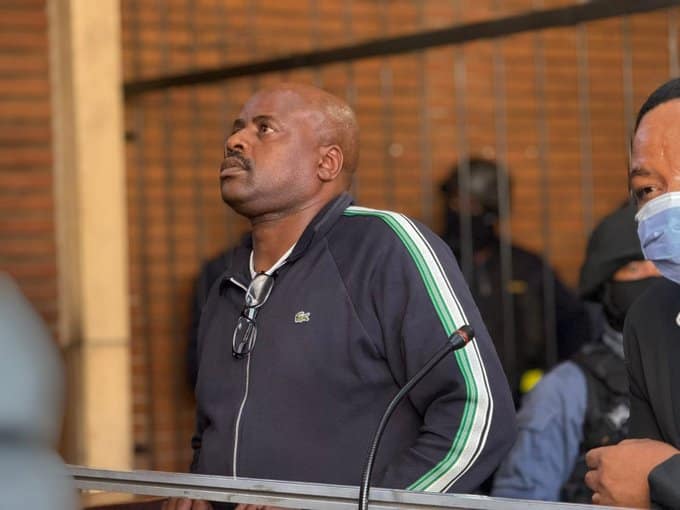
Mkhwanazi, 52, a 28-year veteran of law enforcement who rose through the ranks to become one of the most senior metro police officers in Gauteng, appeared briefly in the packed courtroom, dressed in a dark suit and tie but without the insignia of his rank. He listened intently as Magistrate Thabo Mokoena delivered the bail ruling, showing little emotion as the court ordered that he remain in custody at the Pretoria North Police Station holding cells.
The case has drawn significant public attention due to Mkhwanazi’s high-profile role in the EMPD and the serious nature of the allegations against him, which include fraud, corruption, money laundering, and contravention of the Municipal Finance Management Act. The state alleges that Mkhwanazi was part of a sophisticated network of officers and civilian contractors who siphoned millions of rands from the EMPD through fraudulent tender processes and inflated invoices for services never rendered.
The Bail Hearing: A Detailed Ruling
During Monday’s bail proceedings, state prosecutor Advocate Lerato Mogale argued forcefully that Mkhwanazi should be denied bail, citing three primary grounds: the risk of flight, the risk of interference with witnesses, and the seriousness of the charges, which carry potential sentences of up to 15 years imprisonment.
“Accused number one is a senior law enforcement officer with extensive knowledge of police procedures, access to sensitive information, and connections across multiple provinces,” Mogale told the court. “He has the means, the motive, and the opportunity to flee or to intimidate witnesses who have come forward. The state submits that no amount of bail conditions can mitigate these risks.”
Mogale also revealed that the state has gathered statements from 14 witnesses, including former EMPD colleagues, municipal officials, and employees of companies that allegedly received fraudulent tenders. Several of these witnesses, she claimed, have already expressed fear for their safety.
“These witnesses are ordinary citizens. They are not protected by police details. They live in the same communities where the accused holds influence. The state cannot guarantee their safety if the accused is released,” Mogale said.
Defense counsel, Advocate Sipho Ndlovu, argued passionately for bail, describing his client as “a decorated officer with an unblemished record until these allegations emerged.” Ndlovu proposed stringent bail conditions, including a R100,000 surety, surrender of Mkhwanazi’s passport, daily reporting to the nearest police station, and house arrest at his residence in Benoni.
“Brigadier Mkhwanazi is not a flight risk. He is a father of three, a grandfather of two, and a man who has served this country for nearly three decades. He has strong community ties and no criminal record. The state’s case is circumstantial at best,” Ndlovu argued.
However, Magistrate Mokoena was not persuaded. In his ruling, he stated: “The court acknowledges the accused’s long service record. However, the nature and seriousness of the charges, the strength of the state’s prima facie case, and the real risk of witness interference outweigh any personal considerations. Bail is denied. The accused shall remain in custody until the conclusion of his trial or until a successful bail appeal.”
The Allegations: A Web of Fraud and Corruption
The case against Mkhwanazi stems from a two-year investigation by the Hawks’ Serious Corruption Investigation Unit, which was prompted by a whistle-blower complaint in 2024. According to the state’s indictment, Mkhwanazi allegedly used his position as deputy chief of the EMPD to influence the awarding of tenders for security equipment, vehicle maintenance, and uniform supplies.
Specific allegations include:
- R12 million uniform tender (2022-2023): Mkhwanazi allegedly instructed subordinates to approve invoices from a company owned by his cousin, despite the company having no prior experience in manufacturing police uniforms. The uniforms delivered were reportedly substandard, with some batches falling apart within weeks.
- R8.5 million vehicle tracking system (2023): The state alleges that Mkhwanazi received kickbacks totaling R1.2 million from a service provider in exchange for awarding a contract for a GPS tracking system that was never fully installed. EMPD vehicles remain without the promised tracking capabilities.
- R4.2 million “consultancy” fees (2021-2024): Mkhwanazi is accused of creating a shell company in his wife’s name that invoiced the EMPD for consulting services that were never performed. Bank records allegedly show payments flowing from the company into a joint account held by Mkhwanazi and his spouse.
- R2.5 million in irregular overtime payments: The state claims that Mkhwanazi authorized overtime claims for officers who were on leave or who had already resigned, with the excess funds allegedly channeled back to him through intermediaries.
Mkhwanazi has pleaded not guilty to all 18 charges. In a statement issued through his lawyers last week, he described the allegations as “a malicious conspiracy” by rivals within the EMPD who sought to damage his reputation and derail his anticipated promotion to chief of police.
The EMPD’s Response and Institutional Fallout
The Ekurhuleni Metro Police Department has been rocked by the scandal, which has exposed deep-rooted corruption within the municipality’s law enforcement wing. EMPD Chief of Police, Major-General Anna Sithole, issued a brief statement confirming that Mkhwanazi was suspended immediately following his arrest and that an internal disciplinary process has been initiated.
“The EMPD does not tolerate corruption at any level. We are cooperating fully with the Hawks and the NPA. Brigadier Mkhwanazi is entitled to the presumption of innocence, but he must also account for his actions through the proper legal and disciplinary channels,” Sithole said.
However, sources within the EMPD, speaking anonymously for fear of retaliation, told this publication that Mkhwanazi’s arrest has created a climate of fear and uncertainty. “He was a powerful man. He had friends in high places. People are worried that if he gets bail, he will come back and punish those who spoke against him,” said one senior officer.
Another source described a culture of impunity that allegedly flourished under Mkhwanazi’s leadership. “He ran his division like a fiefdom. Contracts went to his friends. Promotions went to his loyalists. Anyone who questioned him was transferred to a rural station or buried in paperwork. We are not surprised by the charges. We are surprised it took this long.”
The City of Ekurhuleni has announced that it will conduct a full forensic audit of all EMPD contracts awarded between 2020 and 2025. Mayor Tania Campbell said: “The residents of Ekurhuleni deserve a police service that protects them, not one that preys on public funds. We will leave no stone unturned.”
The Human Cost: Families in Limbo
While the legal proceedings dominate headlines, the human cost of Mkhwanazi’s arrest is felt most acutely by his family. His wife, Thandi Mkhwanazi, who is not accused of any wrongdoing but whose name appears in the bank records linked to the shell company, has been attending court hearings in tears.
“My husband is not a criminal. He is a good man. He built schools in our community. He paid for children’s uniforms. He helped widows. Now they want to destroy him,” she told reporters outside the courthouse, her voice trembling.
The couple’s three adult children have also been thrust into the public eye. Their eldest son, a university student, has reportedly taken a leave of absence due to stress. Their youngest daughter, still in high school, has been bullied by classmates who have seen news coverage of her father’s arrest.
“People forget that there are real human beings behind these headlines,” said family spokesperson Reverend Thabo Mokoena. “Whatever the court decides, this family has already been punished. The shame, the financial strain, the public humiliation—these are not trivial things.”
What Happens on Thursday?
On Thursday, 23 April 2026, Mkhwanazi is expected to appear again in the Pretoria North Magistrate’s Court for what is officially listed as a “further case management and disclosure hearing.” The state is expected to formally hand over additional evidence, including bank statements, email correspondence, and sworn affidavits from key witnesses.
The defense has indicated that it will use Thursday’s hearing to request that certain evidence be declared inadmissible, arguing that it was obtained through “irregular means” by the Hawks. If the magistrate rules in favor of the defense, a significant portion of the state’s case could be weakened.
Alternatively, if the state’s evidence is deemed admissible, the court will likely set a date for a full trial. Given the complexity of the case and the number of witnesses involved, legal experts predict the trial could begin as early as September 2026 but could be delayed until 2027.
Mkhwanazi’s legal team has also confirmed that they will file an urgent appeal against the bail refusal, possibly as early as Wednesday. The appeal will be heard in the Gauteng High Court in Pretoria. If successful, Mkhwanazi could be released pending trial. If not, he will remain in custody for the foreseeable future.
Broader Implications: Corruption in South African Policing
The Mkhwanazi case is the latest in a series of high-profile corruption scandals to hit South African law enforcement. In the past three years, senior officers in the South African Police Service (SAPS), the Johannesburg Metro Police Department (JMPD), and now the EMPD have been arrested on charges ranging from tender fraud to bribery and money laundering.
Anti-corruption activists have welcomed the prosecution but warn that individual arrests are not enough. “We need systemic reform,” said Karam Singh of Corruption Watch. “The problem is not one bad apple. The problem is a barrel that rewards loyalty over competence, connections over integrity, and silence over accountability.”
Singh called for the establishment of an independent police ombudsman with the power to investigate and prosecute corruption within all law enforcement agencies, including municipal police departments. “Until we have external oversight, the police will continue to police themselves. And we have seen where that leads.”
A Waiting Game
As Thursday approaches, all eyes are on the Pretoria North Magistrate’s Court. Brigadier Julius Mkhwanazi, once one of the most powerful metro police officers in Gauteng, now spends his days in a holding cell, reviewing legal documents with his attorneys through a glass partition. His wife prays at home. His children avoid the news. His former colleagues whisper in corridors.
The state says it has the evidence to prove that Mkhwanazi enriched himself at the expense of the public. The defense says it has the arguments to tear that evidence apart. The magistrate will listen. The law will decide.
And on Thursday, the gavel will fall—not as a final judgment, but as another step in a long, winding journey toward whatever truth the courts can find.
About The Author