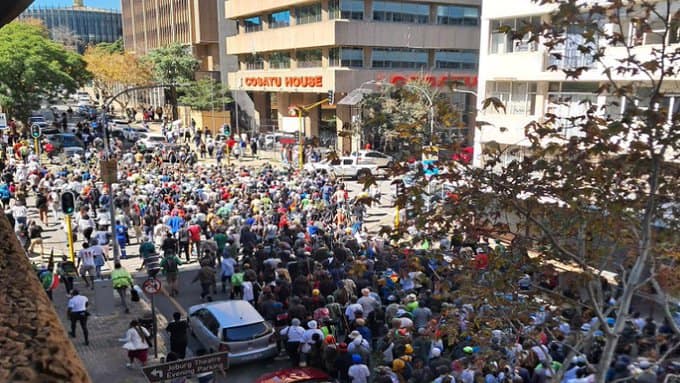
Tensions in South Africa’s economic heartland escalated dramatically on Wednesday as the grassroots activist coalition known as the March and March Movement issued a firm seven-day ultimatum to Gauteng Premier Panyaza Lesufi. After delivering a detailed memorandum of grievances to the Gauteng Provincial Legislature, the movement warned that failure to respond satisfactorily would trigger “further and significantly stronger protests” across the province.
The atmosphere outside the legislature was electric as hundreds of demonstrators, draped in red and black and carrying placards reading “Lesufi Listen!” and “Service Delivery Now!”, gathered from the early hours of the morning. By mid-morning, the crowd had swelled to over a thousand, forcing police to redirect traffic on the busy Inner City ring road. Unlike previous protests that have fizzled into disorganized shouting matches, this one had a palpable sense of discipline and urgency.
At precisely 11:00 AM, a delegation of five movement leaders, flanked by community representatives from Soweto, Tembisa, and Alexandra, was allowed inside the legislature building. They emerged forty-five minutes later, stone-faced, to address the waiting crowd. Spokesperson Thandiwe Nkosi read the core of their demand aloud: “Premier Panyaza Lesufi has exactly seven calendar days from today to provide a written, itemized response to each demand contained in our memorandum. Not a general statement. Not a committee referral. A direct response. Failure to do so will be met with a province-wide shutdown that will make previous disruptions look like a Sunday picnic.”
The memorandum, a 12-page document that the movement says was compiled after months of door-to-door consultations in Gauteng’s most neglected townships and informal settlements, outlines a slate of demands that cut to the very heart of provincial governance failures. According to copies obtained by this publication, the key demands include:
First, an immediate forensic audit into the R9 billion allocated for informal settlement upgrading over the past three years, with full public disclosure of all contracts and beneficiaries. Second, the dismissal of three named MECs whom the movement accuses of gross incompetence in housing and health portfolios. Third, a binding commitment to end load-shedding disruptions at all primary healthcare clinics in the province within 90 days, backed by a dedicated emergency generator fund. Fourth, the establishment of a citizen-led oversight committee with direct access to the Premier’s office to monitor service delivery targets month by month. And fifth, a public apology from Lesufi himself for what the movement calls “years of broken promises and deliberate deception.”
The ultimatum lands on the Premier’s desk at a particularly vulnerable moment. Lesufi, who has cultivated a public image as a hands-on, social-media-savvy leader, is already facing mounting criticism from within the African National Congress (ANC) in Gauteng, where factional battles ahead of the next elective conference have left him politically exposed. A prolonged standoff with a well-organized civil movement could further erode his standing just as he needs to project strength and control.
Speaking briefly to reporters outside his Sandton office late Wednesday afternoon, a visibly weary Lesufi attempted to strike a conciliatory but firm tone. “I have received the memorandum. I respect the right of our people to protest peacefully and to make their voices heard. That is the bedrock of our democracy,” he said. “However, I want to be clear: we do not respond to threats or timetables set by any group. We respond to the people of Gauteng through due process and proper governance channels. I will engage with the memorandum in the spirit of openness, but not under a countdown clock.”
The Premier’s carefully worded response did little to satisfy the movement’s leadership. Minutes after his statement was broadcast, March and March Movement national coordinator Jabu Mahlangu fired back on a live social media video: “Due process? Proper channels? Those are just fancy words for bureaucratic paralysis. We have been going through ‘proper channels’ for years. Letters ignored. meetings promised and canceled. Reports gathering dust. The seven days are not a threat. They are a deadline for accountability. When that clock runs out, we will not ask permission to be heard.”
Political analysts watching the standoff closely note that the March and March Movement is not a traditional protest group. Formed in the wake of the July 2021 unrest, it has deliberately styled itself as a hybrid organization—part community policing forum, part service delivery watchdog, part rapid mobilization network. Its leaders have rejected affiliation with any political party, though they have been seen as useful pressure valves by some opposition groups. What makes them particularly formidable is their use of encrypted messaging apps and decentralized ward-level cells, allowing them to mobilize thousands in hours rather than days.
“The seven-day ultimatum is a classic protest tactic, but the movement’s real power lies in its ability to follow through,” said Prof. Lindiwe Ngcobo, a political sociologist at the University of Johannesburg. “They have demonstrated before that they can shut down major intersections, occupy government buildings peacefully but effectively, and sustain pressure for weeks. Lesufi is in a bind: concede publicly and look weak, or ignore them and risk a confrontation that could spiral into violence—violence that would be blamed on his administration’s failure to engage.”
On the streets of Alexandra on Wednesday evening, residents gathered around braziers and streetlamps to discuss the ultimatum. For many, the movement’s demands resonated with a deep, personal exhaustion. “I have lived in this shack for eleven years,” said Miriam Dlamini, a mother of three who works as a domestic worker. “Every election they come with brochures and smiles. Afterwards, nothing. Seven days? I have been waiting eleven years. Let them protest. Maybe then someone will finally listen.”
The clock on the movement’s ultimatum began ticking at noon on Wednesday. As of Thursday morning, the Premier’s office had not yet announced a formal meeting with the movement’s delegates. Meanwhile, the March and March Movement has already begun distributing flyers for what they call “Phase Two”—a rolling series of stay-aways, intersection occupations, and a possible march on the Premier’s official residence in Houghton.
Whether Lesufi will meet the deadline or call the movement’s bluff remains to be seen. One thing, however, is already certain: the seven days between now and next Wednesday will be some of the most politically charged of his premiership. And in the townships of Gauteng, where patience has long since run dry, the countdown has already begun.
About The Author