The quiet, rolling hills of Mbumbulu, south of Durban, were shattered on a lazy Sunday afternoon when three unidentified men pulled up outside the rural homestead of outspoken anti-immigration activist Ngizwe Mchunu. What followed was a brazen act of retaliation that has since ignited a firestorm of political tension, online debate, and a high-stakes police investigation.
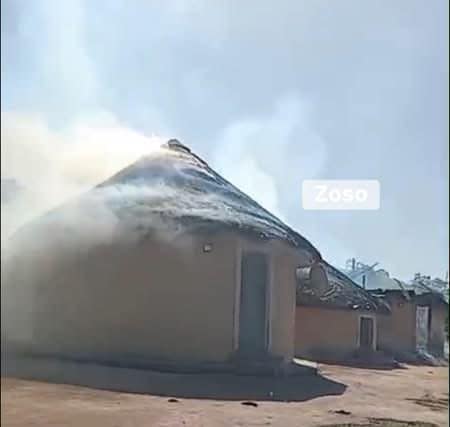
According to local sources and Mchunu’s close associates, the three men arrived in a silver sedan around 2 p.m. They approached the property’s entrance, where they briefly questioned a neighbor about Mchunu’s whereabouts. Informed that the activist was away—split between his political engagements in Cape Town and Johannesburg—the men wasted no time. Witnesses described seeing them produce jerry cans and rags, methodically dousing several traditional thatched-roof homes before igniting them. Within minutes, thick black smoke billowed over the rural landscape, drawing horrified onlookers who could do little but watch as the flames consumed the structures. The attackers fled the scene before any local security or firefighters could arrive. No injuries were reported, as Mchunu’s family members were also away at the time.
Mchunu, a former radio personality turned fiery political agitator, confirmed the incident via a series of emotional social media posts later that evening. “They came for me, but I was not there. They burned my ancestors’ home,” he said in a video, his voice trembling. “This is what happens when foreigners take over our country. They want to silence me.”
The arson attack did not occur in a vacuum. It came less than a week after Mchunu led a controversial series of protests dubbed the “March and March” campaign, a reference to his dual demonstrations in Durban and Johannesburg against undocumented immigration. During those marches, Mchunu and his supporters accused foreign nationals—particularly those from other African countries—of “hijacking” the spaza shop economy, flooding townships with illicit drugs, and driving violent crime. “Our people are suffering while illegal foreigners prosper,” he had declared to cheering crowds. “We will take back our streets.”
In the wake of the fire, Mchunu’s most ardent supporters have rallied online, using hashtags like #JusticeForNgizwe and #HandsOffOurLand to mobilize outrage. Many have pointed fingers directly at immigrant communities, alleging without evidence that the attack was organized by foreign spaza shop owners or drug syndicates retaliating against Mchunu’s activism. “They think burning a few huts will scare us? We are more determined than ever,” one supporter posted on X (formerly Twitter).
However, the incident has also drawn sharp skepticism. Critics, including some political analysts and rival activists, have questioned the timing and circumstances of the fire. Mchunu had been publicly announcing his travel plans for days, leaving his property conspicuously empty on a weekend afternoon. No security cameras captured the attackers’ faces, and no witnesses came forward with license plate details. “It’s not impossible that this is genuine retaliation,” said political commentator Zanele Dlamini, “but there’s a long history in South African politics of staged attacks to generate sympathy. Empty traditional huts burning cleanly, with no one hurt, on a Sunday when you know journalists are available? It raises eyebrows.”
Mchunu has fiercely denied any staging. “I have lost property that cannot be replaced,” he said. “You think I would burn my own home, my own heritage, for votes? That is an insult.”
The South African Police Service (SAPS) has confirmed that an arson case has been opened, and a specialized task force has been assigned due to the “high-profile nature of the victim and the potential for community unrest.” A police spokesperson told local media that “forensic teams are combing the scene, and we are following several leads,” including phone geolocation data from the area. The Hawks—the Directorate for Priority Crime Investigation—are reportedly monitoring the case, signaling its potential to escalate into broader national security concerns.
As dusk settled over the smoldering ruins of Mchunu’s homestead, the deep divisions in South Africa’s immigration debate were once again laid bare. For some, the attack is proof that unchecked immigration leads to lawlessness and reprisals. For others, it is a convenient tragedy for a man building a political career on xenophobia. And for the residents of Mbumbulu, who now watch police tape flutter in the wind, it is simply the latest sign that a national fire is burning—and no one is sure who will be burned next.
About The Author