For months, the signs of decay had been impossible to ignore. Students sleeping on library floors because their accommodation allowances have not been paid. Universities threatening to deregister thousands of first-year applicants whose funding remained in limbo. Whistleblowers emerging from the shadows with damning evidence of ghost students, inflated contracts, and procurement rot that seemed to spread through the organisation like a slow, silent cancer.
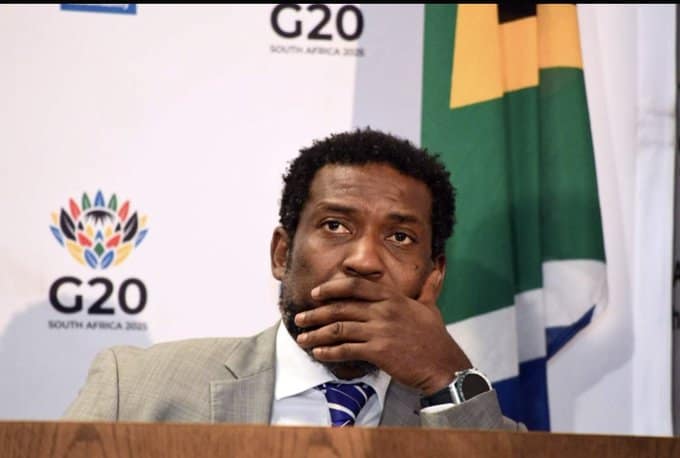
On Monday morning, Higher Education and Training Minister Buti Manamela finally did what many in the sector had been demanding for nearly a year: he wielded the hammer.
Standing before a bank of microphones outside the Ministry’s offices in the Pretoria CBD, a visibly weary Manamela announced that the National Student Financial Aid Scheme (NSFAS)—the government entity responsible for funding nearly one million students annually, with a budget exceeding R50 billion—would be placed under immediate administration.
“This decision was not taken lightly,” Manamela said, his voice heavy with the weight of responsibility. “NSFAS is bleeding. It is bleeding talent, it is bleeding credibility, and most importantly, it is bleeding the futures of young South Africans who have placed their trust in this government to help them climb the ladder of opportunity. We have reached a point where the board is no longer functional. Governance has collapsed. And students are paying the price with their dreams.”
The Perfect Storm
The announcement marked the culmination of a governance crisis that has been spiraling for eighteen months. The NSFAS board, already reduced from seven members to just three following a wave of resignations in March and April, became unable to form a quorum for critical meetings. The final blow came last week when board chairperson Ernest Khosa submitted his resignation, citing “irreconcilable differences” with the Ministry over procurement reforms and the handling of the direct payment system disaster that left thousands of students stranded without funds.
Khosa’s resignation followed those of board members Lwazi Zuma, Nomalungelo Ndlovu, and Thandi Orleyn, all of whom stepped down between February and April, citing a toxic working environment, political interference, and a lack of support from the Ministry to implement crucial reforms.
“It became untenable,” Khosa told the Sunday Times before his resignation. “Every attempt to clean up the system was met with resistance. Every effort to hold officials accountable was stonewalled. I could no longer sit at a table where the rules were being rewritten to protect the corrupt rather than the student.”
Minister Manamela, appointed to the higher education portfolio in the December 2025 cabinet reshuffle following Blade Nzimande’s departure, inherited a ticking time bomb. A forensic investigation commissioned by his predecessor had identified over R2.3 billion in irregular expenditure between 2022 and 2025, including inflated service provider contracts, duplicate payments, and a direct payment system that collapsed within weeks of launch, leaving 150,000 students without access to their allowances.
The Administrators
Under Section 27A of the NSFAS Act, the Minister has the power to place the scheme under administration for a period of up to 12 months, renewable once. The appointed administrator assumes all powers and functions of the board, including financial controls, procurement decisions, and the authority to suspend or dismiss senior staff.
Manamela announced the appointment of a three-person administration team led by Freeman Nomvalo, a veteran public finance expert and former director-general of the National Treasury who previously served as administrator for the South African Social Security Agency (SASSA) during its own governance crisis.
He will be supported by advocate Mahlape Sello SC, a specialist in public finance law, and Dr. Palesa Mokhoanatse, a higher education policy expert from the University of Johannesburg.
“I have given the administration team a clear mandate,” Manamela said. “First, stabilise payments. No student should miss a meal or lose their accommodation because of administrative chaos. Second, clean the books. Identify every cent of irregular expenditure and pursue recoveries where possible. Third, restructure the organisation. We need a leaner, more accountable, more transparent NSFAS that serves students, not middlemen.”
Nomvalo, speaking via video link from Cape Town, accepted the assignment with characteristic sobriety. “This is not a rescue mission,” he said. “It is a salvage operation. The ship is listing badly. Our job is to keep it afloat while we repair the hull. Students should not have to drown in bureaucracy while we do that work.”
The Political Fallout
The announcement was met with a predictable political firestorm.
The Economic Freedom Fighters, who have long called for the scrapping of NSFAS in favor of free education for all, described the decision as “too little, too late.”
“This is what happens when you leave student funding in the hands of capitalists and corrupt apparatchiks,” said EFF spokesperson Sinawo Thambo. “NSFAS has been stealing from the mouths of poor Black students for years while the ANC looked away. Placing it under administration is an admission of failure, not a solution.”
The Democratic Alliance welcomed the move but called for a full parliamentary inquiry. “The rot at NSFAS did not happen overnight,” said DA Shadow Minister of Higher Education Dr. Mimmy Gondwe. “It is the product of years of political patronage, cadre deployment, and a complete lack of oversight. We need to know who knew what and when they knew it. And we need criminal charges where warranted.”
The South African Union of Students (SAUS), representing over 600,000 students across 26 universities and 50 TVET colleges, gave a guarded response. SAUS president Neliswa Mkhize acknowledged the urgency of the intervention but warned that students had heard promises before.
“We welcome the administration because something had to change,” Mkhize said. “But we will be watching closely. We have seen board after board, CEO after CEO, all promising transformation. Meanwhile, our members are going hungry. Our members are being evicted. Our members are dropping out because the money they were promised never arrives. Administration means nothing if the student experience does not change.”
The Human Cost
To understand the magnitude of the crisis, one must leave the corridors of power in Pretoria and travel to the university residences and off-campus backyard rooms where students are fighting not just for grades, but for survival.
At the University of the Witwatersrand, second-year law student Thandeka Ndlovu has been surviving on one meal a day since March. Her NSFAS allowance, meant to cover food, transport, and books, has not been paid for four months. She has sold her textbooks. She has borrowed from friends until they stopped answering her calls. She has considered dropping out eight times.
“I am studying to be a lawyer so that I can change my family’s life,” she told this publication, tears streaming down her face. “But right now, I cannot afford to travel to the library. I cannot afford to print my assignments. And every day, I watch wealthier students walk past me without a care. NSFAS has failed me. The government has failed me. And now they say they are putting a new person in charge. What difference will that make to my empty stomach?”
At Tshwane University of Technology, mechanical engineering student Sipho Nkosi has been sleeping on a couch in a friend’s one-room flat after his landlord evicted him for non-payment of rent. He has not seen his family in Mpumalanga since January because he cannot afford the bus fare.
“I applied for NSFAS in August 2025,” he said. “I got a confirmation email saying I was funded in November. Since then, nothing. No money, no communication, no explanation. Every time I call the call centre, they put me on hold for an hour and then hang up. I am not asking for a luxury. I am asking for the money the government promised me so that I can finish my degree. Is that too much to ask?”
A History of Broken Promises
NSFAS was established in 1991 as a loan scheme for disadvantaged students. In 2017, following the #FeesMustFall movement, former President Jacob Zuma announced that NSFAS funding would be converted from loans to bursaries for first-time university entrants from households earning less than R350,000 per year.
The move was hailed as a historic step toward真正的 access to higher education. But the organisation never fully adapted to its expanded mandate. Between 2018 and 2025, the number of funded students nearly tripled, from 350,000 to over 950,000. The budget grew from R16 billion to over R50 billion. But the administrative capacity, governance structures, and oversight mechanisms did not grow with it.
“NSFAS became a cash cow,” said Professor Jonathan Jansen, a distinguished education scholar at Stellenbosch University. “Political figures saw it as an opportunity for patronage. Service providers saw it as a gravy train. And students saw it as a lottery system where some got lucky and most did not. The tragedy is that the original idea was noble, even beautiful. But noble ideas do not survive contact with corruption.”
The Road Ahead
The administration team faces a daunting task. Beyond the immediate crisis of unpaid allowances, they must address systemic issues that have plagued NSFAS for nearly a decade: outdated IT systems, a dysfunctional call centre, procurement processes that invite abuse, and a staffing culture that has often prioritized loyalty over competence.
Nomvalo has indicated that his first priority will be to resolve outstanding payments for the April and May cycles. He has asked universities to provide updated lists of registered, unfunded students so that emergency disbursements can be processed by the end of May.
His second priority will be a comprehensive audit of the direct payment system, which outsourced student allowances to three private fintech companies—a move that has been widely criticized as opaque and prone to exploitation.
“Students need to know exactly where their money is at all times,” Nomvalo said. “That means an end to third-party deductions that students did not authorize. That means real-time visibility of balances. That means a system that works for the student, not for the service provider.”
The administration team has also indicated that criminal investigations into alleged fraud and corruption within NSFAS will continue in parallel, with several dockets already handed to the Hawks.
A Test of Leadership
For Minister Manamela, the decision to place NSFAS under administration is a gamble. If the intervention succeeds, he will be remembered as the minister who finally cleaned up an institution that had become emblematic of post-apartheid governance failure. If it fails, he will be blamed for waiting too long and acting too late.
“This is not about me,” Manamela insisted at the press conference. “This is about the 950,000 young South Africans who wake up every morning hoping that today will be the day their funding arrives. This is about the mothers who take out loan sharks to keep their children at university because NSFAS has let them down. This is about the future of this country, which depends on an educated generation. We cannot afford to fail them again.”
As the press conference ended and the reporters scattered to file their stories, a small group of students gathered outside the Ministry’s gates. They held no placards. They chanted no slogans. They simply stood in silence, watching the building where their futures were being debated.
One of them, a young woman with a worn backpack and tired eyes, spoke to no one in particular: “We have heard this all before. New person. New plan. New promises. We will believe it when the money is in our accounts.”
Her words hung in the Pretoria air, a quiet indictment of an institution that had forgotten its founding purpose. The administrators are now in charge. The clock is ticking. And nearly a million students are waiting—not for sympathy, not for speeches, but for the simple, sacred promise of a country that said education was the key to freedom.
The key, it seems, is still lost. South Africa is praying that the new locksmiths know how to find it.
About The Author