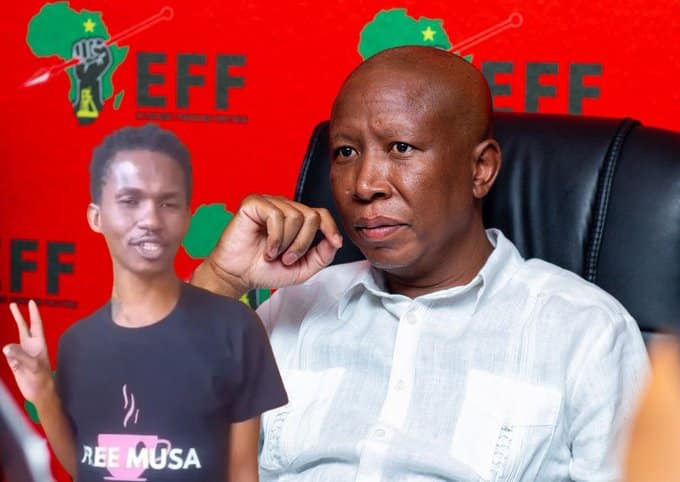
The Gauteng High Court delivered a sweeping judgment on Thursday morning that will resonate far beyond the polished oak benches of Court 12D. In a ruling that pitted one of South Africa’s most polarizing political figures against one of its most controversial social media personalities, the court found in favor of Economic Freedom Fighters (EFF) leader Julius Malema in his defamation lawsuit against commentator Musa Khawula.
The judgment, handed down by Acting Judge Nthabiseng Mofokeng, ordered Khawula to pay the full legal costs of the proceedings after determining that he had published “untrue, malicious, and damaging” statements about Malema and his wife, Mantwa Matlala-Malema. The ruling brings to a close—at least in legal terms—a bitter two-year feud that played out across Twitter, YouTube, and the fever swamps of online gossip culture.
But for those who followed the case closely, the judgment was about more than one man’s reputation. It was about the boundary between free expression and defamation, the power of social media to destroy lives with a single post, and the question of whether public figures must simply endure the slings and arrows of outrageous commentary—or whether they can fight back.
“The law is clear,” Judge Mofokeng said as she read a summary of her written judgment. “Freedom of expression does not grant anyone a license to publish falsehoods that harm the dignity and reputation of another person. This is not a close case. The statements in question were demonstrably false. The respondent knew they were false, or at the very least, acted with reckless disregard for the truth.”
The Statements That Sparked the Fire
The defamation case originated from a series of social media posts and YouTube videos published by Khawula between January and March 2024. In the posts, which were viewed hundreds of thousands of times and shared across multiple platforms, Khawula alleged that Malema had been involved in an extramarital affair and that his wife, Mantwa Matlala-Malema, had knowledge of and had benefited financially from the alleged relationship.
More seriously, Khawula also alleged that Malema had misused EFF party funds for personal expenses, including luxury vehicles and international travel. None of these allegations were supported by any evidence, the court found.
“The allegations were not merely salacious,” Judge Mofokeng wrote in her full judgment, which runs to 47 pages. “They were calculated to injure the reputation of the first plaintiff [Julius Malema] as a political leader and the second plaintiff [Mantwa Matlala-Malema] as a private individual who did not choose the public spotlight. The harm caused was real and substantial.”
Malema’s legal team, led by Advocate Tembeka Ngcukaitobi, argued that Khawula had acted with “actual malice,” repeatedly publishing the same false claims even after receiving legal notices demanding retractions. Khawula, who represented himself in court after failing to secure legal aid, argued that he was merely exercising his right to freedom of speech and that as a public figure, Malema should expect robust criticism.
The court rejected that argument entirely.
“Criticism of a public figure is protected,” Judge Mofokeng said. “Lies are not. Fabrications are not. Statements made without any factual basis are not.”
The Rise of Musa Khawula
To understand the significance of the judgment, one must understand the peculiar phenomenon of Musa Khawula. A former blogger and self-styled “celebrity commentator,” Khawula built a massive following—over 800,000 across various platforms—by publishing sensational, often unverified claims about South African politicians, musicians, and reality television stars.
His formula was simple: make explosive allegations, frame them as “exclusives,” and dare his targets to sue him. Some did. Most did not. Those who ignored him often saw the allegations metastasize, repeated by gossip accounts and sometimes even picked up by mainstream media outlets operating without sufficient verification.
But Khawula’s methods caught up with him. Prior to the Malema case, he had already lost defamation lawsuits brought by two prominent musicians, with courts ordering him to pay damages and issue retractions. He had also been banned from several social media platforms for violating terms of service related to harassment and misinformation.
“He built an entire career on other people’s pain,” said media law expert Emma Sadleir, who has followed Khawula’s legal battles closely. “He understood that for many public figures, the cost of suing—in time, money, and emotional energy—outweighs the benefit. He counted on that. This judgment sends a message that there are limits.”
Malema’s Response
Outside the courthouse, a visibly composed Julius Malema addressed a small crowd of supporters and journalists. Flanked by his wife, Mantwa, who held his hand throughout the brief press conference, Malema described the judgment as “a victory for truth” and “a defeat for the culture of lies that is poisoning our society.”
“I am not a perfect man,” Malema said, his voice calm but firm. “I have said things I regret. I have made mistakes. But I have never—never—been what Musa Khawula said I was. He attacked my marriage. He attacked my integrity. He attacked my wife, who has never sought public attention and who did nothing to deserve his cruelty.”
Malema paused, looking at his wife, who nodded slightly.
“This judgment is not about money,” he continued. “I did not ask for damages. I asked for the truth. And the court has given me that. Now Mr. Khawula must pay his own legal costs—not mine, but his—because the court has found that his behavior was so unreasonable that he cannot expect the taxpayer or anyone else to foot the bill.”
Khawula, who was not present in court for the judgment, later posted a brief statement on his Telegram channel: “The fight is not over. This is what happens when the rich and powerful use the law to silence the people. I will appeal.”
Legal experts, however, say an appeal faces long odds. “The judge’s findings of fact are very detailed and very damning,” said law professor James Grant. “An appeals court would have to find that she made an error of law or fact. That is possible, but it is not likely. Khawula’s best bet would be to settle and move on.”
The Wife’s Role
One of the more unusual aspects of the case was the inclusion of Mantwa Matlala-Malema as a co-plaintiff. Unlike her husband, who has spent two decades in the rough-and-tumble of South African politics, Matlala-Malema is a private citizen—a businesswoman and mother who rarely grants interviews or appears on social media.
Her legal team argued that the statements about her were particularly damaging because they impugned her character without any public-interest justification. The court agreed, noting that “the second plaintiff has done nothing to invite public scrutiny of her private life” and that the statements about her were “gratuitous and cruel.”
“Mantwa was the innocent party in all of this,” said a source close to the Malema family, speaking on condition of anonymity. “She watched her husband being dragged through the mud for years. She accepted that as part of his political life. But when they came for her—when they said she was complicit in lies and schemes—that was a line. And Julius drew it.”
Political Reactions
Unsurprisingly, the political response to the judgment split along familiar lines. The EFF released a triumphant statement hailing the ruling as “a landmark moment in the fight against disinformation” and calling on other public figures to “follow Comrade Julius’s example and defend their names in court.”
The Democratic Alliance (DA) offered a more measured response, with shadow justice minister Glynnis Breytenbach noting that “the right to reputation is an important component of our constitutional order” while also cautioning that “defamation law should never be used to chill legitimate criticism.”
The African National Congress (ANC) was characteristically quiet, though one senior party official, speaking off the record, described the judgment as “ironic” given Malema’s own history of inflammatory statements about others. “He has called people dogs, thieves, traitors,” the official said. “He has never been held to account the way he is now holding Khawula. There is a lesson there about glass houses.”
Malema’s legal team pushed back against that characterization, noting that political speech—even harsh political speech—is different from the kind of fabricated personal allegations at issue in this case. “There is a difference between calling someone a bad leader and saying they are a thief without evidence,” Ngcukaitobi said. “The first is opinion. The second is defamation.”
The Broader Implications
The Malema v. Khawula case arrives at a moment of growing concern about the impact of social media on public discourse in South Africa. With the rise of anonymous “insider” accounts, unverified gossip pages, and algorithm-driven outrage, the line between fact and fiction has become increasingly blurred.
The Protection of Personal Information Act (POPIA) provides some recourse for individuals whose data or reputations have been harmed, but defamation law remains the primary tool for those seeking to correct the public record. However, defamation lawsuits are expensive, time-consuming, and emotionally draining—luxuries that most ordinary South Africans cannot afford.
“The problem is that the law is only available to those who can pay for it,” said media ombudsman Pansy Tlakula. “Julius Malema can afford top lawyers. Most people cannot. So while this judgment is a victory for him personally, it does not solve the systemic problem of online defamation. That requires platform regulation, digital literacy, and a cultural shift in how we consume information.”
Khawula’s supporters have already framed the judgment as evidence of a “two-tier” justice system, where the wealthy and powerful can silence critics while the poor are left defenseless. But legal experts say that argument misunderstands the facts of the case.
“This wasn’t a case of a powerful man silencing a poor critic,” said Sadleir. “This was a case of a man who repeatedly published provable lies, ignored warnings, and refused to participate in the legal process in good faith. He was not silenced. He was held accountable.”
What Comes Next
With the costs order now in place, Khawula faces a substantial financial burden. Legal costs in a High Court defamation action can easily exceed R500,000, and while the court did not award damages against him, the costs order alone could bankrupt him.
Khawula has 15 days to file an appeal. If he does not, or if his appeal fails, he will be required to pay the costs within a specified timeframe. Failure to pay could result in garnishment of wages, seizure of assets, or even contempt proceedings.
For Malema, the judgment closes one chapter but does not end his legal battles. He remains embroiled in other cases, including a separate defamation lawsuit brought against him by a former EFF member, as well as ongoing investigations into his financial affairs. But on this day, at least, he was able to claim a clear and unambiguous win.
As the sun set over the High Court in Johannesburg, the building’s imposing columns cast long shadows across the pavement. A small group of EFF supporters had gathered earlier, singing struggle songs and waving red berets. By evening, they had dispersed, leaving behind only a few discarded posters and the faint echo of their chants.
Inside the courthouse, the clerks were already preparing for the next case. The machinery of justice grinds on, indifferent to the fame or infamy of those who pass through its doors. But for one day, at least, the machine delivered a verdict that felt, to many, like a small victory for the simple idea that the truth still matters.
Malema, leaving the courthouse with his wife at his side, offered no further comment. But as he climbed into a waiting vehicle, he turned briefly to the cameras and smiled—a small, tight smile that said more than any speech could.
About The Author