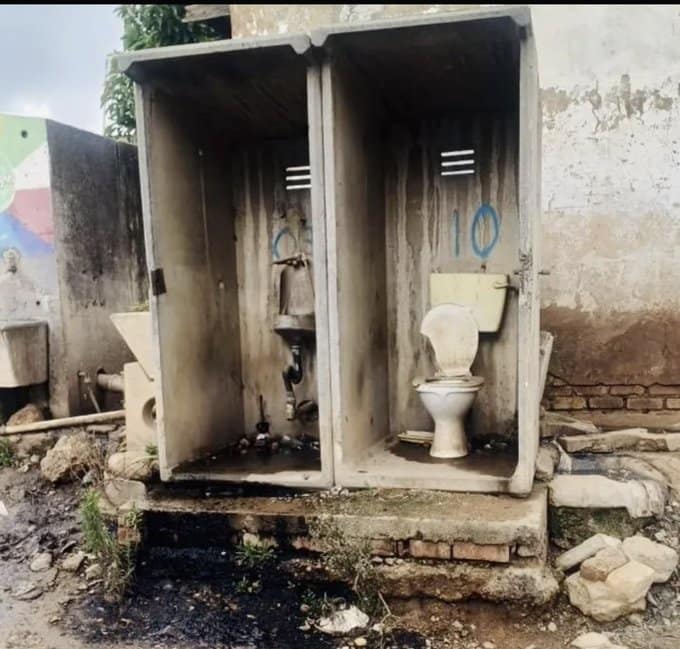
The stench hits you before the sight does. It hangs in the air of Diepsloot Extension 1 like a permanent, unwelcome guest—a thick cocktail of raw sewage, stale water, and the quiet desperation of people who have been forgotten.
On Wednesday morning, that desperation boiled over. Hundreds of residents from this sprawling informal settlement gathered at the intersection of Spider Street and Diepsloot Boulevard, their voices rising in a chorus of anger that echoed off the corrugated iron shacks. In their hands were handwritten placards, some scrawled in marker, others painted with painstaking care: “R10 is too much for dignity,” “Joburg fails us,” and the one that carried the sharpest political edge—”We won’t vote.”
The trigger for the protest was a seemingly small amount of money: R10. But in Diepsloot, where unemployment hovers above 60% and many families survive on a single meal a day, ten rand is not small. It is the difference between bread and hunger. It is the cost of paraffin for a week. And now, it is the price residents are being asked to pay every time a communal toilet in their block gets blocked.
“We are not a cash cow,” shouted community leader Thabo Ndlovu, his voice hoarse from hours of chanting. “We pay taxes. We buy electricity. We buy water from private vendors because the city doesn’t give us pipes. And now they want us to pay to fix their broken toilets? Toilet we didn’t break? Toilet that is full because they haven’t sent a truck to empty it in three months? No. Enough is enough.”
The Levy That Broke the Camel’s Back
The “toilet repair levy,” as residents have bitterly named it, is not an official City of Johannesburg policy. It is a local arrangement that has emerged from the vacuum of municipal neglect. When communal toilets—often concrete structures shared by up to 30 families—become blocked or overflow, residents have two choices: live with the sewage seeping into their pathways, or pool money to hire a private plumber or “honey sucker” truck.
The going rate is R10 per yard. A yard, in Diepsloot parlance, means a stand—a plot of land that may hold one family or five, depending on how many shacks have been crammed onto it. The money is collected by informal block leaders, handed to a private contractor, and the toilet is unblocked. Until the next time. Which is often just days or weeks later.
“We have paid this levy four times since January,” said Miriam Khumalo, a 47-year-old mother of six who lives in a two-room shack on Spider Street. She stood with her arms crossed, her eyes red from crying. “That is R40. Do you know what R40 means to me? It means my children ate yesterday. It means I could buy soap. And now it’s gone, and the toilet is blocked again, and they want another R10. I cannot. I will not.”
The City of Johannesburg, which has jurisdiction over Diepsloot, has acknowledged the sanitation crisis but says it lacks the resources to address it fully. In a statement released in response to the protest, the city’s MMC for Environment and Infrastructure Services, Councillor Michael Sun, said that Diepsloot’s rapid population growth had outpaced infrastructure development.
“Diepsloot was originally designed for a fraction of its current population,” the statement read. “The city is aware of the challenges and is implementing a phased upgrading plan. However, residents must understand that informal settlements present unique technical difficulties.”
The statement did not mention the R10 levy. It did not apologize. And it did not satisfy anyone in the crowd.
A History of Neglect
Diepsloot Extension 1 is one of the poorest and most densely populated corners of Johannesburg. Established in the early 2000s to accommodate families displaced from other informal settlements, it has grown into a community of over 350,000 people, many of whom live without formal electricity, running water, or proper roads.
The toilet crisis is not new. For years, residents have complained about broken flush mechanisms, cracked concrete, and sewage spills that turn unpaved pathways into biohazards. Children have fallen ill with diarrhea and cholera-like symptoms. Elderly residents have slipped in the sludge. And through it all, the city’s response has been slow, inconsistent, and often dismissive.
“We have submitted memorandums. We have held meetings. We have gone to the offices in Braamfontein,” said Nomsa Dlamini, a community health worker who has documented dozens of sanitation-related illnesses in her neighborhood. “They give us promises. They give us pamphlets. They give us phone numbers that no one answers. But they do not give us working toilets.”
The situation has worsened in the past year, as budget cuts have reduced the frequency of municipal toilet maintenance. According to internal city documents leaked to the media, the number of service requests for Diepsloot has increased by 40% since 2024, while the number of completed repairs has dropped by 25%.
The Electoral Threat
The most politically potent aspect of Wednesday’s protest was the promise—or threat—not to vote in the upcoming local government elections, currently scheduled for October 2026.
For the African National Congress (ANC), which governs Johannesburg through a coalition arrangement, the loss of Diepsloot’s votes would be a significant blow. The township has traditionally leaned toward the ruling party, but disillusionment has been growing for years. In the 2021 local elections, ANC support in Diepsloot dropped by nearly 15 percentage points compared to 2016.
“We are not fools,” said Andile Mbeki (no relation to the former president), a 34-year-old taxi driver who joined the protest after his shift. “We know elections are coming. We know politicians will come here with T-shirts and food parcels and empty promises. But we have seen this movie before. They win. They forget us. And we are left with blocked toilets and R10 levies. So no. We will not vote. Not for the ANC. Not for the DA. Not for the EFF. Not for anyone.”
The Economic Freedom Fighters (EFF) and the Democratic Alliance (DA) have both sought to capitalize on the discontent, with local party activists distributing pamphlets at the protest. But residents were skeptical of both.
“Everyone wants our votes. No one wants to fix our toilets,” said Khumalo. “Maybe if we all stay home on election day, they will finally hear us.”
Political analysts say the Diepsloot protest is a warning sign for all parties, but especially for the ANC, which is already facing a national decline in support.
“When communities start saying they won’t vote, that is not an expression of apathy,” said political analyst Dr. Sithembile Mbete. “It is an expression of profound alienation. These are people who feel that the political system has failed them so completely that participation is meaningless. That is a dangerous place for a democracy to be.”
The Human Cost
Beyond the politics and the placards, there is the daily reality of life without proper sanitation. Residents described waking up to sewage pooling outside their doors. Children missing school because of stomach illnesses. Elderly neighbors unable to use the communal toilets because the walkways are too slippery with waste.
“Two weeks ago, my three-year-old granddaughter stepped in raw sewage on her way to the toilet,” said 68-year-old Grace Mofokeng, her voice trembling. “She cried for an hour. I had to wash her with water from a bottle. That is not living. That is surviving. And I am tired of surviving.”
Mofokeng said she has lived in Diepsloot for 15 years. She has watched the community grow, watched children be born, watched neighbors die. But she has never seen it this bad.
“The city has money for stadiums. The city has money for fancy buildings in Sandton. But the city does not have money for our toilets,” she said. “That tells you everything you need to know about how they see us. We are not citizens. We are problems to be managed.”
The City’s Response
Following the protest, which dispersed peacefully after several hours, the City of Johannesburg issued a more detailed response. Spokesperson Mabine Seabe said that the city would send an emergency maintenance team to Diepsloot Extension 1 within 48 hours to assess the most critical toilet blocks.
“The city empathizes with the frustrations of residents,” Seabe said. “However, we must also emphasize that the informal nature of the settlement makes conventional sanitation solutions difficult. The city is exploring alternative technologies, including dry sanitation systems, that may be more appropriate for high-density informal areas.”
He also addressed the R10 levy directly, calling it “unofficial and unauthorized.”
“No resident should be paying any levy for toilet maintenance,” Seabe said. “If such payments are being demanded, they are not sanctioned by the city. We urge residents to report any such demands to their ward councillor or to the city’s hotline.”
Residents laughed bitterly when told of this response.
“Unauthorized?” said Ndlovu, the community leader. “Of course it’s unauthorized. That’s the whole point. The city doesn’t provide the service, so we have to organize it ourselves. We don’t want to pay. We have to pay. Unless the city wants to start sending trucks. Which they won’t.”
What Happens Next
The protest may have ended, but the anger has not. Community leaders have vowed to return to the streets if the city does not take concrete action within two weeks. They have also launched a petition demanding the scrapping of the R10 levy and the installation of a regular, free maintenance schedule for all communal toilets.
“We are not asking for mansions. We are not asking for swimming pools,” said Dlamini, the community health worker. “We are asking for toilets that work. That is the most basic human dignity. And if the city cannot provide that, then they should not be surprised when we refuse to participate in their elections.”
As the sun set over Diepsloot, casting long shadows across the maze of shacks and narrow pathways, the smell of sewage still hung in the air. Somewhere in the distance, a child coughed. A dog barked. And a group of women gathered outside a blocked toilet block, counting coins to see if they had enough for another private truck.
They did not. So they waited. As they have always waited. For a city that rarely comes, for a government that rarely listens, and for a dignity that remains stubbornly out of reach.
About The Author