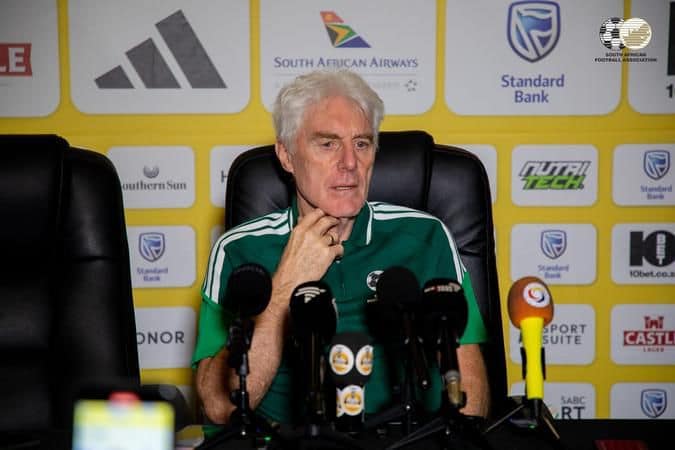
Bafana Bafana coach Hugo Broos has described the decision to schedule two international friendly matches against Panama as a “great choice,” insisting that the Central American opposition provides exactly the right kind of test his squad needs as South Africa’s 2026 FIFA World Cup qualification campaign gathers momentum.
The Belgian tactician, who guided South Africa to the Africa Cup of Nations (AFCON) semifinals in Ivory Coast last year, is leaving no stone unturned as he prepares his side for the critical months ahead. With the World Cup set to be co-hosted by the United States, Canada, and Mexico, Broos views the upcoming friendlies as a vital opportunity to sharpen his team’s edge against a style of football they do not frequently encounter on the African continent.
Speaking to the media during a press briefing at the team’s training base on Tuesday, Broos was unequivocal in his praise for the choice of opponent, emphasizing that Panama’s physicality, tactical discipline, and CONCACAF pedigree make them an ideal sparring partner.
“We Must Prepare for Everything”
The two friendly matches, scheduled to take place during the upcoming FIFA international window, will see Bafana Bafana square off against Panama in what Broos described as a “proper test” of his team’s adaptability. Panama, who qualified for the 2018 FIFA World Cup in Russia, have established themselves as a competitive force in North and Central America, known for their robust defensive organization and ability to disrupt technically gifted opponents.
“When we look at the teams we will face in the World Cup qualifiers and potentially at the World Cup itself, we cannot only prepare for African opponents,” Broos explained. “Panama is a great choice because they bring something different. They are physical, they are aggressive without the ball, and they are tactically very well organized. That is exactly the kind of challenge my players need.”
The coach elaborated on his philosophy of ensuring that Bafana Bafana are not caught off guard by unfamiliar styles of play, particularly as the team harbors ambitions of representing Africa on the global stage in 2026. “We have seen in recent World Cups that African teams sometimes struggle against opponents from the Americas because the rhythm is different, the refereeing is different, the intensity is different. We must prepare for everything. That is why these friendlies are so important.”
Building on AFCON Momentum
Broos’s tenure has been characterized by a methodical, long-term approach. Since taking over the reins in 2021, he has overseen a period of steady rebuilding, moving away from reliance on aging stars and placing his faith in a young, dynamic core of players. The AFCON semifinal run last year signaled that the project was bearing fruit, and the coach has since set his sights firmly on securing qualification for the 2026 World Cup—a tournament South Africa has not graced since hosting the event in 2010.
The Panama friendlies form part of a carefully calibrated preparation plan. With the next round of CAF World Cup qualifiers scheduled for later this year, Broos is using the FIFA window to integrate new players, test tactical variations, and build squad depth. He confirmed that he would be using both matches to rotate his squad, giving opportunities to fringe players while maintaining a competitive edge.
“We have a group of 23 to 25 players who I believe can do the job, but we need to see them in competitive matches against strong opposition,” Broos said. “Panama is a team that will not give us an easy game. That is what we want. If we win easily, we learn nothing. If we are pushed to our limits, we discover who is ready for the big moments.”
Panama: A Credible Test
Panama enters the friendly fixtures with their own objectives. Ranked just outside the top 40 in the FIFA World Rankings—a similar standing to South Africa—the Central Americans are in the midst of their own qualification campaign for the 2026 World Cup, which will feature an expanded 48-team field. For Panama, the matches against South Africa offer a valuable opportunity to test themselves against a top African nation.
The contrast in styles promises to make for compelling viewing. South Africa, under Broos, has developed a possession-based identity, relying on technical proficiency and quick transitions. Panama, by contrast, is known for its physical approach, set-piece prowess, and ability to absorb pressure before striking on the counter. It is precisely this stylistic clash that Broos believes will benefit his players.
“When we go to the World Cup—and I say when, not if, because that is our mentality—we will face teams from all over the world,” Broos said. “We must be comfortable playing against teams that press high, teams that sit deep, teams that are physical, teams that rely on technique. These friendlies are a step in that direction.”
The Road to 2026
South Africa currently sits in a competitive CAF qualification group, with their next fixtures looming as crucial determinants of their path to the expanded 48-team World Cup. The tournament’s expansion has opened up additional slots for African nations, and Broos has made no secret of his belief that Bafana Bafana have the quality to be among the continent’s representatives.
However, the coach has consistently cautioned against complacency. He noted that while the AFCON performance raised expectations, the reality of World Cup qualification is a grueling marathon that requires consistency, resilience, and meticulous preparation.
“The fans are excited, and that is good. But we cannot live on what we did at AFCON,” Broos said. “That is in the past. The World Cup qualifiers are a different beast. Every match is a final. We need to be ready for every scenario, and these friendlies against Panama will help us do that.”
Squad News and Injury Updates
As the team gathers for the upcoming camp, Broos provided updates on the fitness of key players. He confirmed that captain and defensive stalwart Ronwen Williams, who delivered a heroic performance in the AFCON quarterfinal penalty shootout against Cape Verde, is fit and available for selection. There was also positive news regarding several overseas-based players who have been in impressive form for their European clubs.
The coach did, however, sound a note of caution about managing player workloads, acknowledging that the congested football calendar places significant strain on his squad. He indicated that the two friendly matches would be used to give minutes to a broad group of players, ensuring that the team emerges from the window stronger and more cohesive.
Looking Ahead
As Bafana Bafana prepare to take on Panama in what promises to be a revealing double-header, the message from Broos is clear: these matches are not mere formalities. They are foundational steps in a project aimed at returning South Africa to the global stage.
With the countdown to 2026 well and truly underway, the coach’s insistence on facing varied, high-quality opposition reflects a broader ambition. Broos is not simply building a team to qualify for the World Cup; he is building a team that can compete credibly once they get there.
“We are not going to the World Cup just to participate,” Broos said firmly. “If we qualify—and I believe we will—we want to go there and show that South African football is back. These friendlies are part of that journey. Panama is a great choice, and I am confident that when we step onto the pitch, my players will show that they are ready for what comes next.”
The two friendly matches will be played later this month, with kick-off times and venues to be confirmed by the South African Football Association (SAFA) in the coming days.
About The Author