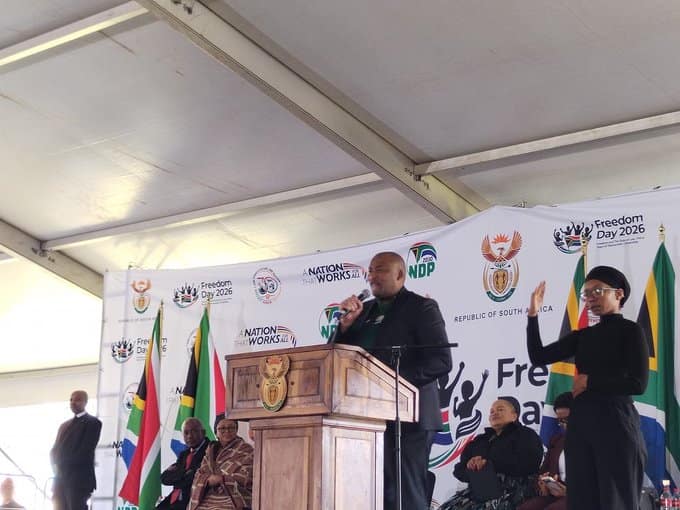
The Dr. Petrus Molemela Stadium had already heard from the President. It had heard the formalities, the statistics, the careful diplomatic calibrations. But when Gayton McKenzie, the Minister of Sport, Arts and Culture, gripped the podium on Freedom Day, the crowd seemed to shift in their seats. Something different was coming.
This was not the McKenzie of old—the former bank robber turned motivational speaker turned politician. Or perhaps it was exactly that man: scarred, repentant, audacious, and unafraid to speak in a register that few cabinet members dare to use. Dressed in a sleek black blazer over a golf shirt, McKenzie stepped into the April sun and immediately dispensed with the teleprompter.
“Comrades, citizens, and all who still believe in the dream of 1994,” he began, his voice a gravelly baritone that carried to the cheap seats. “I stand before you not as a perfect man. I stand before you as a man who was once lost. I stood on the wrong side of the law. I stood on the wrong side of hope. But today, by the grace of this democracy and the forgiveness of this nation, I stand here as your Minister.”
The stadium, which had been restless during some of the longer bureaucratic segments of the morning, fell into a rapt silence. McKenzie had that rare gift: the ability to make 30,000 people feel like he was speaking only to them.
Reflecting on the Long Walk
The Minister did not shy away from the contradictions of Freedom Day. He acknowledged that for many South Africans, April 27 brought mixed emotions—celebration tinged with lingering pain, hope shadowed by persistent inequality.
“When I was a child in the dusty streets of the Northern Cape,” McKenzie recalled, “Freedom Day was a concept, not a reality. We knew the date. We sang the songs. But we did not yet taste the fruit. Today, my mother—who cleaned white people’s houses for a pittance—my mother votes. She owns a home. She watches me on television and still cannot believe it.”
He paused, letting the weight of his own biography settle over the crowd. “That is the miracle of this nation. That a boy from the township, a boy who made every wrong turn a young man can make, can one day stand in Bloemfontein and speak for the arts, for the athletes, for the dreamers. Only in South Africa. Only because of 1994.”
But McKenzie was not there for nostalgia alone. His voice hardened as he pivoted to the present.
A Call to the Creative Industries
As Minister of Sport, Arts and Culture, McKenzie has made headlines for his unconventional style—Instagram rants, late-night calls to artists, and a fierce determination to monetize South Africa’s cultural capital. On Freedom Day, he issued a manifesto.
“To every musician in Mamelodi who cannot afford studio time: I see you. To every painter in Nyanga whose canvases gather dust because galleries won’t look your way: I see you. To every dancer, every poet, every filmmaker telling our stories with almost no budget and an infinite amount of heart: I see you.”
He announced a new, though previously trailed, initiative: the Creative Industries Catalytic Fund, a R500 million pool designed to provide micro-grants and low-interest loans to emerging artists. But more than the policy, the crowd responded to the passion.
“Our athletes bring home gold. Our musicians fill stadiums in London and New York. Our designers dress the world’s biggest stars. And yet,” McKenzie’s fist tapped the podium, “and yet, we beg for sponsorship. We beg for government attention. No more.”
He called for a “cultural spring,” a decade in which South African art would become an export industry to rival mining and finance. “The world is hungry for our stories. Not the poverty porn. Not the tragedy reels. Our triumph. Our style. Our indestructible joy.”
National Unity: The Uncomfortable Ask
Then came the part of McKenzie’s speech that would spark the most debate. The Minister, who leads a party (Patriotic Alliance) often associated with tough-on-immigration rhetoric, surprised many by calling for a different kind of unity.
“We are fighting among ourselves while the world watches,” he said, his tone softening. “Foreign national. Local. Zulu. Xhosa. White. Black. Indian. Coloured. The divisions are a luxury we cannot afford. Freedom Day is not just about remembering the past. It is about choosing, every single day, to build a future together.”
He acknowledged the spaza shop tensions, the xenophobic flare-ups, the political point-scoring. But he refused to take a side in the way many expected.
“I am not here to tell you who to blame,” McKenzie said. “I am here to tell you that blame has never filled a stomach. Blame has never built a stadium or funded a film. We need solutions. We need to sit at the same table—South African born, naturalized citizen, refugee—and say: how do we make this economy work for everyone who lives here legally?”
It was a delicate tightrope. His own supporters, many of whom are vocal in their anger over foreign-owned shops, shifted uncomfortably. But others—particularly in the creative sector, which thrives on cross-border collaboration—nodded vigorously.
The Crowd’s Response
As McKenzie wrapped up, he returned to his personal story. “I am proof that a person can change. I am proof that a nation can heal. But change requires action. Healing requires work. So let us leave this stadium not with flags folded in our pockets, but with fire in our bellies.”
The applause was not universal—pockets of the crowd remained seated, arms crossed—but it was loud. Very loud. President Ramaphosa, seated in the VIP section, was captured on video leaning over to whisper something to Deputy President Paul Mashatile, a faint smile on his face.
After the event, social media erupted. Some called McKenzie’s speech the highlight of Freedom Day. Others dismissed it as “performative populism” from a man with a criminal past. But no one could deny its impact.
Political Fallout and Praise
Cape Town Mayor Geordin Hill-Lewis, who had earlier praised Ramaphosa’s address, tweeted: “McKenzie brings an authenticity that cabinet sorely needs. Whether you agree with him or not, you cannot say he doesn’t believe what he says.”
But ActionSA leader Herman Mashaba, ever the antagonist, was less impressed. “A former convict now preaching unity while his own party stokes anti-foreigner sentiment on the ground? Spare me. Freedom Day speeches are cheap. Let’s see action.”
McKenzie, never one to let a slight pass, responded hours later on his own social media: “Herman, my brother, I have done more for artists and athletes in six months than you did for Joburg in six years. But I still love you. Come, let’s braai and talk. No hard feelings. 🇿🇦”
The response—combining a jab, an olive branch, and a barbecue invitation—was pure McKenzie. And perhaps that was the point. In a political landscape often dominated by cautious technocrats and angry ideologues, Gayton McKenzie offers something else: a showman’s instinct, a sinner’s humility, and a believer’s stubborn hope.
Epilogue
As the stadium emptied under the late afternoon sun, McKenzie lingered on the field, shaking hands with young artists who had rushed the barriers. He posed for selfies, promised to visit a community theatre in Rockville, and signed an autograph for a boy who said he wanted to be “a dancer, not a gangster.”
“Then dance,” McKenzie told him, ruffling the child’s hair. “Dance like your life depends on it. Because in this country? It just might.”
Freedom Day 2025 would be remembered for many things: the President’s balancing act, the brief stage rush, the underlying tensions of a nation in transition. But for those who heard him, it would also be remembered as the day Gayton McKenzie stepped fully into his role—not as a curiosity, but as a minister with a voice all his own.
Whether that voice will translate into lasting change for South Africa’s arts, culture, and sport sectors remains an open question. But on this day, in Bloemfontein, he made sure no one could look away.
About The Author