Several families in the densely populated villages of Shayandima and Muledane, located just outside Thohoyandou, are now homeless after local authorities launched an aggressive demolition drive on Monday morning, bulldozing dozens of structures that they claimed were built illegally on municipal land. The operation, which began at daybreak without prior written notice to many residents, has left over 150 people—including elderly grandparents, pregnant women, and young children—scrambling for shelter as the winter chill begins to settle over the region.
The demolitions have sparked outrage in the community, with residents accusing the Thulamela Local Municipality of acting with “brutal haste” and “inhumane disregard” for the lives of vulnerable families. Local civic organizations have called for an urgent investigation, while the provincial government has urged calm and promised to assist displaced families.
The Demolitions: A Day of Ruin
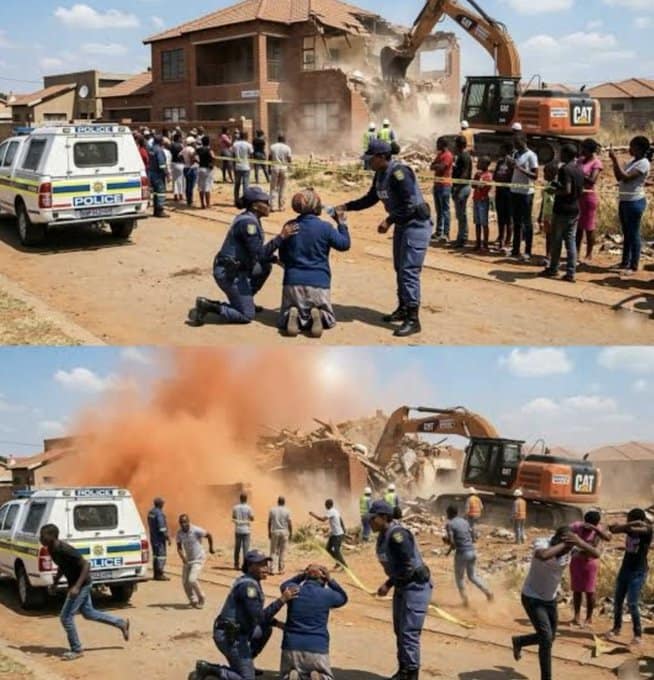
According to eyewitnesses and affected residents, the demolitions began around 6 a.m. on Monday, 20 April 2026. A convoy of municipal vehicles, including two bulldozers, a water tanker, and several pickup trucks carrying armed municipal police officers, arrived without warning at an informal settlement on the eastern edge of Shayandima.
“The noise woke us up. We heard metal crashing and people screaming,” said Ndivhuwo Rambuda, 34, a mother of three who had lived in the settlement for five years. “When I ran outside, I saw a bulldozer pushing down my neighbor’s house. My children were still sleeping. I grabbed them and ran. I didn’t even have time to put on shoes.”
Over the course of eight hours, municipal crews razed approximately 45 structures across three separate sites in Shayandima and Muledane. Most were makeshift homes built from corrugated iron, wooden planks, and concrete blocks. A handful were more substantial structures, including one two-bedroom brick house that residents claim had been standing for over a decade.
By late afternoon, all that remained of the settlement were piles of twisted metal, splintered wood, broken furniture, and scattered personal belongings—clothing, schoolbooks, photographs, cooking pots—trampled into the mud by the bulldozers’ tracks.
“We lost everything,” said 67-year-old Vho-Makhado Netshivhale, a retired farmworker who had lived in his shack for 12 years. “My bed, my blankets, my medicine. I am diabetic. My insulin was in a small fridge. Now it’s gone. I don’t know what to do.”
The Municipality’s Position: Illegal Occupation of Municipal Land
The Thulamela Local Municipality has defended the demolition drive, stating that the structures were erected on land designated for future infrastructure development, including a planned road expansion and a new public health clinic.
“The land in question is clearly demarcated as municipal property. These families were informed on multiple occasions that they were occupying the land illegally and that they would need to relocate,” said municipal spokesperson Khodani Tshivhase in a written statement. “The municipality has a duty to enforce its bylaws and to protect public land from unlawful occupation. This is not a matter of cruelty; it is a matter of law.”
Tshivhase added that the municipality had offered alternative land in a newly developed relocation area approximately 15 kilometers away, but that most residents had refused to move because the site lacked water, electricity, sanitation, and road access.
“They were offered a lawful alternative. They chose to remain on unlawful land. The municipality could not wait indefinitely,” Tshivhase said.
Residents strongly dispute this account. Many told this publication that they never received written eviction notices, and that the only communication they received were sporadic verbal warnings from local councillors—warnings that they say were vague and did not specify a demolition date.
“We were told ‘one day you will have to move.’ We were never told that day was today,” said 28-year-old Mulalo Ramashia, whose home was destroyed. “If they had given us a date, we could have packed our things. We could have found somewhere to go. Now we have nothing.”
The Aftermath: A Community in Crisis
By nightfall on Monday, the displaced families had gathered in two makeshift collection points: the grounds of the Shayandima Community Hall and a dusty open field near the Muledane Taxi Rank. Blankets, food parcels, and bottled water were distributed by local NGOs, church groups, and sympathetic neighbors, but the resources were grossly inadequate for the scale of the crisis.
“We have counted 47 families so far, but the number may rise as more people come forward,” said Rendani Mulaudzi, a volunteer with the Vhembe Disaster Relief Network. “That is approximately 180 people, including 60 children under the age of 12. They need shelter tonight. It is already getting cold. By June, it will be freezing. We cannot leave them in the open.”
Local schools have offered to open their classrooms as temporary shelters, but municipal approval is required. As of Monday evening, that approval had not been granted.
“I am sleeping here, on the ground, with my three children,” said Tshilidzi Munyai, 31, pointing to a thin blanket spread over bare earth. “The youngest is two years old. She is crying because she is cold. What do I tell her? That the municipality says we are criminals for having no home?”
Human Rights Concerns and Legal Questions
The demolition drive has raised serious legal and human rights questions. Under South African law, evictions and demolitions of informal structures must follow strict procedures outlined in the Prevention of Illegal Eviction from and Unlawful Occupation of Land Act (PIE Act), which requires a court order before any eviction can be carried out, as well as meaningful engagement with affected communities.
The PIE Act also requires that alternative accommodation be provided—or at least offered—to vulnerable individuals, including children, the elderly, and people with disabilities, before any eviction or demolition takes place.
Legal experts say the Thulamela Municipality may have violated the PIE Act if it did not obtain a court order and did not provide reasonable alternative accommodation.
“The bulldozing of homes without a court order is not just unlawful—it is unconstitutional,” said advocate Naledi Phala of the Legal Resources Centre in Polokwane. “The right to adequate housing is enshrined in Section 26 of the Constitution. Even if someone is occupying land illegally, the state cannot render them homeless without due process. What we saw in Shayandima appears to be a clear violation of that right.”
Phala added that her organization is in contact with affected families and is considering an urgent application to the Limpopo High Court to interdict any further demolitions and to compel the municipality to provide emergency shelter.
Political Reactions: Outrage and Defensiveness
The demolitions have drawn sharp criticism from opposition parties and civil society groups, while the ruling African National Congress (ANC) in Limpopo has struck a cautious tone, calling for “dialogue and compassion.”
The Economic Freedom Fighters (EFF) in Vhembe district condemned the operation as “state-sponsored violence against the poor.” EFF regional chairperson Collen Maswanganyi said: “Thulamela Municipality has blood on its hands. These people are not criminals. They are victims of apartheid’s spatial planning and post-apartheid neglect. The ANC must answer for this.”
The Democratic Alliance (DA) called for an immediate investigation by the Limpopo Department of Cooperative Governance, Human Settlements, and Traditional Affairs (COGHSTA). “If the municipality acted outside the law, heads must roll,” said DA Limpopo spokesperson Freddy Sonakile.
COGHSTA MEC Basikopo Makamu issued a brief statement expressing “concern” over the demolitions and promising to dispatch a team to assess the situation. “We will engage both the municipality and the affected families to find a humane solution. No one should be left homeless, regardless of the circumstances of their occupation.”
However, Makamu stopped short of condemning the municipality, noting that “illegal land occupation remains a serious challenge across Limpopo.”
The Broader Context: A Housing Crisis in Vhembe
The demolitions in Shayandima and Muledane are not an isolated incident. Across the Vhembe District Municipality, rapid urbanization, high unemployment, and a severe shortage of affordable housing have driven thousands of families to occupy vacant municipal and private land informally.
Thohoyandou and its surrounding villages have seen a population boom in recent years, as young people migrate from rural areas in search of work and education opportunities. The official waiting list for government-subsidized housing in Thulamela currently stands at over 12,000 applicants, with an average waiting period of seven to ten years.
“It is a crisis of supply and demand,” said urban planner Dr. Rendani Tshivhase (no relation to the municipal spokesperson). “People cannot wait a decade for a house. So they build where they can—on empty land, on road reserves, on any piece of ground that is not occupied. The municipality’s response has been reactive and punitive, not proactive and developmental.”
Tshivhase called for a moratorium on demolitions until a comprehensive housing plan is in place. “You cannot bulldoze your way out of a housing crisis. You only create more anger, more suffering, and more instability.”
Stories from the Rubble
Among the displaced families, stories of loss and resilience are emerging.
Florence Mbedzi, 58, a grandmother of six, had lived in her Shayandima home for 18 years. She had built it herself, brick by brick, working as a domestic worker and saving every extra rand. “That house was my pension. My children were born there. My husband died there. Now it is dust. I am too old to start again.”
Tinyiko Mkansi, 24, a university student studying at the University of Venda, lost all his textbooks, his laptop, and his research notes in the demolition. “I have exams in three weeks. How am I supposed to study? I don’t even have a roof over my head. My education is destroyed because someone decided to send bulldozers instead of letters.”
And then there are the children. Little Amukelani, age five, sat on a cardboard box clutching a torn teddy bear. “Where is my house?” she kept asking her mother. “When can we go home?” Her mother had no answer.
What Happens Next?
The displaced families are demanding:
- Immediate emergency shelter, food, blankets, and sanitation facilities.
- A moratorium on further demolitions pending proper engagement.
- A court-ordered review of the municipality’s compliance with the PIE Act.
- A clear, time-bound plan for alternative housing or land with basic services.
The Thulamela Municipality has not indicated whether it will provide emergency shelter. Municipal spokesperson Tshivhase said only that “the matter is being discussed internally.”
The Legal Resources Centre has confirmed that it will file an urgent application with the Limpopo High Court in Thohoyandou as early as Wednesday morning, seeking an interdict against further demolitions and an order compelling the municipality to provide basic emergency relief.
“We cannot undo what has been done,” said Advocate Phala. “But we can prevent it from happening again. And we can demand that the state fulfill its constitutional obligation to provide emergency housing to those it has rendered homeless.”
A Final Reflection
In the fading light of a cold autumn evening, the displaced families of Shayandima and Muledane huddled together for warmth. A church group arrived with a pot of hot soup and a stack of second-hand blankets. A local taxi driver offered to transport elderly residents to his own home for the night. A teenager used his phone’s flashlight to help a young mother find her child’s asthma inhaler in the rubble.
In the midst of official indifference, ordinary people showed extraordinary humanity. But kindness alone cannot build a home. Kindness alone cannot keep a child warm through a Limpopo winter.
The bulldozers have left. The dust has settled. But the question remains: In a country with a constitutional right to housing, how many more homes must fall before the state learns to build?
About The Author