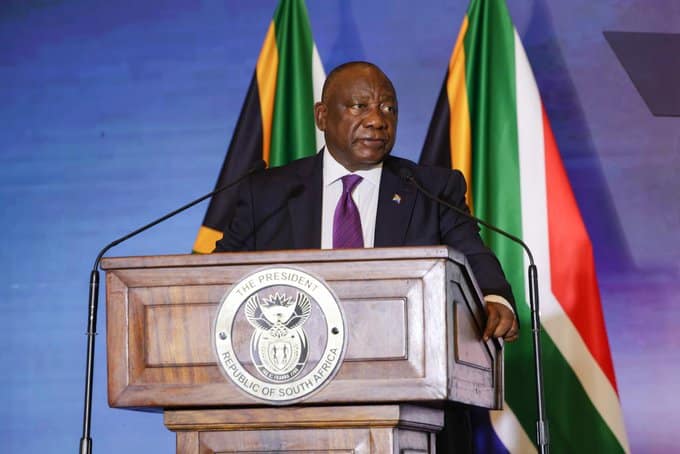
In a speech that framed the nation’s educational future in the starkest terms, President Cyril Ramaphosa has identified a powerful yet perennially underfunded lever for change: Early Childhood Development (ECD). Addressing a national education summit convened by the Department of Basic Education, the President moved beyond aspirational rhetoric to declare that substantive, systemic reform of South Africa’s troubled schooling system is impossible without a revolutionary investment in its very first years.
“We have spent decades treating the symptoms of our educational crisis in the upper grades—low pass rates, high dropout numbers, skills mismatches,” President Ramaphosa told an audience of policymakers, teachers’ union leaders, and education experts. “But the diagnosis, and the cure, lies much earlier. The real change, the transformative change we seek, must be cemented in the earliest grades, in the foundational experiences of our youngest learners. If we want to build a skyscraper of future engineers, scientists, and artisans, we cannot afford to have a weak foundation. That foundation is ECD, and it is everything.”
From Rhetoric to a Concrete Policy Pivot
The President’s speech signaled a significant and deliberate policy pivot, tying together several recent government actions into a coherent, urgent mission. He pointed to the landmark shift of ECD functions from the Department of Social Development to the Department of Basic Education in 2022, a move long advocated for by experts, as the critical administrative first step. “This was not merely a bureaucratic transfer,” he asserted. “It was a philosophical statement. Early childhood is not simply welfare or childcare; it is the first and most crucial phase of learning.”
He outlined a multi-pronged vision for this “foundational-first” reform:
- Universal Access and Quality: Moving beyond the current patchwork of community-based and private facilities to ensure every child, regardless of birthplace or income, has access to a registered, quality early learning programme. This includes ambitious plans for infrastructure development, particularly in rural and township areas.
- Professionalisation of the ECD Workforce: Acknowledging the often informal and underpaid status of ECD practitioners, Ramaphosa committed to a national drive for formal training, improved qualifications, and better remuneration. “Our children’s first teachers must be recognised as the critical professionals they are,” he stated.
- Curriculum and Support Integration: Ensuring the Grade R year and the early grades of primary school are seamlessly aligned with a play-based, cognitively stimulating ECD curriculum, preventing the jarring transitions that often disadvantage children.
- Nutrition and Health as Prerequisites for Learning: Emphasizing that learning cannot happen on an empty stomach or in poor health, he reinforced the commitment to expanding the National School Nutrition Programme to include qualified ECD sites and linking them to primary healthcare services.
A Response Rooted in Crisis and Evidence
The President’s forceful emphasis comes against a grim backdrop. International assessments, such as the Progress in International Reading Literacy Study (PIRLS), consistently show that a majority of South African Grade 4 learners cannot read for meaning in any language. Economists and educational sociologists have long traced this deficit directly to inadequate early childhood stimulation, language development, and pre-numeracy skills.
“President Ramaphosa is correct on the science and the economics,” said Dr. Mothomang Diaho, an education policy analyst. “Every rand invested in quality ECD yields exponential returns in improved educational outcomes, reduced grade repetition, higher future earnings, and lower social costs. He is framing this not just as an educational imperative, but as the single most effective investment in our national economic future.”
Skepticism and the Challenge of Implementation
While the address was broadly welcomed by the education sector, it was met with cautious skepticism from opposition parties and civil society groups, who pointed to the government’s historic struggles with implementation and resource allocation.
“The vision is impeccable, but we have heard similar commitments before,” said a spokesperson for the NGO Equal Education. “The proof will be in the budget, in the timelines, and in the political will to see this through over multiple electoral cycles. We need to see the detailed, costed plan and a commitment to ring-fence this funding, especially when fiscal pressures mount.”
Teachers’ unions, while supportive, highlighted the practical challenges. “We agree completely with the President,” said a representative of the South African Democratic Teachers Union (SADTU). “But this means massive new infrastructure, hiring and training tens of thousands of new practitioners, and ensuring the existing system is ready to receive these better-prepared learners. It cannot be a slogan; it must be a fully resourced, decade-long project of national importance.”
A Legacy in the Making
By staking his administration’s educational legacy on the success of ECD, President Ramaphosa has set a clear and ambitious benchmark. The move reframes the entire educational challenge, shifting the focus from crisis management at the matriculation exit point to intentional construction at the starting gate.
As the summit concluded, the directive to the Basic Education department was clear: accelerate the rollout of the integrated ECD plan. The nation now watches to see if this focus on the youngest South Africans can finally begin to dismantle the entrenched inequalities that have long been reproduced in its classrooms. The foundation, as the President declared, must now be poured with urgency, precision, and unwavering commitment.
About The Author