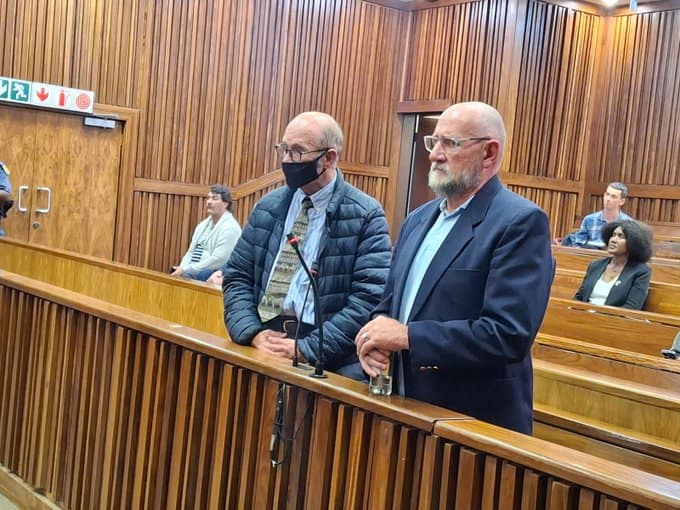
In a courtroom heavy with the spectral weight of history, two elderly former apartheid police officers were remanded into custody on Thursday, their bail judgment reserved following their conviction for a murder that has haunted a nation for nearly 40 years. The decision by the High Court to keep them behind bars ahead of sentencing marks a pivotal, if agonisingly belated, chapter in the long fight for justice for Caiphus “Caipi” Nyoka, a 20-year-old Congress of South African Students (COSAS) activist executed in his sleep in 1986.
The convicted men, former Sergeants Thabo Nkosi and Johannes van Rensburg, showed little emotion as Magistrate Lebohang Modise announced she would rule on their bail application next week. For the Nyoka family, packed into the public gallery, the moment was a fragile victory—a tangible sign that the wheels of justice, though rusted by time, are finally turning.
“We have lived with a hole in our lives since 1986,” whispered Lindiwe Nyoka, Caiphus’s now-elderly sister, outside the courthouse, her voice thick with emotion. “Seeing them in the dock, hearing them called ‘convicted murderers’… it does not bring Caipi back. But it tells us that his life mattered. That his fight for freedom was not in vain.”
The Night That Shattered a Family
The facts of the case, laid bare during the trial, are a stark reminder of the cold brutality of the apartheid security apparatus. On the night of 12 September 1986, under the guise of a “counter-terrorism” operation, Nkosi and Van Rensburg led a squad to a house in Rockville, Soweto. They kicked in the door of the room where Nyoka, a passionate young organiser, was sleeping. Ignoring his attempts to identify himself as a student, they opened fire at point-blank range. The official police report would later falsely claim he was an armed “terrorist” killed in a shootout.
For decades, the case lay dormant, one of hundreds deemed “unresolved” by the Truth and Reconciliation Commission (TRC), as the perpetrators failed to apply for amnesty. Its revival is due to the dogged work of the National Prosecuting Authority’s (NPA) Priority Crimes Litigation Unit, which has been re-examining TRC-era cases under renewed political and social pressure.
A Legal Battle Over “Changed Men”
In their bail application, defence attorneys argued that Nkosi, 71, and Van Rensburg, 69, were frail, law-abiding pensioners who posed no flight risk. They presented evidence of community involvement and argued that the 38-year delay in prosecution was prejudicial. “These men have lived productive, quiet lives for decades. They are not the same men they were in the 1980s,” argued Advocate Johan Botha.
State Prosecutor Advocate Nomusa Khumalo countered with searing force. “The gravity of the offence—the premeditated, execution-style murder of a sleeping youth—is extreme. They betrayed the very oath they swore to protect. Their comfortable lives for the past decades were built on a foundation of a lie and a stolen future. They have shown no remorse and have enjoyed their freedom while the Nyoka family grieved. They must await sentencing in custody.”
A Nation Confronting Its Ghosts
The case has reignited a painful national conversation about unfinished business from the TRC era. Dozens of similar cases remain in legal limbo, with perpetrators ageing and evidence fading.
“This is not about vengeance; it is about accountability,” said Dr. Mavuso Msimang, a veteran of the liberation struggle. “The TRC offered a path to forgiveness through truth. Those who ignored that bargain, who chose to hide behind lies, must now face the consequences. For reconciliation to be real, justice cannot have a statute of limitations.”
As the two former officers were led down to the cells, the quiet in the courtroom was broken by a single, soft sob from the family bench. For them, and for a country still stitching together the ragged seams of its past, the wait continues—not just for a bail ruling next week, but for the final sentencing that will, at last, write a definitive postscript to a young life cut short in the dark of an apartheid night. The message from Courtroom 4C is clear: in South Africa’s long walk to justice, even the coldest of cases can be thawed by the relentless heat of truth.
About The Author