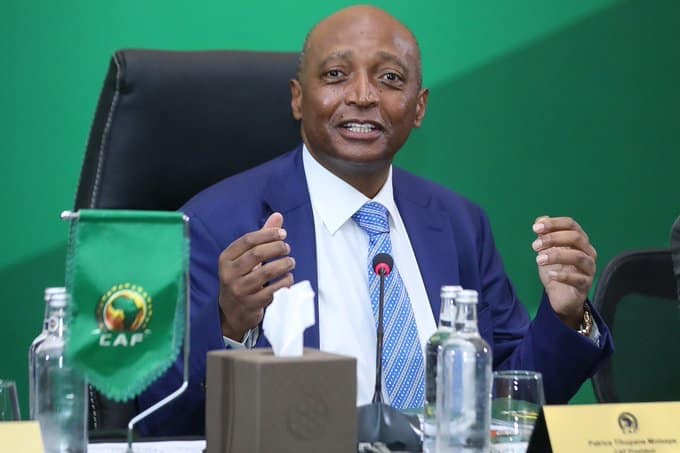
The red-eye diplomacy of African football shows no signs of slowing down. Barely 24 hours after concluding a high-stakes round of negotiations in the bustling Senegalese capital of Dakar, Dr. Patrice Motsepe, the President of the Confederation of African Football (CAF), touched down on Moroccan soil yesterday for what insiders are calling a “crucial strategic engagement” with the North African kingdom’s football leadership.
The whirlwind visit, which saw Motsepe’s private jet land at Rabat-Salé Airport under overcast skies, is the latest chapter in the South African mining magnate-turned-football administrator’s broader campaign to unify, modernize, and stabilize the often fractious landscape of African football governance.
Stepping onto the tarmac with the quiet confidence of a man accustomed to boardroom battles and pitch-side politics alike, Motsepe was received by a delegation led by Fouzi Lekjaa, the powerful president of the Royal Moroccan Football Federation (FRMF) and a key figure in Moroccan sports infrastructure development. The two embraced warmly—a gesture that belied the complex geopolitical and sporting tensions that have historically dogged relations between North and sub-Saharan African football bodies.
“Football is the one language that requires no translator,” Motsepe said briefly to waiting journalists before being whisked away for closed-door meetings. “Morocco is not just a football nation; it is a football powerhouse. Our discussions will focus on how we build a stronger, more prosperous African game—together.”
The timing of the visit is anything but accidental. Just a day prior, Motsepe had wrapped up a high-stakes mission in Dakar, where he met with Senegal’s Minister of Sports and the executive committee of the Senegalese Football Federation. That leg of his diplomatic tour focused heavily on youth development, the sustainability of the Africa Cup of Nations (AFCON) hosting model, and resolving outstanding financial disputes between CAF and several West African member associations.
Now, in Morocco, the agenda shifts to other pressing matters. Sources close to CAF’s executive committee indicate that Motsepe’s talks with Lekjaa will center on three critical pillars:
First, infrastructure and legacy. Morocco, fresh off its historic run to the 2022 World Cup semi-finals and its successful hosting of the 2023 FIFA Club World Cup, has set a continental benchmark for stadium quality, training facilities, and tournament logistics. Motsepe is believed to be seeking Moroccan expertise and investment to replicate that model across other CAF member nations, particularly as the continent prepares for an expanded AFCON and the potential hosting of future FIFA tournaments.
Second, club licensing and inter-club competitions. The CAF Champions League and Confederation Cup have faced recurring issues with stadium standards, refereeing controversies, and scheduling conflicts. Morocco’s top clubs—Wydad Casablanca, Raja Casablanca, and AS FAR—have been among the continent’s most consistent performers. Motsepe is reportedly keen to harness Morocco’s organizational muscle to help reform CAF’s club competition frameworks.
Third, and perhaps most delicately, geopolitical bridge-building. Morocco has long been a football powerhouse but has also faced political isolation from certain African nations due to the disputed status of Western Sahara, where the FRMF has sought to integrate local teams. Motsepe’s visit is widely seen as an attempt to keep football separate from politics—a delicate balancing act that has defined his presidency since he took over from Ahmad Ahmad in 2021.
“We are not here to solve political disputes,” a senior CAF official traveling with Motsepe told reporters on condition of anonymity. “We are here to ensure that Moroccan football—its clubs, its referees, its academies, its commercial power—feels fully integrated into CAF’s vision. When Morocco wins, African football wins. When African football wins, Morocco wins. That is the message Dr. Motsepe is carrying from Dakar to Rabat.”
The visit also carries symbolic weight. Morocco is widely expected to launch a bid for the 2030 FIFA World Cup, potentially alongside Spain and Portugal. While CAF does not directly decide World Cup hosts, Motsepe’s vocal support for a pan-African or Moroccan-led bid could prove decisive in swaying African votes within FIFA’s broader congress. His presence in Rabat sends an unmistakable signal of continental endorsement.
For his part, Lekjaa welcomed Motsepe with characteristic enthusiasm. “The President of CAF is always at home in Morocco,” Lekjaa said in a brief address. “We have worked tirelessly to elevate Moroccan football, but we know our destiny is tied to Africa’s. Every stadium we build, every coach we train, every tournament we host—we do it for the continent.”
The meetings are expected to continue through the evening, with a joint press conference likely tomorrow morning. From there, Motsepe’s diplomatic marathon is rumored to continue eastward, with unconfirmed reports suggesting stops in Egypt and Tanzania before month’s end.
What is clear, however, is that Motsepe is no longer content to simply preside over CAF from a glass-walled office in Cairo. He is taking African football’s case to the capitals, the training grounds, and the boardrooms—one handshake, one strategic visit, one hard-won agreement at a time.
“Football diplomacy is not about photo opportunities,” Motsepe once said in an earlier interview. “It’s about showing up. Listening. Building trust. Then going back and delivering.”
Yesterday in Rabat, he showed up again. The question now is what those deliveries will look like when the talking stops and the real work begins.
About The Author