The dusty streets of Mbazwana, a small town in the far northeastern corner of KwaZulu-Natal, do not look like the usual setting for a national conversation about quantum physics or artificial intelligence. The roads are unpaved in places. The cellphone signal is patchy. The nearest traffic light is a hundred kilometers away.
But on a bright Wednesday morning, under the shade of a marula tree outside the local community hall, science came to town.
Deputy Minister of Science, Technology and Innovation, Dr Nomalungelo Gina, arrived in uMhlabuyalingana Municipality not with a delegation of white-coated academics or high-tech gadgets that beep and whir, but with something arguably more powerful: a message. The message was simple, urgent, and profoundly democratic.
Science is not a luxury for the laboratory. Science is a tool for survival, for progress, for dignity. And it belongs to everyone.
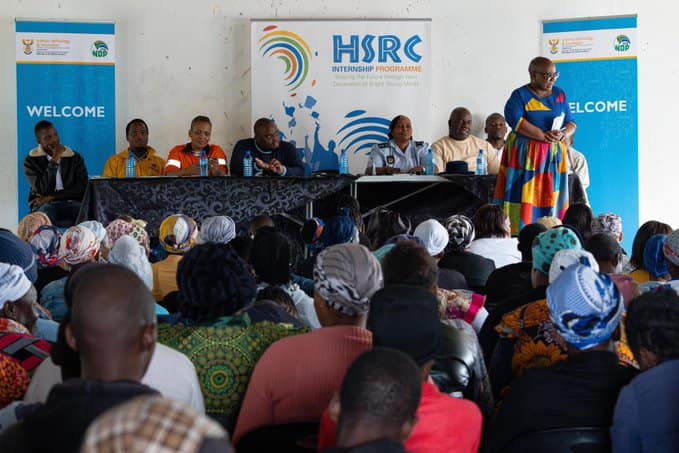
Before a crowd of several hundred community members—farmers, teachers, students, pensioners, and traditional leaders—Dr Gina kicked off a Freedom Month engagement that felt less like a government briefing and more like a revival meeting for the rational age.
“Quando, quando? When will our lives improve? That is the question I hear everywhere I go,” Dr Gina said, switching seamlessly between English and isiZulu, her voice amplified by a portable speaker borrowed from a local taxi rank. “I am here today to tell you: the answer is not someday. The answer is now. And the key is not waiting for someone to save you. The key is science.”
The crowd, initially skeptical, began to lean forward.
The Problem: A Municipality on the Edge
uMhlabuyalingana is one of KwaZulu-Natal’s most remote and underserved municipalities. It shares a border with Mozambique and eSwatini. Its coastline includes parts of the iSimangaliso Wetland Park, a UNESCO World Heritage Site. Its people are predominantly rural, subsistence farmers and cross-border traders who have learned to survive with minimal state support.
But survival is not thriving. And for years, the community has felt forgotten.
“We have no library,” said Themba Ndlovu, a 52-year-old father of four who walked 7 kilometers to attend the event. “We have no youth center. The clinic runs out of medicine. The roads wash away every rainy season. And the politicians come, they take pictures, they promise, and they leave. We have learned not to hope.”
That cynicism—hard-earned and deeply felt—was the real adversary Dr Gina had come to confront. She did not pretend otherwise.
“I am a woman from the Eastern Cape. I grew up without running water. I studied by candlelight. I know what it is to feel that the state does not see you,” she told the crowd, her voice softening. “But I also know that science lifted me. It gave me tools my mother could not imagine. And I am here to give those tools to you.”
The Solutions: Technology in Action
The Deputy Minister did not come empty-handed. She brought with her a mobile exhibition unit—a converted shipping container painted in bright colors, filled with interactive displays and staffed by young science graduates from the South African National Space Agency (SANSA) and the Council for Scientific and Industrial Research (CSIR).
Inside the container, community members saw, for the first time, how satellite imagery is being used to predict drought patterns in their own district. On a large screen, a map of uMhlabuyalingana glowed in blues and browns, showing soil moisture levels, vegetation health, and water table depths.
“This is not someone else’s data,” explained Dr Thabo Mkhize, a CSIR geographer. “This is your land. We can tell you, with 90% accuracy, which fields will produce a crop this season and which will fail. That means you can plant smarter. You can save seeds. You can feed your children.”
A woman in a yellow headscarf raised her hand. “And this is free? For us? They don’t charge?” The room laughed, but the question was serious.
“Free,” Dr Gina confirmed. “Paid for by your taxes. Because you own this technology. It belongs to South Africa. And South Africa is you.”
Safety and Security: Eyes in the Sky
Perhaps the most dramatic demonstration involved crime prevention. uMhlabuyalingana, like many rural border communities, has struggled with stock theft, cross-border smuggling, and a sense of lawlessness in remote areas.
Dr Gina showed how a pilot project using low-cost drones and community-based sensor networks has already reduced stock theft by 40% in two neighboring traditional councils.
“We call it ‘community techno-vigilance,'” she said. “You are the eyes. The technology is the ears. Together, we create a system where criminals cannot hide.”
A group of young men, cattle herders by trade, listened with intense focus. One of them, 23-year-old Sipho Zungu, approached the microphone afterward.
“Deputy Minister, we herd cows many kilometers from home. Sometimes we are gone for days. We worry about our animals. If this drone thing can help us… we will learn. We will do the training. Just tell us when.”
Dr Gina smiled and reached into her bag, pulling out a business card. “Call my office on Monday. Not next year. This Monday. We will start.”
Youth and the Future: Coding in the Countryside
The engagement was not only about fixing present problems. It was about planting seeds for a future where young people do not have to leave uMhlabuyalingana to find opportunity.
Dr Gina announced a new pilot program: a mobile coding and robotics lab that will visit five rural schools in the municipality over the next six months. The lab, a brightly painted bus equipped with laptops, 3D printers, and satellite internet, will teach basic programming to learners as young as ten.
“Your children are not less smart than children in Sandton,” Dr Gina said, her voice rising. “They only have less access. We are going to fix that. We are going to bring the classroom to the kraal. And we are going to produce the next generation of African innovators—right here, in uMhlabuyalingana.”
The announcement was met with cheers, especially from the schoolchildren who had been bused in from local primary schools. A 14-year-old girl named Nomfundo Mthethwa, wearing a faded school uniform two sizes too big, stood up and asked a question that brought a hush to the crowd.
“Deputy Minister, my mother is a domestic worker in Richards Bay. She comes home once a month. I want to be a engineer so I can build things here so she does not have to leave. Can you help me?”
Dr Gina walked across the dusty ground, took the girl’s hand, and spoke quietly into the microphone. “Nomfundo, I was you. I was a girl with a dream and no one to believe in me. Today, I am a Deputy Minister. And I am not leaving this place until I have your name and your number. We will find a way. I promise you.”
The crowd erupted in applause. Several women wiped tears from their eyes.
Access to Services: Cutting Red Tape with Tech
The Deputy Minister also demonstrated how digital platforms are already improving access to government services in the municipality. A live demonstration of the govchat system—a WhatsApp-based platform that allows residents to apply for birth certificates, social grants, and identity documents—showed how technology can bypass the long queues and missing files that have plagued rural administration.
“We have processed 1,200 applications in this municipality in the last three months alone,” said a Department of Home Affairs official who accompanied the Deputy Minister. “Every one of those applications was done on a phone. No travel to the nearest town. No waiting for hours. Just a WhatsApp message.”
An elderly man, walking with a cane, stood up slowly. “I have been trying to get my pension re-registered for eight months,” he said, his voice trembling. “I have walked to the office five times. Each time they say come back. Can this phone thing help me?”
Within ten minutes, a young volunteer had helped the man, whose name was Bheki Mkhabela, complete his application. He stared at his phone in disbelief.
“That’s it? It’s done?” He looked at the screen, then at the Deputy Minister, then back at the screen. “Eight months. And now… eight minutes?”
Dr Gina nodded. “That is science, Baba Mkhabela. That is democracy. That is what we are building.”
The Bigger Picture: Freedom Month with Teeth
Freedom Month in South Africa is often marked by speeches, flag-raising ceremonies, and nostalgic recollections of the struggle against apartheid. But Dr Gina has made it her mission to redefine what freedom means in 2026.
“Freedom is not a history lesson,” she told the crowd. “Freedom is a 14-year-old girl learning to code. Freedom is a grandmother receiving her pension without walking 20 kilometers. Freedom is a farmer knowing when to plant. That is what science gives us. That is the democracy we are fighting for.”
Her approach—part policy wonk, part community activist, part motivational speaker—seems to be resonating. The engagement in Mbazwana was the fifth in a series of rural visits, and each one has drawn larger crowds than the last.
“The old model was top-down,” said Dr Gina’s spokesperson, Bongani Ndlovu. “The Deputy Minister believes in bottom-up. You don’t tell communities what they need. You ask them. Then you show them how science can help. It’s basic democracy. But it’s revolutionary when most people have never seen it in action.”
Challenges Ahead: From Demonstration to Delivery
For all the optimism of the day, no one pretended that a single community engagement would transform uMhlabuyalingana overnight. The municipality remains deeply under-resourced. The digital divide is real—not everyone has a smartphone or reliable data. And government departments have a long and unhappy history of announcing pilot programs that quietly die.
Dr Gina acknowledged these challenges candidly.
“We cannot promise to fix everything tomorrow. That would be a lie,” she said. “But we can promise to start. We can promise to be honest with you. We can promise to come back, again and again, until the job is done. That is not politics. That is accountability.”
She also announced a follow-up visit in three months, during which she will personally review progress on each of the initiatives unveiled on Wednesday.
“I will be here,” she said. “And I expect you to be here too. With questions. With complaints. With demands. Because that is how democracy works. We push each other. We hold each other accountable. And we build, together.”
Community Response: Cautious Hope
The mood as the crowd dispersed was a mixture of elation and skepticism. Many had been disappointed before. But something about Dr Gina’s directness, her refusal to offer empty platitudes, and her willingness to get her hands dirty—quite literally, as she helped set up the mobile lab herself—seemed to have struck a chord.
“I have seen many politicians,” said Nokuthula Dlamini, a 45-year-old community health worker. “They come, they speak, they leave. But this one… she stayed. She answered every question. She gave her phone number to that girl. That is different. I don’t know if it will work. But it is different.”
Sipho Zungu, the young cattle herder who asked about drones, was already on his phone, calling the number on Dr Gina’s business card.
“They said call Monday,” he said with a grin. “But I am calling today. I want to be the first.”
Epilogue: The Marula Tree and the Future
As the sun began to sink toward the Mozambique border, painting the sky in shades of orange and gold, Dr Gina stood alone for a moment under the marula tree where the engagement had been held. The crowd had gone. The mobile lab was packed up. The satellite dishes were folded.
An old woman, one of the last to leave, approached her and pressed a small plastic bag into her hands. Inside were dried herbs—a traditional gift for honored guests.
“Take this,” the woman said in isiZulu. “You have a good heart. But the road is long. You will need strength.”
Dr Gina accepted the gift with both hands, bowing her head. “Ngiyabonga, Mama. I will not forget this place. I will not forget you.”
And then she climbed into her car, the dust rising behind her as she headed back toward the N2, back toward Pretoria, back toward the endless meetings and budgets and bureaucratic battles that awaited.
But for one day, in one small corner of rural KwaZulu-Natal, science and democracy had met in the dust. And something new had begun to grow.
About The Author