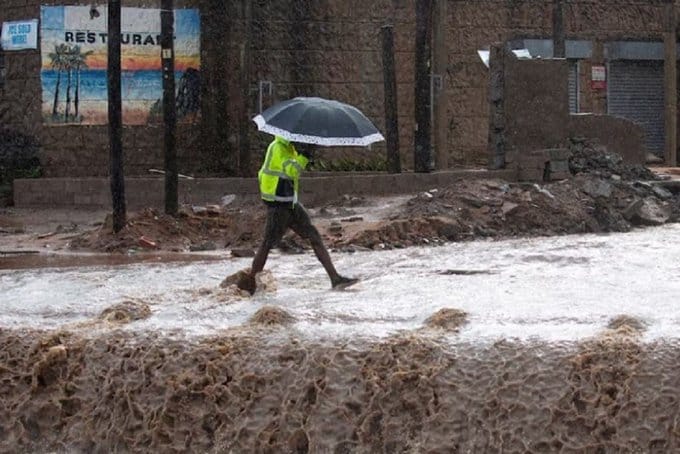
For a week, the rain did not stop. It fell in sheets, in curtains, in relentless, pounding waves that turned dusty streets into muddy rivers, gardens into swamps, and homes into watery graves for the possessions of the poor. The North West province, known for its sweeping plains, its maize fields, and its harsh, sun-baked beauty, has been transformed into a waterlogged disaster zone.
As the clouds finally began to part on Thursday, revealing a pale, watery sun for the first time in days, the true scale of the devastation began to emerge. Roads have been washed away. Bridges are submerged. Homes have collapsed. Families have been displaced. And at least four people have lost their lives—swept away by flash floods that came with no warning in the dead of night.
The North West Department of Cooperative Governance, Human Settlements and Traditional Affairs (COGHSTA) has announced that disaster management teams are now conducting detailed assessments in all affected areas. The teams, working in coordination with the South African National Defence Force (SANDF), the South African Police Service (SAPS), and various non-governmental organisations (NGOs), are fanning out across the province to quantify the damage, identify the most urgent needs, and coordinate the relief effort.
“The priority is to ensure that no one is left stranded,” said MEC for COGHSTA, Collen Maine, in a statement. “We are deploying teams on the ground, using whatever resources we have, to reach every affected community. The assessment will take time. The damage is extensive. But we will not rest until we know the full extent of the crisis and have a plan to address it.”
The Affected Areas: From the City to the Bush
The heavy rainfall, which began on Friday, 17 April 2026, has affected virtually every corner of the North West province. But some areas have been hit harder than others.
- Mahikeng (Capital): The capital city has recorded over 300mm of rain in the past week—nearly half its annual average. The Molopo River, which runs through the city, burst its banks, flooding low-lying areas including the suburbs of Golf View, Danville, and Montshiwa. Hundreds of homes have been inundated. Families have been evacuated to community halls and churches.
- Rustenburg (Platinum Belt): The mining hub has experienced severe flash flooding, with several informal settlements—including Freedom Park and Phokeng—particularly hard hit. Mudslides have blocked roads leading to the mines, disrupting operations and leaving thousands of workers stranded.
- Potchefstroom (Academic Hub): The North-West University campus was partially submerged, forcing the cancellation of classes and the evacuation of student residences. The Mooi River, which flows through the town, rose to its highest level in 50 years.
- Klerksdorp and Orkney (Goldfields): These towns, built around the mining industry, have seen widespread damage to infrastructure, including the collapse of a bridge on the N12 highway, cutting off a major transport route between Gauteng and the Northern Cape.
- Rural areas: Villages across the province, many accessible only by dirt roads, have been cut off from the outside world. In the small village of Reagile, near Zeerust, 50 families have been trapped for three days, with no food, no clean water, and no communication with the outside world. Disaster teams are attempting to reach them by helicopter.
“The rural areas are the most vulnerable,” said a disaster management official. “They have no infrastructure to speak of. Dirt roads become impassable. Bridges are washed away. Cell towers lose power. People are literally cut off. It takes time to reach them. Time we do not have.”
The Human Toll: Stories from the Survivors
Behind the statistics are real people. Real stories. Real suffering.
Makgabo Mthembu, 45, Mahikeng: “I woke up at 3 AM to the sound of water rushing into my bedroom. I thought I was dreaming. But then I felt the cold. The water was up to my ankles. My children were screaming. I grabbed them—one under each arm—and ran. I did not take anything. Not my phone. Not my purse. Not my shoes. We ran to the neighbour’s house. By morning, our home was gone. Everything we owned. Gone.”
Johannes Mokwena, 58, Rustenburg: “I have lived in this village for 30 years. I have never seen rain like this. The river came up so fast. We tried to save our livestock, but it was impossible. I lost 20 goats. My entire herd. That was my retirement. My children’s inheritance. Gone. The government says they will help. But how? They cannot bring back my goats.”
Thabo Ndlovu, 22, Potchefstroom (student): “We were sleeping in the residence when the fire alarm went off. We thought it was a drill. We walked outside, and the water was already up to our knees. The entire ground floor of the residence was flooded. Our textbooks, our laptops, our clothes—all destroyed. The university says they will help. But the academic year is disrupted. We may have to repeat the semester. I cannot afford that.”
Nomsa Khumalo, 34, Reagile (trapped for three days): “We have no food. We have no clean water. The river took our only road. We have been drinking from the river, but we know it is contaminated. My children have diarrhoea. My baby is feverish. We need help. Please. Send help.”
As of Thursday afternoon, the official death toll stands at four. But authorities fear that number may rise as floodwaters recede and rescue teams gain access to isolated areas.
- A 7-year-old boy in Mahikeng was swept away while trying to cross a flooded street. His body was found 2 kilometers downstream.
- A 32-year-old woman in Rustenburg drowned when her car was swept off a low-water bridge.
- A 65-year-old man in Klerksdorp died of a heart attack while trying to salvage belongings from his flooded home.
- An infant in Reagile is missing, presumed dead, after the family’s shack collapsed into a swollen river.
“The death toll is a tragedy,” said MEC Maine. “Every life lost is a family destroyed. We send our deepest condolences to the families. We will do everything in our power to support them.”
The Infrastructure Damage: A Province in Ruins
Beyond the human toll, the flooding has caused extensive damage to infrastructure across the province.
Roads and Bridges: Preliminary assessments indicate that over 500 kilometers of roads have been damaged or destroyed, including sections of the N12, N14, and N18 highways. Dozens of bridges have been washed away or rendered unsafe for use. The cost of repairs is expected to run into the hundreds of millions of rands.
Electricity: Heavy rains and flooding have knocked out power to an estimated 50,000 households. Eskom crews are working around the clock to restore electricity, but some areas may remain without power for weeks.
Water Supply: Several water treatment plants have been damaged or overwhelmed by the floods, leading to water shortages in Mahikeng, Rustenburg, and Potchefstroom. Residents have been advised to boil tap water before drinking or to rely on bottled water.
Housing: More than 2,000 homes have been damaged, with over 500 completely destroyed. The majority of the damaged homes are in informal settlements, where structures are poorly built and offer little protection against the elements.
Agriculture: The maize belt, which stretches across the North West province, has been devastated. Thousands of hectares of crops have been flooded, destroying the harvest and threatening food security. Livestock losses are also significant.
“This is not just a humanitarian crisis,” said an agricultural economist. “It is an economic crisis. The North West is the breadbasket of the country. If the harvest is destroyed, food prices will rise. Inflation will spike. The poor will suffer the most.”
The Assessment Process: How Disaster Teams Operate
The detailed assessments now underway are a critical first step in the disaster response. The teams, led by provincial disaster management officials, include engineers, social workers, health professionals, and logistics experts.
The assessment process involves:
- Reconnaissance: Teams are airlifted by helicopter or drive to affected areas to establish an initial picture of the damage.
- House-to-house surveys: Teams go door-to-door, interviewing residents, photographing damage, and collecting data on the number of people affected, the extent of property damage, and the immediate needs (food, water, shelter, medical care).
- Infrastructure inspections: Engineers inspect roads, bridges, power lines, and water treatment plants to determine what is safe to use and what needs repair.
- Needs analysis: The data is collated and analysed to determine the priorities for relief and recovery.
- Resource allocation: Based on the needs analysis, resources—food, water, blankets, tents, building materials—are allocated to the most affected areas.
“It is a massive logistical operation,” said a disaster management official. “We are talking about thousands of square kilometers, hundreds of villages, millions of people. It is like a wartime operation. But we have done it before. We will do it again. We have to.”
The Relief Effort: What Is Being Done
While the assessments are underway, the relief effort is already in motion.
Emergency shelter: Community halls, churches, schools, and other public buildings have been opened as emergency shelters. As of Thursday, approximately 5,000 people are staying in shelters across the province.
Food and water: The Department of Social Development is distributing food parcels and bottled water to affected families. Thus far, 10,000 food parcels have been distributed. The South African Red Cross Society is also on the ground, providing hot meals and psychological first aid.
Medical care: Mobile clinics have been deployed to affected areas, providing primary healthcare, vaccinations, and treatment for waterborne diseases. The National Institute for Communicable Diseases (NICD) is monitoring for outbreaks of cholera, typhoid, and other water-related illnesses.
Search and rescue: The SANDF has deployed helicopters and rescue swimmers to assist with search and rescue operations. The focus is on reaching isolated communities and evacuating those at risk.
Psychosocial support: Trauma counsellors are being deployed to affected communities, recognising that the psychological impact of the floods may be as severe as the physical impact.
“The flooding is not over,” said a SANDF spokesperson. “There is more rain forecast for the weekend. We are preparing for the worst while hoping for the best.”
The Call for Help: A Nation Responds
The North West government has called for assistance from the national government, the private sector, and ordinary South Africans.
The national government has responded by declaring the North West a provincial disaster area, unlocking access to emergency funding and resources. The South African National Defence Force has been deployed. The National Disaster Management Centre (NDMC) is coordinating the response.
The private sector has also stepped up. Mining companies in Rustenburg have donated equipment, fuel, and personnel. Retailers have donated food, water, and blankets. Construction companies have offered heavy machinery for road repairs.
Ordinary South Africans have also answered the call. Donations are pouring into collection points across the country. Social media campaigns are raising funds. Volunteers are traveling to the North West to assist with relief efforts.
“We are overwhelmed by the response,” said MEC Maine. “It shows that South Africans are capable of great compassion. It shows that we are not a selfish people. We are a people who care for one another. That gives me hope.”
How You Can Help:
- Monetary donations: Can be made to the North West Disaster Relief Fund at any FNB branch (account number 123456789, branch code 12345).
- In-kind donations: Food, water, blankets, clothing, and hygiene products can be dropped off at any collection point (list available on the provincial government’s website).
- Volunteers: Qualified volunteers (medical personnel, engineers, social workers) can register through the Department of COGHSTA.
- Blood donation: The South African National Blood Service (SANBS) has put out an urgent call for blood donations to support flood victims.
The Weather Forecast: More Rain on the Horizon
While the skies have cleared temporarily, the weather forecast is not encouraging. The South African Weather Service (SAWS) has issued a warning for more heavy rainfall over the weekend, particularly in the eastern parts of the province.
“There is a high probability of further flooding,” said a SAWS meteorologist. “The ground is already saturated. The rivers are already full. Any additional rain will quickly lead to renewed flooding. We urge residents in low-lying areas to remain vigilant and to evacuate if advised to do so.”
The provincial government has activated a flood warning system, sending SMS alerts to residents in high-risk areas. But many people in rural areas do not have cellphones or electricity to charge them.
“We are using every means of communication,” said MEC Maine. “Radio announcements. Loudhailers. Even word of mouth. We are doing our best. But we cannot reach everyone. That is the reality.”
The Long Road to Recovery: What Comes Next
Once the floodwaters recede and the immediate crisis has passed, the long road to recovery will begin.
Phase 1: Stabilisation (weeks)
- Restore basic services (water, electricity, sanitation)
- Provide emergency shelter and food
- Prevent disease outbreaks
Phase 2: Reconstruction (months)
- Repair roads, bridges, and other infrastructure
- Rebuild damaged homes
- Restore livelihoods (agriculture, small businesses)
Phase 3: Resilience (years)
- Invest in flood defences (dams, levees, drainage systems)
- Improve early warning systems
- Relocate communities from high-risk areas
- Address the underlying causes of vulnerability (poverty, inequality, lack of affordable housing)
“The recovery will take years,” said a disaster management expert. “And it will cost billions. The question is whether the government will commit the necessary resources—and whether the international community will help.”
The Final Word: A Province in Mourning, a People Resilient
As the sun set over Mahikeng on Thursday evening, casting a golden glow over the muddy streets and the damaged homes, the people of the North West province began the slow, painful process of picking up the pieces.
In a church hall in Danville, 50 families huddled together, sharing blankets, sharing food, sharing stories. A woman sang a hymn. Others joined in. A child laughed for the first time in days.
“We have lost everything,” said Makgabo Mthembu, the woman who had fled her home with her children. “But we have not lost each other. We have not lost our faith. We have not lost our hope. The rain will stop. The sun will shine. And we will rebuild. That is what we do. That is who we are.”
The rain may have stopped, but the work is just beginning. The assessments are underway. The relief is flowing. The nation is watching.
And the people of the North West, battered but not broken, are determined to rise again.
*The North West Department of COGHSTA has established a hotline for flood-related inquiries: 0800 123 456. Residents in need of emergency assistance should contact the provincial disaster management centre at 018 123 4567. The South African Weather Service has issued an orange level 5 warning for further heavy rainfall in the North West province for Saturday, 25 April 2026.*
About The Author