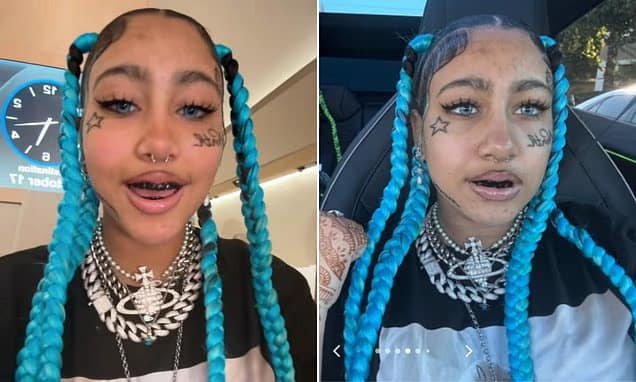
The latest firestorm in the ever-public lives of the Kardashian-West family was ignited not by a new business venture, but by a series of TikTok videos from their 12-year-old daughter, North West. Shared on October 21, the clips showcased a dramatic transformation: North sported vibrant blue braids, striking colored contact lenses, dramatic fake eyelashes, a metallic grill on her teeth, a faux nose ring, and an array of temporary face tattoos. Garnering millions of views within hours, the videos instantly became a cultural Rorschach test, sparking a fierce and multifaceted debate over parenting, performance, and the right to a childhood in the spotlight.
The immediate backlash was swift and pointed, with a significant portion of criticism directed at her mother, Kim Kardashian. Critics questioned Kardashian’s permissive parenting, accusing her of allowing her pre-teen daughter to adopt an overly sexualized and mature aesthetic. This criticism was sharply amplified when resurfaced clips of North’s father, Kanye West, began recirculating online. In these videos, West is seen expressing visible frustration over North’s previous TikTok activities and voicing his concerns about co-parenting dynamics, providing a jarring counter-narrative to the curated reality presented on social media.
However, a vocal contingent of supporters rushed to defend both North and her mother. They framed the look as creative, age-appropriate expression, noting its timing close to Halloween and identifying it as a clear homage to rising rapper Molly Santana, known for a similar bold and alternative style. To these defenders, the backlash was a case of misplaced outrage, punishing a child for engaging in the kind of imaginative play that is typical for her age, albeit on a global platform.
Beneath the surface of the parenting debate lies a more profound conversation about the privacy of celebrity children born into immense fame. North West has never known a life without paparazzi and public scrutiny, and this incident has fueled ongoing discussions about the ethics of media coverage and the long-term impact of growing up under a microscope. Commentators have noted a perceived bias in the coverage, with some outlets framing the story as a parenting failure while others champion it as youthful creativity.
Ultimately, the episode is about more than just temporary tattoos and blue hair. It represents the latest flashpoint in the complex negotiation of identity for the children of mega-celebrities. It raises difficult questions: Where is the line between supporting a child’s self-expression and protecting their innocence? And in the age of social media, can the children of the famous ever truly claim a narrative of their own, or are their every move destined to become a proxy for larger cultural battles? For now, North West’s TikTok has provided no easy answers, only millions of opinions.
About The Author