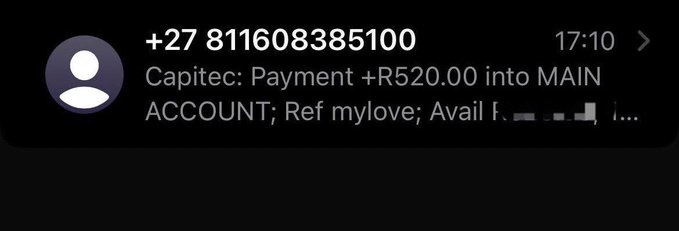
It started with a screenshot. A Capitec Bank notification, glowing blue on a smartphone screen, showing a transfer of R520. The reference line read: “Ref mylove.” Innocent enough, perhaps even sweet. But for the woman who received it, the R520 was not a gift. It was an insult. A half-measure. A symbol of everything wrong with modern dating.
The woman, identified only as Mo on social media, had requested an emergency payment of R2,000 from the man she was seeing. He sent R520 instead. Her response? She blocked him. Then she posted the receipt online, and the internet exploded.
“Imagine requesting R2,000 and he sends R520,” Mo wrote in the now-viral post on X (formerly Twitter). “I told him I had an emergency. He had all day to send the full amount. Instead, he sends this and thinks I should be grateful. Blocked. Next.”
The post has since been viewed over 8 million times, shared tens of thousands of times, and generated a furious debate that shows no signs of cooling. Men’s rights activists have condemned Mo as entitled and greedy. Women’s advocates have defended her right to set standards. Comedians have turned the saga into memes. And radio hosts, influencers, and ordinary South Africans have weighed in with opinions as divided as the country’s politics.
At the heart of the storm is a simple question: In a strained economy, what does a partner owe?
The backstory: R2,000, an emergency, and a partial payment
According to screenshots and subsequent posts shared by Mo, the situation unfolded on a Tuesday morning. She claims she woke up to an urgent financial crisis — she did not specify the nature of the emergency, leading some to speculate it was rent, medical expenses, or debt repayment — and reached out to the man she was dating for help.
“I don’t ask for money easily,” Mo wrote in a follow-up post. “I work. I pay my own bills. But this was an emergency. I needed R2,000. He said he would help. He had the whole day. He sent R520 at 9 PM. With a love note. As if that fixes anything.”
The man, whose identity remains unknown, did not publicly respond. But his partial payment — and the affectionate reference line — suggested an attempt to help within his means while maintaining affection.
Mo was not impressed.
“He had all day to send R2,000,” she wrote. “He chose to send R520. That is not help. That is a performance. I blocked him because a man who cannot provide fully is not a man I need.”
The blocking, she explained, was not about the money itself but about what the partial payment represented: a lack of seriousness, a lack of commitment, a lack of the “provider mentality” she expects from a partner.
“If he wanted to, he would,” she wrote, invoking the popular dating mantra. “He didn’t. So I moved on.”
The backlash: ‘Entitled’ and ‘delusional’
The reaction from male commentators was swift and brutal.
Radio host Sizwe Dhlomo, one of South Africa’s most influential media personalities, weighed in during his morning show on Kaya 959.
“Let me understand this,” Dhlomo said, his voice dripping with sarcasm. “You asked a man for R2,000. He sent you R520 — which is still money, by the way — and you blocked him? Because it wasn’t enough? In this economy? Do you hear yourself?”
Dhlomo urged women to be more realistic about what men can afford, especially in a country where unemployment hovers above 32% and the cost of living continues to rise.
“A man sends you what he can, when he can, and you punish him for it?” Dhlomo continued. “That is not standards. That is entitlement. That is how you end up alone.”
His comments were echoed by thousands of men on social media, who accused Mo of being “delusional,” “greedy,” and “financially abusive.”
“You are not entitled to anyone’s money, emergency or not,” wrote one user. “He sent what he could. That is love. Blocking him is cruelty.”
Another added: “R520 is a lot of money to many people. The fact that she dismissed it like trash says everything about her character.”
The other side: ‘R520 is insulting’
But Mo also found defenders — mostly women who argued that a partial payment in an emergency is worse than no payment at all.
“If I ask for R2,000 for an emergency, it means I NEED R2,000,” wrote one user. “Not R520. Not ‘something.’ The full amount. Sending less does not help. It just shows you don’t take me seriously.”
Another added: “He had all day to send the full amount. He chose to send R520 at 9 PM with a cute note. That is not love. That is manipulation. She was right to block him.”
Some pointed out that the man could have communicated his financial limits instead of sending a partial payment with a romantic reference line.
“If he could only afford R520, he should have said so,” wrote a user. “Instead, he sent it with ‘Ref mylove’ as if that makes up the difference. That is performative. That is insulting.”
The influencer take: ChrisExcel102 and the ‘unemployed women’ jab
The controversy took a sharp turn when influencer ChrisExcel102, known for his provocative takes on dating and finance, entered the fray.
“Imagine dating an unemployed woman in 2026,” ChrisExcel wrote. “She asks for R2,000. You send R520. She blocks you. And then she posts it online. This is why you date women who have their own money. Entitlement is a disease.”
The post was liked over 50,000 times and quoted by dozens of other accounts. It also drew fierce backlash from women who accused ChrisExcel of mocking unemployed South Africans during a cost-of-living crisis.
“Not everyone is unemployed by choice,” wrote one user. “The economy is destroyed. People are struggling. Mocking unemployed women is not a flex. It is cruelty.”
Another added: “ChrisExcel talks like every woman who is struggling deserves disrespect. That is not the flex he thinks it is.”
ChrisExcel doubled down, posting a follow-up: “I am not mocking poor people. I am mocking entitled people. There is a difference. If you have no job and no money, you should not be demanding R2,000 from anyone. Get your life together first.”
The economic context: South Africa’s strained reality
The debate over R2,000 cannot be separated from the economic reality in which it is happening. South Africa is in the grip of a prolonged cost-of-living crisis. Unemployment is at 32.9%. Youth unemployment exceeds 45%. Food inflation has only recently begun to moderate after months of double-digit increases. Fuel prices remain volatile. And wages have largely stagnated.
For many South Africans, R520 is not a small amount. It is a week’s groceries. A month’s electricity. A child’s school uniform. A significant chunk of a monthly budget.
“When I saw people calling R520 ‘nothing,’ I realized how disconnected some people are,” wrote one user. “R520 is life-changing money for millions of South Africans. The fact that she dismissed it so casually tells me she has never truly struggled.”
Others argued that the amount is relative and that Mo’s expectations should be judged in context.
“If she is dating a man who drives a BMW and eats out every night, R520 is insulting,” wrote another. “If she is dating a man who is also struggling, R520 might be everything he has. We don’t know the context. That is why judging is dangerous.”
The ‘provider’ debate: What do men owe?
At its core, the Mo controversy is about the evolving expectations of gender roles in relationships. Does a man have a duty to provide financially? If so, how much? And what happens when he cannot?
Traditional gender norms — still powerful in many South African communities — hold that a man should be the primary provider. He should pay for dates, cover rent, and step up in emergencies. A man who cannot provide is seen as less of a man.
But feminists and progressives have pushed back against this model, arguing that it is outdated, patriarchal, and financially unsustainable in a modern economy where women also work.
“We cannot have it both ways,” said relationship coach Dr. Nomsa Khumalo. “Women want equality in the workplace and at home, but many still expect men to be the sole providers in emergencies. That is a contradiction. If we want equal partnerships, we have to accept equal financial responsibility — even in hard times.”
Mo’s defenders reject that argument, pointing out that she works and pays her own bills. The emergency payment, they argue, was an exception, not the rule.
“She is not asking him to fund her life,” wrote one supporter. “She had an emergency. She needed help. He failed her. That is not about gender roles. That is about partnership. If your partner cannot step up in an emergency, what are they even there for?”
The viral economy: Is this just engagement bait?
As the debate raged, a growing number of users suggested that the entire saga might be fabricated — a “rage bait” post designed to generate engagement, followers, and ultimately money.
“Nobody blocks someone over R520 and then posts the receipt,” wrote one skeptical user. “This is fake. She is farming interactions. And everyone fell for it.”
Others pointed out that Mo’s account was relatively new and had gained thousands of followers since the post went viral.
“Check the dates,” wrote another. “She posted this, gained 10,000 followers in 24 hours, and now she is selling ‘relationship advice.’ This is a grift. And we are the marks.”
Mo has denied the allegations, posting a follow-up video in which she insisted the story was true.
“I don’t care if you believe me,” she said. “I know what happened. I know why I blocked him. You can think it’s fake. That doesn’t change my reality.”
Whether true or not, the post has succeeded in generating exactly what it was designed to generate: attention. And in the attention economy, attention is currency.
The radio host’s warning: ‘Be careful what you normalise’
Sizwe Dhlomo returned to the topic later in the week, expanding on his initial comments and warning both men and women about the dangers of viral dating drama.
“When you post something like this, you are not just telling your story,” he said. “You are shaping how young people think about relationships. You are normalising blocking someone over a partial payment. You are teaching young men that no amount is ever enough. You are teaching young women that a man’s wallet is the only thing that matters. That is dangerous.”
Dhlomo urged his listeners to communicate with their partners rather than airing grievances online.
“If you need R2,000 and he sends R520, have a conversation,” he said. “Ask him: ‘Is this all you have? Can you send more later?’ Maybe he is struggling too. Maybe he is embarrassed. Maybe he needs grace, not a screenshot and a block.”
The final word: A divided nation
The Mo saga has no clear resolution. The man has not spoken. Mo has not apologized. The debate continues to rage, with new posts, new hot takes, and new arguments emerging every hour.
But beneath the noise, there is a deeper truth: South Africans are struggling. Money is tight. Relationships are strained. And social media has become a battleground where the frustrations of the real economy are fought out in 280-character skirmishes.
R520 is not nothing. R2,000 is not everything. And love — real love, the kind that survives emergencies and partial payments — is not measured in bank notifications.
But try telling that to the internet.
For now, Mo is single. Her ex (if he was ever officially an ex) is R520 poorer but possibly wiser. And millions of South Africans are arguing about who was right, who was wrong, and what any of it means.
In a country where survival is a daily struggle, the question of who owes what to whom is not just academic. It is personal. It is painful. And it is not going away.
The next time a Capitec notification lights up a phone, someone will think of Mo. Someone will hesitate before sending a partial payment. Someone will wonder if “Ref mylove” is enough.
And somewhere, a woman is deciding whether to block or forgive.
The debate continues. The economy struggles. And love — messy, complicated, and often underfunded — stumbles on.
About The Author