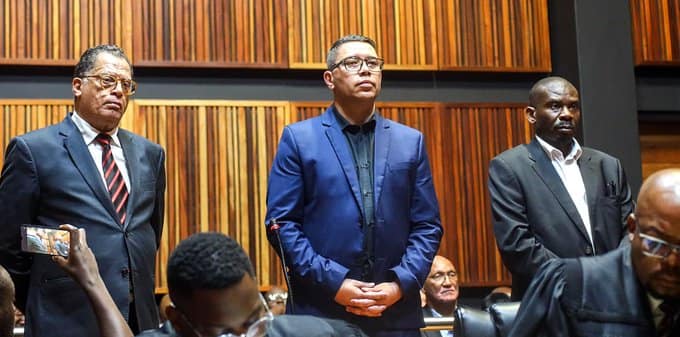
The man who once orchestrated the world’s greatest sporting spectacle—who stood on a podium in Zurich and brought the FIFA World Cup to African soil for the first time—walked into the Palm Ridge Magistrate’s Court on Monday morning with the weight of a different kind of legacy on his shoulders.
Dr. Danny Jordaan, the embattled president of the South African Football Association (SAFA), returned to the dock alongside his three co-accused as the long-running fraud and corruption case against them ground through yet another procedural chapter. For nearly an hour, the courtroom—packed with legal representatives, journalists, and a smattering of football officials—watched as the state and defense traded legal arguments, after which Magistrate Phillip Venter postponed the matter to 14 April 2026.
The postponement, while routine, offered little comfort to Jordaan’s supporters or his detractors. After more than two years of legal wrangling, the case has yet to reach a full trial. And for a man who once basked in the glow of global adulation, each court appearance chips away a little more at the statue he built.
The Accused
Jordaan, 74, faces charges of fraud and theft alongside three co-accused: SAFA chief financial officer Gronie Hluyo, and marketing consultant Trevor Neethling, who are both implicated in the alleged misappropriation of funds. A fourth individual, whose name has been withheld pending further investigation, has also been joined to the proceedings.
The charges stem from a sprawling investigation by the Hawks’ Serious Commercial Crime Unit, which alleges that between 2014 and 2018, approximately R1.3 million of SAFA’s funds was irregularly spent. According to the state’s indictment, the money was used for unauthorized purposes, including the hiring of a private security company to protect Jordaan and the procurement of marketing services that were never properly tendered.
Jordaan has consistently denied any wrongdoing, describing the charges as “politically motivated” and part of a broader campaign to tarnish his reputation. His legal team has argued that all expenditures were approved by SAFA’s executive committee and that the case represents a misunderstanding of the organization’s internal financial controls.
“The state is attempting to criminalize administrative decisions,” Jordaan’s lead counsel, Advocate Mike Hellens SC, told the court during an earlier hearing. “My client has served South African football with distinction for decades. He has not enriched himself. He has not stolen a single rand.”
The State’s Case
Prosecutor Lawrence Gcaba, however, painted a different picture. In previous court appearances, Gcaba has alleged that Jordaan and his co-accused acted “in concert” to circumvent SAFA’s financial protocols, authorizing payments to companies owned by or connected to the accused without proper disclosure.
The most serious allegation involves the hiring of a private security company called SSG Security. The state claims that the company was paid nearly R800,000 for services rendered to Jordaan personally, but that the invoices were disguised as “SAFA operational expenses” to avoid scrutiny.
“The accused knew exactly what they were doing,” Gcaba told the court last year. “They created a paper trail designed to hide the true beneficiaries of these payments. That is not an administrative error. That is fraud.”
Neethling, the marketing consultant, faces additional allegations related to a sponsorship deal with a major corporate partner. The state alleges that Neethling received commissions that were not disclosed to the SAFA board, effectively double-dipping from both the sponsor and the association.
A Legacy Under Siege
For many South Africans, the spectacle of Danny Jordaan in the dock is a painful one. He is, after all, the man who led South Africa’s successful 2004 World Cup bid, uttering the famous words, “This is for Africa,” as tears streamed down his face. The 2010 tournament remains a source of national pride, a moment when the country stood tall on the global stage.
But that was 16 years ago. In the intervening years, SAFA has been plagued by infighting, financial scandals, and allegations of mismanagement. Jordaan has survived multiple attempts to remove him from the presidency, but his grip on power has weakened with each court appearance.
“This is a tragedy,” said football analyst and author Sibusiso Mkhabela, speaking outside the courthouse. “Danny Jordaan is a giant of African football. But giants can fall. And when they fall, they fall hard. The question now is whether he will be remembered for the World Cup or for the handcuffs.”
Jordaan’s supporters, a dwindling but fiercely loyal group, see the case differently. They argue that the Hawks investigation is a witch hunt, driven by enemies within SAFA who have long resented Jordaan’s dominance.
“He has given everything to football,” said Thabo Mokoena, a former SAFA executive who attended Monday’s hearing to show support. “And this is how they repay him? With court cases and humiliation? It is not right.”
The Courtroom Scene
Monday’s proceedings were brief but tense. Jordaan arrived shortly before 9 a.m., dressed in a dark suit and tie, his silver hair neatly combed. He did not speak to reporters as he walked past the media scrum, but he paused briefly to shake hands with a small group of well-wishers.
Inside the courtroom, the atmosphere was formal but charged. Jordaan sat in the front row of the accused’s bench, flanked by his legal team. Hluyo and Neethling sat to his left, their faces impassive.
Magistrate Venter, who has overseen the case since its inception, listened as the state requested additional time to finalize a key witness list. The defense did not object, and the magistrate granted the postponement without comment.
The next hearing, scheduled for 14 April 2026, is expected to address outstanding disclosure issues. A trial date has not yet been set, but legal observers say it is unlikely to begin before late 2026 or early 2027.
“This case is moving at a glacial pace,” said legal analyst Nthabiseng Mofokeng. “That benefits the defense, because memories fade and witnesses become harder to find. But it also frustrates the public, who want to see accountability.”
The Political Context
The Jordaan case has also taken on a political dimension, intersecting with broader debates about governance in South African sport. In recent years, several high-profile sports administrators have faced corruption allegations, including former Athletics South Africa president Leonard Chuene and ex-SASCOC boss Gideon Sam.
Some see this as evidence of a systemic problem—a culture of impunity that has taken root in sporting bodies that receive millions in government funding.
“Sport in South Africa is not immune to the rot that has affected other sectors,” said Democratic Alliance shadow minister of sport Désirée van der Walt. “When public money is involved, there must be transparency and accountability. No one, not even the man who brought us the World Cup, should be above the law.”
Jordaan’s legal team has pushed back against this narrative, arguing that the case is a distraction from SAFA’s real work—developing football at the grassroots level and preparing Bafana Bafana for international competition.
What Lies Ahead
With the next court date set for mid-April, both sides will use the coming weeks to prepare. The state is expected to finalize its witness list, which is rumored to include several high-ranking SAFA officials who have agreed to testify. The defense, meanwhile, will continue its efforts to have certain pieces of evidence excluded.
For Jordaan, the stakes could not be higher. A conviction on fraud charges could carry a prison sentence of up to 15 years, effectively ending his career and shattering his legacy. An acquittal, on the other hand, would allow him to claim vindication and potentially return to the helm of SAFA with renewed authority.
But for now, there is only the waiting. The slow, grinding machinery of the criminal justice system, turning case by case, postponement by postponement.
As Jordaan left the Palm Ridge courthouse on Monday, he was met by a small group of journalists. He stopped briefly, adjusted his jacket, and offered a single sentence: “The truth will prevail.”
Then he climbed into a waiting sedan and disappeared into the Johannesburg traffic, leaving behind a courthouse full of unanswered questions and a nation still divided over whether to celebrate the man or condemn him.
Outside, a young boy in a Bafana Bafana jersey held up a handwritten sign. It read: “Danny, we still believe in you.”
His mother gently pulled the sign down and led him away. The case, like the boy’s sign, remains a matter of faith—until the law decides otherwise.
About The Author