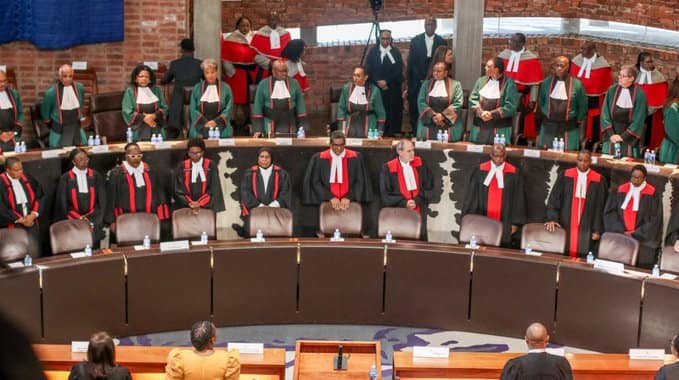
For three decades, the South African Human Rights Commission (SAHRC) has operated with a quiet but crucial assumption: that when it issued a directive—a finding, a recommendation, a binding order—the recipients were legally obligated to comply. That assumption was shattered on a crisp Thursday morning, when the Constitutional Court delivered a landmark ruling that will reshape the landscape of human rights enforcement in the country.
In a unanimous judgment read by Acting Justice Nthabiseng Masiya, the apex court upheld the Supreme Court of Appeal’s (SCA) 2025 decision, confirming that directives issued by the SAHRC are not legally binding. They are, in the court’s carefully chosen words, “persuasive but not enforceable”—recommendations dressed in the language of authority, but without the teeth to back them up.
The ruling stems from a protracted legal battle between the SAHRC and a private security company, which had refused to comply with a commission directive to reinstate a worker allegedly dismissed for whistleblowing. The company argued that the SAHRC had overstepped its constitutional mandate, which the court ultimately agreed with.
“We have long operated under the impression that our findings carried the weight of law,” a visibly shaken SAHRC official said outside the court, speaking on condition of anonymity. “Today, we learned that we have been issuing strongly worded suggestions. That is a devastating blow—not to us, but to the vulnerable people we are meant to protect.”
The Judgment: A Narrow Reading of the Constitution
The Constitutional Court’s reasoning was technical but consequential. Section 184 of the Constitution establishes the SAHRC and grants it the power to “investigate” and “report” on human rights violations, as well as to “take steps to secure appropriate redress.” For 30 years, the commission interpreted “take steps” to include issuing binding directives—orders that required individuals, companies, or government departments to take specific actions.
The court disagreed.
Writing for a unanimous bench, Acting Justice Masiya held that the SAHRC’s powers are investigative and promotional, not adjudicative or enforcement-oriented. The Constitution, the court noted, creates separate institutions for binding dispute resolution—the courts, the Public Protector (with certain limitations), and the Commission for Conciliation, Mediation and Arbitration (CCMA). The SAHRC, by contrast, was designed as a watchdog, not a prosecutor or a judge.
“The commission’s role is to shine a light,” Masiya wrote. “It is to expose, to recommend, to persuade, and to advocate. But where the Constitution intended to grant the power to issue binding orders, it did so expressly. It did not do so for the SAHRC. This court cannot read into the text what the framers chose to leave out.”
The judgment acknowledged the SAHRC’s important work over three decades but insisted that the remedy for non-compliance with its directives lies not in enforcement but in publicity—and, ultimately, in court action.
“If a party ignores a commission directive, the commission may approach a court to compel compliance,” Masiya continued. “But the directive itself is not self-executing. It is a trigger for further process, not the final word.”
The Dissent That Wasn’t: A Rare Moment of Judicial Unanimity
Notably, the ruling was unanimous—a rarity in the Constitutional Court, where even clear legal questions often produce vigorous dissents. Legal observers interpreted the lack of dissent as a sign that the court considered the issue legally straightforward, even if the consequences were politically explosive.
“There was no real legal ambiguity,” said Professor Lindiwe Ndlovu, a constitutional law expert at the University of Cape Town. “The text of Section 184 is quite clear. The SAHRC investigates and reports. It does not adjudicate. The mistake was not the court’s ruling; the mistake was the SAHRC’s assumption, shared by many, that its powers were broader than they actually are.”
But Ndlovu also warned that legal clarity does not always translate into practical wisdom.
“The court is technically correct. But technically correct is not always just. The SAHRC has been using these binding directives for 30 years. Many violators complied out of respect for the commission’s moral authority, not legal coercion. Now that authority is gone. And the court has offered no replacement.”
The SAHRC’s Response: Defiance Disguised as Acceptance
In a carefully worded statement issued hours after the judgment, SAHRC Commissioner Professor Bongani Majola struck a tone of reluctant acceptance mixed with barely concealed frustration.
“We respect the judgment of the Constitutional Court, as we must,” Majola said. “However, we note with deep concern that this ruling leaves a gaping hole in the architecture of human rights protection in South Africa. The commission will now be forced to rely almost entirely on moral suasion and public shaming—tools that have proven ineffective against repeat violators and well-resourced respondents.”
Majola announced that the SAHRC would immediately seek a meeting with the Minister of Justice and Correctional Services to discuss legislative amendments that would explicitly grant the commission binding directive powers—a move that would require Parliament to amend the South African Human Rights Commission Act, and potentially the Constitution itself.
“We will not abandon the vulnerable,” Majola said. “If the law as it stands is insufficient, we will change the law. The Constitution is a living document. It can be amended to reflect the needs of a maturing democracy. We intend to pursue that path.”
Legal experts noted that a constitutional amendment would require a two-thirds majority in the National Assembly and support from six of the nine provinces in the National Council of Provinces—a high bar in the current fractured political landscape.
The Victim: A Whistleblower’s Long Road
At the centre of the case—though largely invisible in the legal maneuvering—is a man named Vusi Ndlovu (not his real name). Ndlovu was a security guard at a private company when he reported his supervisor for falsifying attendance records and pocketing the wages of absent workers. He was dismissed two weeks later. The company cited “insubordination.” Ndlovu said it was retaliation.
The SAHRC investigated, found in Ndlovu’s favour, and issued a directive ordering the company to reinstate him with back pay. The company ignored the directive. The SAHRC went to court to compel compliance. The company challenged the SAHRC’s authority to issue binding directives in the first place. The rest is legal history.
“The company won,” Ndlovu said in a brief telephone interview, his voice heavy with exhaustion. “The courts said the commission has no power. So I am still jobless. The supervisor who stole is still there. And I am the one who spoke the truth. That is justice in South Africa.”
Ndlovu’s lawyer confirmed that they would now explore other legal avenues, including a direct application to the Labour Court for unfair dismissal. But that process could take years. And in the meantime, Ndlovu survives on piecework and the kindness of neighbours.
“I believed in the commission,” Ndlovu said. “I thought they could help me. Now I know they cannot. They can only write letters. And the people who hurt me can throw those letters in the bin.”
The Political Fallout: Opposition Parties Pounce
In Parliament, the ruling was met with predictable outrage from opposition parties, who accused the ANC government of allowing the SAHRC to be “neutered” through neglect.
“The ANC has spent 30 years building a human rights architecture that looked impressive on paper but had no foundation,” said DA shadow justice minister Glynnis Breytenbach. “Now the courts have exposed the rot. The SAHRC was a paper tiger. And today, the Constitutional Court confirmed that it has no claws.”
The EFF went further, calling for the immediate resignation of the SAHRC commissioners for “overselling their powers and misleading the public.”
“You cannot promise protection you cannot deliver,” said EFF MP Naledi Chirwa. “The SAHRC has been lying to us for 30 years. Every directive they issued was a lie. Every victim who believed them was betrayed. They must go.”
The ANC defended the commission, arguing that the ruling was a technical clarification, not an indictment of the SAHRC’s work.
“The commission has done tremendous work over three decades,” said ANC chief whip Mdumiseni Ntuli. “This judgment does not erase that. It simply clarifies the legal framework. We will now work with the commission to strengthen that framework through legislation.”
But critics noted that the ANC has held a majority for 30 years and could have amended the SAHRC’s powers at any time. It chose not to.
The Civil Society Reaction: A Coordinated Response
Human rights organisations reacted with alarm, convening an emergency meeting within hours of the judgment. The South African Litigation Centre, the Helen Suzman Foundation, Section27, and the Legal Resources Centre issued a joint statement warning of “catastrophic consequences for human rights enforcement.”
“The SAHRC is often the only recourse for poor and marginalised people who cannot afford lawyers,” the statement read. “Today’s ruling tells those people that the commission cannot help them in any enforceable way. They must go to court. But going to court costs money. And that is precisely what the violators are counting on.”
The organisations announced plans to launch a constitutional challenge of their own, arguing that the court’s interpretation of Section 184 is unduly narrow and inconsistent with the founding values of the Constitution. Alternatively, they will lobby for a constitutional amendment to explicitly grant the SAHRC binding directive powers.
“This is not over,” said a spokesperson for Section27. “The court has spoken, but the people have not. We will fight for an SAHRC with real power. Anything less is a betrayal of the Constitution’s promise.”
The International Dimension: South Africa’s Reputation at Risk
South Africa has long prided itself on its human rights architecture, often presenting itself as a model for post-conflict societies. The Constitutional Court’s ruling may damage that reputation.
The SAHRC is one of six Chapter Nine institutions established by the Constitution to support democracy and human rights. The others include the Public Protector, the Auditor-General, and the Electoral Commission. Each has faced legal challenges to its powers in recent years, but the SAHRC ruling is the most significant erosion of authority since the Constitutional Court limited the Public Protector’s remedial powers in the 2019 Eskom case.
“Internationally, this will be seen as another weakening of South Africa’s democratic guardrails,” said Dr. Sipho Mkhize, a human rights researcher at the University of the Witwatersrand. “The Chapter Nine institutions are already underfunded and overstretched. Now one of them has been told it has no teeth. That sends a terrible message to human rights defenders everywhere.”
The ruling may also affect South Africa’s standing before international bodies like the African Commission on Human and Peoples’ Rights and the UN Human Rights Council, both of which have previously cited the SAHRC’s powers as a model for other countries to follow.
What Happens Next: A Roadmap Without a Destination
The immediate practical impact of the ruling is that all pending SAHRC directives—potentially hundreds of cases—are now unenforceable. Each complainant must either negotiate a voluntary settlement with the alleged violator or pursue the matter in court, with all the costs, delays, and procedural hurdles that entails.
The SAHRC has announced that it will continue to investigate and issue directives, but will now explicitly state that those directives are recommendations, not binding orders. The commission will also expand its legal aid programme to help complainants take their cases to court—though the programme is severely underfunded.
Legislatively, the path forward is uncertain. An amendment to the SAHRC Act could be passed within months if there is political will. But a constitutional amendment would take years and require a level of cross-party consensus that has been absent in recent years.
In the meantime, Vusi Ndlovu—the whistleblower whose case started it all—remains unemployed. The company that fired him remains unpunished. And the SAHRC, stripped of its powers, can only watch.
“I used to tell people: if you are treated unfairly, go to the Human Rights Commission,” Ndlovu said. “Now I don’t know what to tell them. Maybe I tell them: pray. Because the law will not help you. The commission cannot help you. Only God is left.”
His voice cracked. He ended the call.
The Final Word: A Court, A Commission, A Country
The Constitutional Court did what courts are supposed to do: interpret the law as it is written, not as people wish it were. By that measure, the ruling is sound. The SAHRC was never granted binding powers. The assumption that it had them was a collective fantasy, shared by commissioners, activists, and the public alike.
But fantasies are sometimes necessary. They fill the gaps where reality falls short. For 30 years, the fantasy of a powerful SAHRC allowed vulnerable South Africans to believe that someone was watching, someone could act, someone would protect them.
Now the fantasy is gone. The commission remains. But without the power to enforce, it is a lighthouse with a dead bulb—visible, but unable to guide anyone to safety.
The struggle for human rights in South Africa will continue. It always does. But on a Thursday morning in Johannesburg, that struggle became significantly harder. And the most vulnerable—the Vusi Ndlovus of the country—are the ones who will pay the price.
About The Author