The air in the National Assembly was thick with suspicion long before Enoch Godongwana rose to his feet. For weeks, whispers had circulated through the corridors of Parliament—through coffee catch-ups in the members’ lounge, through encrypted WhatsApp groups, through the kind of off-the-record briefings that precede a political storm.
The whispers had a name: back-door spending.
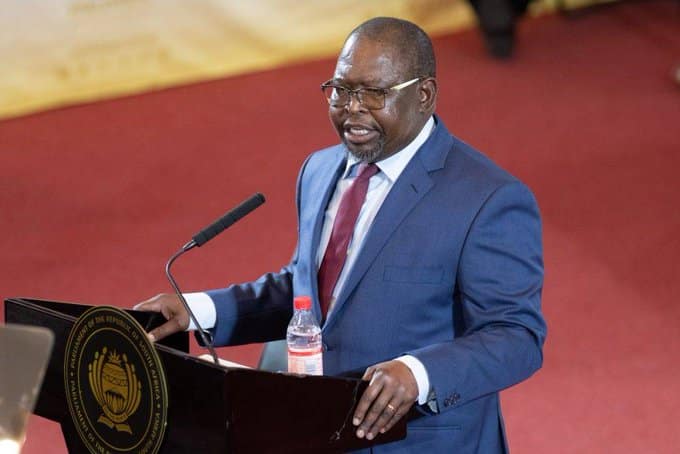
But on Tuesday afternoon, with the clock ticking toward a fiscal deadline and the country watching, the Finance Minister stepped to the podium, adjusted his glasses, and delivered a message that was part lecture, part plea, and entirely without apology.
“There are no back-doors,” Godongwana said, his voice carrying across the green-carpeted chamber. “There are no secret allocations. There is a country in crisis, and there is a government responding. That is all this bill represents.”
The 2026 Special Appropriation Bill—seeking R13.5 billion in additional funds—had been winding its way through parliamentary processes for nearly a month. But it was only when the Democratic Alliance (DA) and Economic Freedom Fighters (EFF) jointly raised procedural objections that the debate exploded into public view.
Their accusation was explosive: that the bill contained “hidden line items,” “unallocated contingencies,” and what one opposition MP called “a slush fund dressed in fiscal clothing.”
Godongwana’s response was swift, sharp, and surprisingly personal.
The Minister’s Defense: Transparency by the Numbers
Standing before a chamber that was unusually full for a Tuesday afternoon, Godongwana walked MPs through the bill line by line—a rare move for a minister who typically relies on broad summaries.
“R5.2 billion for the ongoing flood relief and infrastructure repair in KwaZulu-Natal and Eastern Cape,” he read from his notes, holding up a printed spreadsheet for the cameras. “R3.8 billion for the National Student Financial Aid Scheme (NSFAS) shortfall, without which 180,000 students will not register in 2027. R2.4 billion for the security forces deployed to the eastern Democratic Republic of Congo as part of the SADC mission. R1.6 billion for the health sector’s wage bill settlement. And R500 million for disaster response reserves—a contingency, not a secret.”
He paused, letting the numbers settle.
“That is R13.5 billion. Every cent accounted for. Every department notified. Every MP in this room received the full schedule three weeks ago. If you did not read it, that is not a back-door. That is a failure of homework.”
The remark drew a mix of laughter from the ANC benches and indignant shuffling from the opposition. DA finance spokesperson Mark Burke was on his feet within seconds, demanding a point of order.
“The minister is being disrespectful to this house,” Burke said. “Our concern is not with the existence of these allocations but with the speed and lack of scrutiny. R13.5 billion is not a petty cash tin. It deserves proper oversight.”
Godongwana did not wait for the Speaker to rule. He responded immediately.
“Mr. Burke, you have had twenty-one days to scrutinize this bill. You submitted three written questions. I answered all three within forty-eight hours. What more oversight do you want? A handwritten note? A personal visit to your office?”
The Speaker intervened, calling for order. But the damage—or the clarity, depending on one’s perspective—was done.
The Political Context: A Minister Under Pressure
Godongwana’s defensiveness was not without reason. The 66-year-old former trade unionist and economic development planner has been a steady hand at National Treasury since his appointment in 2021, steering South Africa through post-COVID recovery, energy sector reforms, and repeated credit rating reviews. But the 2026 fiscal year has been brutal.
Tax revenue collections have underperformed by nearly R40 billion, driven by a slowdown in mining exports and weaker-than-expected corporate tax receipts. At the same time, spending pressures—from the public sector wage bill to social grants to the deteriorating road and rail network—have mounted relentlessly.
The Special Appropriation Bill is Treasury’s way of bridging the gap without blowing the deficit target agreed with the International Monetary Fund (IMF). But critics argue that the bill’s structure—bundling multiple urgent needs into a single vote—makes it harder for Parliament to challenge individual items.
“The danger is that we end up swallowing the poison with the medicine,” said EFF MP and finance committee member Nomsa Marawu. “Maybe the student funding is urgent. Maybe the floods are urgent. But the R500 million disaster contingency? That is a blank check. That is the back-door.”
Godongwana rejected the characterization. “A contingency reserve is not a back-door,” he said. “It is a responsible provision for unknown unknowns. Every credible budget has one. Ours is smaller than most. If that is a scandal, then every finance minister in history is guilty.”
The Opposition’s Alternative: Cut First, Spend Later
The DA has proposed an alternative: rather than approving R13.5 billion in new spending, Parliament should first identify R13.5 billion in cuts from existing programs. The party has pointed to what it calls “inefficient” spending on public employment programs, certain agricultural subsidies, and duplicate IT systems across departments.
“If we are truly serious about fiscal discipline, we should not be reaching for the credit card every time there is an emergency,” Burke argued. “We should be asking: what can we stop doing, so that we can afford what we must do?”
Godongwana was unimpressed. “With respect, Mr. Burke, the people of KZN whose homes were washed away in March cannot wait for a forensic audit of agricultural subsidies. The student who cannot afford registration fees cannot wait for a departmental IT review. Emergencies do not wait for efficiency savings. They demand cash. Now.”
The exchange highlighted a deeper philosophical divide: between those who believe fiscal discipline requires spending restraint even in crisis, and those who argue that austerity in the face of urgent need is a form of cruelty.
The Public’s View: Skepticism Meets Fatigue
Outside the parliamentary precinct, the debate over the R13.5 billion bill has generated less public outrage than one might expect. After years of state capture commissions, COVID procurement scandals, and repeated revelations of irregular expenditure, many South Africans have developed a kind of fiscal fatigue.
“I don’t know if it’s back-door or front-door,” said Thandi Mokoena, a teacher waiting for a taxi in downtown Cape Town. “I just know that my school still has leaking roofs and my students can’t afford textbooks. If this money fixes that, fine. If it disappears, we will never know. That is the real problem.”
Others were more direct. “Godongwana is one of the few ministers I trust,” said Sipho Dlamini, a small business owner from Soweto. “But trust is not oversight. Parliament must do its job. We cannot keep approving billions and then acting surprised when the money is stolen.”
What Happens Next
The Special Appropriation Bill will now go to a vote, likely within the next two weeks. The ANC’s majority in the National Assembly (currently 230 out of 400 seats) makes passage almost certain, but the party may need to rely on smaller allies—the Inkatha Freedom Party (IFP) or Good—if internal dissent emerges.
Some ANC MPs have privately expressed discomfort with the bill’s size and speed. One backbencher, speaking on condition of anonymity, told this reporter: “We are worried about the message it sends. We spent years telling the public we were cleaning up our act. Now we are asking for R13.5 billion in a single bill, with very little debate. It looks bad. Even if it is clean, it looks bad.”
Godongwana seemed aware of the optics. In his closing remarks, he offered a concession: “I commit to publishing, within sixty days of the bill’s passage, a full expenditure report on every cent of this R13.5 billion. Not a summary. Not a spreadsheet. A line-by-line accounting. That is not a back-door. That is a glass house.”
The opposition remained unmoved. But outside the chamber, in the lobby where journalists cluster around exit doors, a senior Treasury official whispered: “He didn’t have to offer that report. That is not in the law. He is doing it because he knows people are watching. That is accountability.”
Whether it is enough remains to be seen. The bill will pass. The money will be spent. And in six months, when the first reports emerge, South Africans will learn whether the R13.5 billion was a lifeline or a leaky bucket.
For now, Godongwana has done what he came to do: defend the bill, reject the accusations, and dare his critics to prove him wrong.
“Come with evidence,” he said, gathering his papers as the session adjourned. “Not whispers. Not WhatsApp messages. Evidence. I will wait.”
The chamber emptied. The whispers, for now, quieted. But in politics, as in fiscal policy, silence is never the final word.
The National Assembly will vote on the 2026 Special Appropriation Bill by May 15. The R13.5 billion, if approved, will be released in three tranches starting July 1.
About The Author