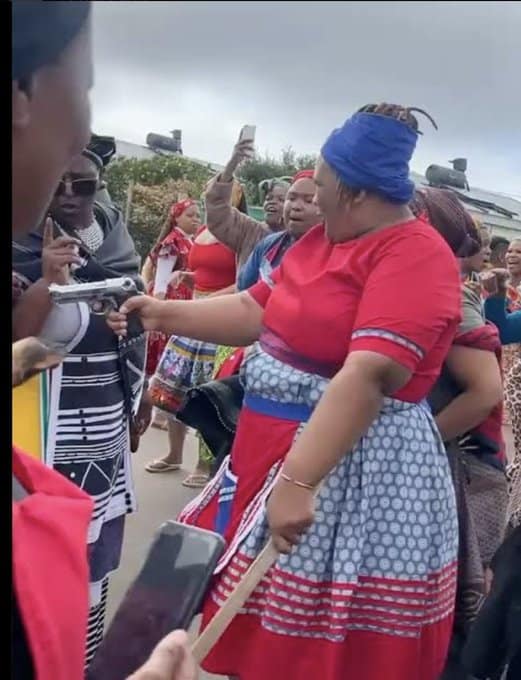
The video is grainy, shot on a cellphone in the flickering light of a December evening. But what it captures is unmistakable: a woman in traditional regalia, her face partially obscured by a headwrap, holding what appears to be a firearm above her head. She gestures with it, waving it not at anyone in particular but in the air, as if in celebration. The crowd around her cheers. Some dance. Others raise their own hands, though whether in salute or in alarm is impossible to tell.
That woman, according to a newly surfaced complaint filed with the Bitou Local Municipality, is Speaker Mavis Busakwe. The event was a traditional celebration in KwaNokuthula, a township outside Plettenberg Bay, in December 2025. The video, which circulated quietly on WhatsApp groups for months, only recently came to the attention of municipal officials and law enforcement.
Now, the municipality has called for a full investigation, and Busakwe—a senior political figure in one of the Western Cape’s most popular tourist destinations—is fighting for her political survival.
“We cannot ignore what we have seen,” said Bitou Mayor Dave Swart in a statement released on Wednesday. “The alleged brandishing of a firearm, whether in celebration or in anger, is a serious matter. It is illegal. It is dangerous. And it is unbecoming of a public official. We have requested the South African Police Service to investigate without delay.”
Busakwe has not yet responded to formal requests for comment, but sources close to her have described the video as “misleading” and “taken out of context.” They claim that the firearm was not hers, that it was a prop used in a traditional dance, and that no shots were fired and no one was threatened.
But the video—and the political storm it has unleashed—has already done damage. And the questions it raises extend far beyond one woman, one firearm, or one festival.
The Video: What It Shows, What It Doesn’t
The footage, which has been viewed by this reporter but not published, is approximately 42 seconds long. It was shot at night, under a makeshift marquee tent decorated with balloons and streamers. The crowd is a mix of ages, from young children to elderly women in matching traditional attire.
At the 12-second mark, a woman—identified by multiple sources as Busakwe—enters the frame from the left. She is wearing a yellow and black traditional dress, a matching headwrap, and beaded jewellery. In her right hand, held above her shoulder, is a dark object consistent in shape and size with a handgun.
She does not point the object at anyone. She holds it aloft, moving it in a slow arc as she dances. At one point, she brings it down to her side, then raises it again. The crowd cheers. A man’s voice can be heard shouting something in isiXhosa that translates roughly to “The lioness is here!”
At no point does the video show Busakwe firing the weapon, threatening anyone with it, or handling it in a way that appears aggressive. But under South African law, merely brandishing a firearm—displaying it in a public place in a manner that causes or could cause alarm—is a criminal offence, regardless of intent.
“The law is clear,” said legal expert and criminal defence attorney Nomalanga Khumalo. “Section 120 of the Firearms Control Act prohibits the pointing of any firearm, whether it is loaded or not, at any other person, or the brandishing of a firearm in a public place. The fact that no one was shot and no one was directly threatened does not mean no crime was committed. The act of brandishing itself is the offence.”
Khumalo noted that the maximum penalty for brandishing a firearm is a fine or imprisonment for up to five years, depending on the circumstances. Conviction would also likely result in the revocation of any firearm license and a prohibition on owning a firearm in the future.
The Speaker: Who Is Mavis Busakwe?
Mavis Busakwe, 54, is a veteran of local politics in Bitou Municipality, which includes the affluent coastal town of Plettenberg Bay and the surrounding townships of KwaNokuthula, Bossiesgif, and Qolweni. A member of the African National Congress (ANC), she has served as Speaker of the municipal council since 2021, a position that makes her responsible for maintaining order in council meetings, overseeing the legislative agenda, and representing the council in ceremonial functions.
Before becoming Speaker, Busakwe served as a ward councillor for KwaNokuthula, where she is widely known and, among some constituents, well-liked. She has been described as a “firebrand” who is not afraid to speak her mind, a quality that has earned her both admirers and enemies.
“She is a fighter,” said a colleague who spoke on condition of anonymity. “She fights for her community. She fights for resources. She fights against the DA [Democratic Alliance], which controls the mayor’s office and many of the senior positions. Sometimes she fights too hard. Sometimes she crosses lines. But she fights.”
That fighting spirit, however, has also led to controversy. Busakwe has been involved in several heated council debates, including one in 2023 that led to her being temporarily suspended for “unparliamentary conduct.” She has also been accused of using inflammatory language against political opponents, though she has denied the allegations.
The firearm video, if proven authentic and if Busakwe is identified as the woman in the footage, could be the most serious controversy of her career. It could also have legal consequences that extend beyond the political realm.
The Event: A Traditional Celebration in KwaNokuthula
The event in question took place on 13 December 2025, at a community hall in KwaNokuthula. It was described as a “year-end celebration” organized by a local women’s group, the KwaNokuthula Traditional Dancers’ Association. The event featured traditional music, dancing, and the recognition of community leaders.
According to attendees who have since spoken to investigators, the celebration was joyful and boisterous, with alcohol flowing freely and spirits high. Busakwe, who had been invited as a guest of honour, arrived late, around 10 PM, and was greeted with cheers.
“When she walked in, everyone was happy to see her,” said an attendee who asked not to be named. “She is our Speaker. She is our sister. People love her. Then someone handed her something. I could not see what it was. Then she held it up and danced. People were cheering. No one thought anything of it. We thought it was a toy. Or a ceremonial thing. No one thought it was a real gun.”
Another attendee, however, was more alarmed. “I saw it clearly,” he said. “It was a gun. A real gun. I don’t know if it was loaded. I don’t know if it was licensed. But it was a gun. And she was waving it around in a room full of people, including children. I was scared. I moved to the back. I left early.”
The video was shot by a third attendee, who initially shared it with a small group of friends on WhatsApp. Over the following weeks, it spread to other groups, eventually reaching municipal officials and, finally, the police.
The Complaint: Who Filed It and Why
The formal complaint that triggered the municipality’s call for an investigation was filed by a group calling itself the Bitou Civic Action Forum (BCAF), a community watchdog organisation that has been critical of the ANC-led council. The BCAF submitted a dossier to the municipal manager on 18 April 2026, including a copy of the video, a sworn affidavit from an attendee, and a request for the municipality to refer the matter to the SAPS.
“We are not anti-ANC,” said BCAF spokesperson Thabo Mkhabela. “We are anti-corruption, anti-lawlessness, anti-hypocrisy. Speaker Busakwe has spoken publicly about the need to reduce gun violence in our communities. She has led campaigns against illegal firearms. And yet here she is, allegedly brandishing a gun at a public event. That is hypocrisy. That is unacceptable.”
Mkhabela also raised questions about the firearm itself. “Whose gun is it? Is it licensed? Was it legally possessed? If it is a service weapon, was she authorised to remove it from wherever it is kept? These are questions that must be answered. And they must be answered by the police, not by the municipality’s internal disciplinary process.”
The BCAF has also called for Busakwe to step down as Speaker pending the outcome of the investigation, a demand that the municipality has not yet endorsed.
The Municipality’s Response: A Delicate Balancing Act
Mayor Dave Swart, a member of the Democratic Alliance (DA), has walked a careful line since the video surfaced. On one hand, his party has every political incentive to see a senior ANC official embarrassed or removed. On the other hand, Swart has emphasized the need for due process and has resisted calls for Busakwe’s immediate suspension.
“The municipality is not a court,” Swart said in his statement. “We cannot judge guilt or innocence. That is the role of the police and, if charges are laid, the courts. Our role is to ensure that a proper investigation takes place and that the law is applied equally to all, regardless of their political affiliation.”
Swart also noted that the municipality has its own code of conduct for councillors and officials, which includes provisions related to criminal behaviour. If Busakwe is charged or convicted, the council could initiate its own disciplinary process, which could lead to her removal as Speaker.
But for now, Busakwe remains in her position. She attended a council meeting on Tuesday, though she left early and did not speak to the media. Her colleagues on the ANC caucus have reportedly rallied around her, at least publicly.
“We support our Speaker,” said ANC caucus leader Xolani Mnguni. “We have seen the video. We have spoken to her. She has given us an explanation that we find satisfactory. We will not comment further while the police are investigating.”
The Police Investigation: What Happens Next
The South African Police Service (SAPS) has confirmed receipt of the complaint and has opened a case docket. Spokesperson Captain Malcolm Pojie said that investigators are reviewing the video, interviewing witnesses, and attempting to locate the firearm in question.
“We are treating this matter seriously,” Pojie said. “The brandishing of a firearm in a public place is a criminal offence. If the evidence supports a charge, the individual will be charged. If the evidence does not support a charge, the case will be closed. We ask the public to be patient and to allow the investigation to proceed without interference.”
Key questions investigators will seek to answer include:
- Is the woman in the video definitely Mavis Busakwe? The video is grainy, and Busakwe has reportedly denied that she is the person depicted. Investigators may use facial recognition technology or seek testimony from attendees to confirm her identity.
- Is the object in her hand a real firearm? If so, what type? Who owns it? Is it licensed? Investigators will seek to locate the firearm for forensic examination.
- Did Busakwe have a valid license to possess the firearm? If not, she could face additional charges of illegal possession.
- Was the firearm discharged? No reports of gunfire at the event have emerged, but investigators will test the weapon for recent discharge.
- Did Busakwe’s actions cause alarm or fear among attendees? The law does not require actual fear; the potential to cause alarm is sufficient. But witness testimony will be relevant.
If charged and convicted, Busakwe could face a fine, imprisonment, or both. She could also lose her firearm license and be prohibited from owning a firearm in the future. Politically, a conviction would almost certainly end her tenure as Speaker and could lead to her expulsion from the ANC.
The Community’s Reaction: Divided and Distressed
In KwaNokuthula, the video has sparked heated debate. Some residents have defended Busakwe, dismissing the incident as a harmless celebration that has been blown out of proportion by political enemies.
“It was a party,” said a neighbour who has known Busakwe for years. “People were drinking. People were dancing. Someone gave her a gun. She held it up. No one was hurt. No one was threatened. Why are we acting like she shot someone? This is politics. Pure politics.”
Others are more critical, seeing the incident as a reflection of a deeper culture of gun violence and impunity.
“She is a leader,” said a young woman who lives in the same township. “Leaders are supposed to set an example. What example does this set? That it is okay to wave a gun around at a party? That the law does not apply to you if you have a title? That is not leadership. That is arrogance.”
The debate has also raised questions about gun culture in South Africa, where an estimated 3 million legal firearms are in private hands, along with an unknown number of illegal weapons. Each year, more than 3,000 people are killed in gun-related incidents, according to the Gun Free South Africa advocacy group.
“South Africa has a toxic relationship with guns,” said Gun Free SA director Adele Kirsten. “We treat them as symbols of power, of masculinity, of authority. We brandish them at parties, at funerals, at political rallies. And then we act surprised when someone gets shot. This incident is not isolated. It is a symptom of a much larger sickness.”
The Political Fallout: ANC vs. DA in the Western Cape
The Busakwe incident has also become a proxy battle in the ongoing political war between the ANC and the DA in the Western Cape. The province is the only one in South Africa where the DA controls the provincial government, but the ANC remains competitive in many municipalities, including Bitou.
For the DA, the video is an opportunity to embarrass the ANC and to reinforce its message that the ANC is “lawless” and “unfit to govern.”
“Here we have a senior ANC official allegedly breaking the law at a public event,” said DA Western Cape leader Tertuis Simmers. “And what does the ANC do? They rally around her. They make excuses. They attack the messenger. That is the ANC’s culture: protect your own, no matter what they have done.”
For the ANC, the incident is a distraction from its core message of service delivery and economic development. Party officials have sought to downplay the video, framing it as a “personal matter” that should not be politicised.
“Mavis Busakwe is an individual,” said ANC Western Cape spokesperson Siseko Mbandezi. “She is entitled to due process. She is entitled to the presumption of innocence. The ANC will not abandon her based on a grainy video and unproven allegations. That is not how we operate.”
The political calculus is complicated by the fact that the Bitou council is closely divided, with the DA holding a narrow majority. If Busakwe were to step down or be removed, the ANC would need to nominate a replacement, a process that could expose internal divisions.
The Broader Implications: What This Means for Public Officials
Regardless of the outcome of the investigation, the Busakwe incident has already sent a message to public officials across South Africa: your private actions, even at festive events, are subject to public scrutiny.
“We live in the age of the cellphone camera,” said political analyst Dr. Naledi Mkhize. “There is no such thing as a private celebration anymore. Everything is recorded. Everything is shared. And everything can come back to haunt you. Public officials need to understand that their conduct, at all times, must be beyond reproach. Because someone is always watching.”
Mkhize also noted that the incident could have implications for gun reform efforts in South Africa. “If a senior political figure can be caught on video brandishing a firearm and still face no consequences, what message does that send to ordinary citizens? It says that gun laws are optional. It says that enforcement is selective. That is dangerous. That undermines every effort to reduce gun violence.”
The Waiting Game
For now, Mavis Busakwe remains Speaker of the Bitou Municipal Council. She attends meetings. She votes. She presides. But a cloud hangs over her, visible in the whispered conversations in the council chamber, in the glances exchanged by her colleagues, in the questions that journalists shout as she walks to her car.
She has not spoken publicly since the video surfaced. Her phone rings unanswered. Her office door is closed.
The police investigation will take weeks, perhaps months. In that time, the video will continue to circulate. The accusations will continue to be debated. And Busakwe’s future—political, legal, and personal—will hang in the balance.
Outside the municipal offices in Plettenberg Bay, a small group of women from KwaNokuthula gathered on Wednesday afternoon. They held no placards. They chanted no slogans. They simply stood, wearing yellow and black—the colours Busakwe wore in the video.
“We are here to support our sister,” said one of them, a grandmother in her sixties. “We are not saying she was right. We are not saying the gun was okay. We are saying: wait. Let the law speak. Do not judge her before the law has spoken. That is all we ask.”
A passerby stopped to argue. “She waved a gun at a party,” he said. “What is there to wait for? You saw it. I saw it. The whole world saw it.”
The grandmother shook her head. “You saw a video,” she said. “You did not see the whole story. None of us did. That is why we wait.”
The two stared at each other for a long moment. Then the passerby walked away, shaking his head. The women remained, standing in the sun, waiting.
And in the Bitou Municipal Council, in the SAPS investigation unit, in the offices of the ANC and the DA, the waiting continues as well.
Waiting for answers. Waiting for justice. Waiting to see whether a grainy video from a December celebration will end a political career—or whether it will be dismissed as much ado about nothing.
Only time, and the law, will tell.
About The Author