The first light of Wednesday morning had not yet touched the peaks of the Soutpansberg mountains when the silence of the N1 highway was shattered by the screech of twisting metal and the screams of the terrified. In the inky darkness between Louis Trichardt and the Hendrik Verwoerd Tunnel, a bus carrying dozens of passengers—many of them asleep, many of them heading home, many of them never to arrive—lost control, overturned, and slid across the asphalt like a dying beast.
By the time the sun rose over the crash site, two people were dead. More than thirty others were injured, some critically. And a stretch of one of South Africa’s busiest national highways had been transformed into a scene of chaos, grief, and desperate rescue.
The bus, a long-distance coach operated by a private company, was traveling from Musina toward Polokwane in the early hours of 22 April 2026. It was carrying approximately 55 passengers, including men, women, and children. The cause of the crash remains under investigation, but preliminary reports suggest that the driver may have lost control on a notoriously dangerous curve just before the Hendrik Verwoerd Tunnel—a section of the N1 that has claimed many lives over the years.
“The bus was lying on its side when we arrived,” said a first responder from the Louis Trichardt Fire and Rescue Department, speaking with a voice heavy with exhaustion. “People were trapped inside. People were outside, wandering, bleeding, crying. It was dark. It was cold. And there was so much screaming. That is the sound I will not forget. The screaming.”
The Victims: Two Lives Cut Short
The identities of the deceased have not yet been officially released by authorities, pending notification of next of kin. However, sources close to the scene have confirmed that one of the victims was a 34-year-old woman from Musina, a mother of two young children, who was traveling to Polokwane for a job interview. The other was a 58-year-old man from Beitbridge, a cross-border trader who made the journey several times a month to sell goods at markets in Gauteng.
“They were just people on a bus,” said a fellow passenger who survived with minor injuries, his arm in a sling, his face bruised. “The woman was nervous about her interview. She kept asking the woman next to her if her outfit looked okay. The old man was sleeping with his head against the window. He was snoring. Everyone could hear him. Now he is gone. Now she is gone. And I am here, and I do not understand why.”
The injured were transported to several hospitals in the region, including the Louis Trichardt Memorial Hospital, the Makhado Hospital, and the Polokwane Provincial Hospital. As of Wednesday afternoon, eight passengers remained in critical condition, with doctors fighting to stabilize them. The others were listed as stable, though many suffered broken bones, head trauma, and deep lacerations.
The Crash Site: A Scene of Devastation
Journalists who reached the scene around 6:00 AM described a tableau of horror. The bus, a white coach with blue stripes, lay on its driver’s side across the southbound lane of the N1. Its windows were shattered, leaving jagged teeth of glass protruding from the frame. Luggage—suitcases, backpacks, plastic bags—was scattered across the road and into the veld, as if the bus had vomited the belongings of its passengers.
Clothing, shoes, and blankets lay in tangled heaps. A child’s stuffed animal, a brown teddy bear missing one eye, sat upright against the guardrail, as if waiting for its owner to return.
The road surface showed long, dark skid marks—evidence of a desperate attempt to brake or steer out of disaster. Those marks led to the point where the bus had left the roadway, struck an embankment, and then rolled back onto the tarmac.
“This is a bad stretch,” said a traffic officer who has worked the N1 for fifteen years. “People drive too fast. The curves are sharp. The trucks are heavy. And in the dark, with the headlights of oncoming traffic, it is easy to misjudge. I have seen more accidents here than I can count. But each one still breaks my heart.”
The Rescue: A Race Against Time
The first emergency call was logged at 3:47 AM. Within minutes, paramedics, firefighters, and police were dispatched from Louis Trichardt, approximately 25 kilometers away. The first units arrived on the scene at 4:12 AM.
What they found was chaos. The bus was unstable, threatening to roll further. Passengers were trapped in the wreckage, their limbs pinned by twisted metal. Others had crawled out through broken windows and were lying on the roadside, dazed and bleeding.
“We had to triage quickly,” said a paramedic who worked the scene. “Red tags for those who needed immediate evacuation. Yellow for those who could wait. Green for the walking wounded. And black for the two who were beyond our help.”
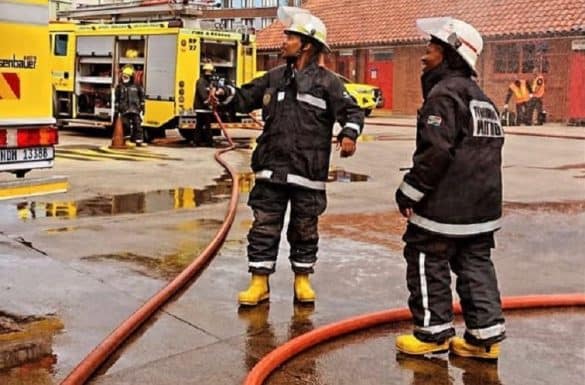
The rescue operation took more than three hours. Using hydraulic cutters and spreaders, firefighters carefully extracted the trapped passengers one by one. Each extraction was accompanied by cries of pain, of relief, of desperate prayer.
“We got everyone out alive except the two,” said a firefighter, his uniform stained with blood. “That is something. But it is not enough. It is never enough.”
Helicopters were dispatched from Polokwane to airlift the most critical patients to better-equipped hospitals. The N1 was closed in both directions for most of the morning, causing massive traffic backups and forcing long-distance travelers to use secondary roads.
The Driver: Questioned but Not Charged
The driver of the bus, a 47-year-old man from Musina, survived the crash with minor injuries. He was treated at the scene and later taken to the Louis Trichardt police station for questioning.
According to sources familiar with the investigation, the driver told police that he had lost control of the vehicle after swerving to avoid an oncoming truck that had drifted into his lane. However, investigators have not yet verified that account, and no witnesses have come forward to corroborate it.
“The driver is cooperating fully,” said Brigadier Motlafela Mojapelo, the Limpopo police spokesperson. “He has not been arrested or charged. The investigation is ongoing. We are examining the vehicle’s brakes, tires, and mechanical systems. We are also reviewing any available CCTV or dashcam footage from the area.”
The bus company, which has not been named pending the investigation, released a brief statement expressing condolences to the families of the deceased and promising full cooperation with authorities.
“We are devastated by this tragedy,” the statement read. “Our thoughts are with the families who have lost loved ones and with those who are recovering in hospital. We are conducting our own internal investigation and will take all necessary actions based on the findings.”
The Road: A History of Tragedy
The N1 between Louis Trichardt and the Hendrik Verwoerd Tunnel is one of the most dangerous stretches of highway in Limpopo. The road winds through the Soutpansberg mountains, with steep gradients, sharp curves, and frequent fog in the early morning hours. Heavy trucks, buses, and passenger vehicles share the road, often at vastly different speeds.
The Hendrik Verwoerd Tunnel itself, named after the former prime minister and architect of apartheid (a name that some have called to change), is a narrow, two-lane passage that requires drivers to reduce speed significantly. Accidents at the tunnel entrance and exit are common.
According to data from the Road Traffic Management Corporation (RTMC), there were 47 fatal accidents on this stretch of the N1 between 2020 and 2025, resulting in 89 deaths. The causes ranged from driver fatigue to mechanical failure to reckless overtaking.
“This road needs to be upgraded,” said a local transport union representative. “It is not fit for the volume of traffic it carries. The curves are too sharp. The shoulders are too narrow. The lighting is inadequate. And the tunnel is a death trap. How many more people have to die before the government acts?”
The Department of Transport has acknowledged the concerns and has announced plans to widen and upgrade the N1 through the Soutpansberg, but the project has been delayed due to funding shortages and land acquisition issues. No completion date has been set.
The Passengers: Stories from the Wreckage
In the aftermath of the crash, survivors have begun to share their stories—fragments of a night that will haunt them forever.
Maria Ndlovu, 29, was sitting near the back of the bus when it overturned. She remembers a sudden jolt, a scream, and then the world turning sideways. “I was thrown against the person next to me. Then against the window. Then against the ceiling. Then everything went dark. When I opened my eyes, I was lying on the road. I did not know how I got there. I could not hear anything. My ears were ringing.”
She suffered a broken collarbone and several deep cuts. She was treated at Louis Trichardt Memorial Hospital and released later that day. “I called my mother,” she said. “She did not know I was on the bus. She thought I was still at work. When I told her, she screamed. She screamed so loud I had to hold the phone away from my ear. Then she prayed. She prayed for a long time.”
Thabo Mokoena, 41, was sitting near the front. He saw the headlights of the oncoming truck. He felt the bus swerve. He remembers gripping the seat in front of him and closing his eyes. “I thought I was going to die. I said goodbye to my children in my head. I said sorry to my wife for not being a better husband. Then the bus stopped moving, and I was still alive. I do not know why. I do not understand.”
He helped pull other passengers from the wreckage before the emergency services arrived. “There was a woman. She was crying for her baby. The baby was under a seat. I pulled the baby out. The baby was not crying. The baby was silent. I thought the baby was dead. But then the baby coughed. And then the baby cried. That cry was the most beautiful sound I have ever heard.”
The baby, a six-month-old girl, was hospitalized with a concussion but is expected to survive.
The Aftermath: Grief, Anger, and Questions
In the village of Mmotong-wa-Bogobe, still reeling from the food poisoning tragedy that killed six people just days earlier, the bus crash has added another layer of grief to a community already in mourning. Several of the bus passengers were from the same village, returning from a family gathering in Musina.
“We have buried six,” said a village elder. “Now we may bury more. How much death can one village endure? How many funerals can one year hold? We are tired. We are so tired.”
The Limpopo provincial government has dispatched trauma counselors to the hospitals and to the affected communities. Premier Dr. Phophi Ramathuba, who visited the crash site on Wednesday afternoon, expressed her condolences and promised a full investigation.
“This is a dark week for Limpopo,” Ramathuba said. “First the food poisoning in Mmotong-wa-Bogobe. Now this terrible crash on the N1. Our hearts are broken. But our resolve is not. We will find out what caused this crash. We will hold those responsible accountable. And we will work to make our roads safer, so that no family has to receive this kind of news again.”
The Investigation: What Happened?
The police investigation will focus on several key areas:
- Mechanical failure: Were the bus’s brakes, tires, or steering systems functioning properly? The bus will be inspected by forensic mechanical engineers.
- Driver fatigue: Had the driver had sufficient rest before the journey? Long-distance bus drivers are required by law to take breaks, but enforcement is inconsistent.
- Road conditions: Was the road surface wet, icy, or damaged? Was lighting adequate? Were warning signs visible?
- The oncoming truck: Police are seeking the driver of the truck that the bus driver claims caused the swerve. If found, the truck driver will be questioned.
- Speed: Was the bus traveling within the speed limit? Data from the vehicle’s tachograph (if installed and functional) will be analyzed.
The investigation could take weeks or months. In the meantime, the families of the deceased must wait—for answers, for justice, for the return of their loved ones’ bodies for burial.
The Broader Context: Road Safety in South Africa
The N1 bus crash is the latest in a long line of road tragedies in South Africa. According to the RTMC, more than 12,000 people die on the country’s roads every year—one of the highest per-capita rates in the world. Bus crashes, while less common than car crashes, are often more deadly due to the number of passengers involved.
Common causes include driver fatigue, speeding, mechanical failure, poor road conditions, and reckless driving. Enforcement of traffic laws is inconsistent, and many buses operate with inadequate maintenance or untrained drivers.
“There is a culture of impunity on our roads,” said a road safety activist. “Drivers know that the chances of being caught and punished are low. Bus companies know that cutting corners on maintenance and driver training saves money. And the government knows that the traffic police are understaffed and underpaid. Until that changes, people will keep dying.”
The Department of Transport has launched several initiatives to improve road safety, including mandatory rest stops for long-distance drivers, stricter vehicle inspection regimes, and the rollout of cameras to catch speeders and red-light runners. But progress has been slow, and funding remains a challenge.
The Vigil: Light in the Darkness
On Wednesday evening, a small group of survivors and family members gathered at the crash site. They brought candles, flowers, and photographs. They stood in silence, looking at the skid marks, at the broken glass still glittering on the road, at the place where two lives ended and dozens more were changed forever.
A pastor from Louis Trichardt led a brief prayer. “Lord, we do not understand why this happened. We do not understand why these two were taken and others were spared. We do not understand your ways. But we ask you to be with the families. Be with the injured. Be with the driver. And be with all of us who must go on living, carrying this weight.”
The candles flickered in the evening breeze. A woman began to sing a hymn, her voice wavering at first, then growing stronger. Others joined in. The sound rose into the darkening sky, a defiant whisper against the silence of death.
They sang for the 34-year-old woman who never made it to her job interview. For the 58-year-old trader who would not return to his family. For the baby who coughed and cried and lived. For all the broken bodies and the broken hearts.
And when the singing stopped, they stood in silence for one minute. Then two. Then three.
Then they blew out the candles, got into their cars, and drove away into the night—carrying the crash with them, as they would carry it forever.
About The Author