The shift had ended. The long day of chasing leads, interviewing witnesses, and building cases was finally over. Two detectives from the Madeira Detective Unit—a tight-knit team that hunts some of the most dangerous criminals in the OR Tambo District—packed up their files, locked their office, and headed home. It was a Wednesday afternoon, unseasonably warm for autumn. They were tired. They were ready to see their families. They had no idea that they were driving into an ambush.
Just before 4 PM, in the New Brighton section of Ngangelizwe township, on a dusty road lined with modest homes and barefoot children, the two officers were intercepted. Witnesses describe a silver sedan pulling up alongside their unmarked vehicle. Then came the gunfire. Multiple shots. Rapid. Relentless.
When the shooting stopped, one detective—a father, a husband, a 15-year veteran of the police service—was dead at the scene. The other—a mother, a daughter, a rising star in the detective unit—was fighting for her life, her body riddled with bullets, her blood pooling on the cracked asphalt of a street that had just become a crime scene.
The attackers fled. Their identities remain unknown. Their motive remains unclear. But in the killing of a police officer—in the attempted killing of another—the state has been dealt a blow that transcends the personal. This was not a robbery gone wrong. This was not a domestic dispute. This was an assassination. And the message was clear: those who enforce the law are not safe from those who break it.
“We are under attack,” said Eastern Cape Police Commissioner Lieutenant General Nomthetheleli Mene, her voice heavy with grief and fury. “Not just these two officers. All of us. Every officer who puts on a uniform, every detective who knocks on a door, every constable who pats down a suspect. We are targets. And we are bleeding.”
The Victims: Two Lives, Two Stories, One Tragedy
The deceased officer has been identified as Sergeant Bongani Mdinwa, 42, a detective with 15 years of service. He joined the South African Police Service (SAPS) in 2011, working his way up from a constable in visible policing to a detective sergeant in the Madeira Detective Unit. He leaves behind a wife and three children, aged 16, 13, and 8.
“He was a gentle man,” said a colleague who had worked alongside Mdinwa for seven years. “He did not shout. He did not lose his temper. He believed in talking. He believed in evidence. He believed in the law. That is what made him a good detective. He did not need to beat confessions out of people. He found the truth. He was good at it.”
Mdinwa was known in the unit for his work on gender-based violence cases, a relentless pursuer of men who hurt women and children. He had secured several high-profile convictions, including a life sentence for a man who had raped his own niece.
“He hated men who hurt children,” the colleague said. “He would go home after those cases and hold his own children for a long time. His daughter. His sons. He would just hold them. He never said anything. He just held them.”
The injured officer is Detective Constable Nolitha Mjoli, 34, a mother of two who joined the SAPS eight years ago. She is currently in the intensive care unit at Mthatha General Hospital, where doctors have performed two emergency surgeries to remove bullets from her abdomen and chest. As of Wednesday night, she was listed in critical but stable condition.
“She is a fighter,” said her sister, who had rushed to the hospital after receiving the call. “She has always been a fighter. She fought to get into the police academy. She fought to be taken seriously as a woman in a man’s unit. She fought for every case she ever closed. And she will fight this. She will survive. She has to. Her children need her.”
Mjoli’s children, aged 10 and 6, have not yet been told the full extent of their mother’s injuries. They have been told that she is “sick” and will be “away for a while.” The family is waiting until her condition stabilizes before deciding how much to share.
“She is their world,” the sister said. “Their father is not in the picture. It has been just her and them. If she dies… I cannot think about that. I will not think about that. She will live.”
The Ambush: What We Know, What We Don’t
The shooting took place on Ngangelizwe Road, a two-lane thoroughfare that cuts through the New Brighton informal settlement. The area is known for high crime rates, gang activity, and a deep distrust of the police among some residents.
According to preliminary investigations, Mdinwa and Mjoli were driving an unmarked silver Hyundai sedan, a standard issue for detectives. They were returning to their homes after a day of court appearances and witness interviews. Neither was in uniform. Neither was driving a marked police vehicle. It is unclear how the attackers identified them—or whether they were identified at all.
“The possibility exists that this was a targeted attack,” said Brigadier Tembinkosi Kinana, the provincial police spokesperson. “The detectives were known to be working on several sensitive cases, including organised crime and drug trafficking. It is possible that someone wanted to stop their investigation. It is also possible that this was a random act of violence. We are not ruling anything out.”
Witnesses reported seeing a silver sedan—possibly a Toyota Corolla—pull up alongside the detectives’ vehicle at a stop sign. A man in the passenger seat reportedly lowered his window and opened fire without warning. Multiple shots were fired, at least 12 according to shell casings found at the scene.
Mdinwa was hit multiple times in the upper body. He died at the scene, slumped over the steering wheel. Mjoli was hit in the chest, abdomen, and left arm. Despite her injuries, she managed to call for help on her police radio before losing consciousness.
“The radio call was garbled,” said a police dispatcher who took the call. “I heard screaming. I heard ‘officer down.’ I heard a woman’s voice. Then silence. That silence was the worst. I thought we had lost both of them.”
Emergency services arrived within 10 minutes. Mdinwa was pronounced dead at the scene. Mjoli was airlifted to Mthatha General Hospital by a police helicopter.
The Manhunt: A City on Edge
A massive manhunt is underway. The Eastern Cape provincial police have mobilized every available resource, including the Tactical Response Team (TRT), the K9 unit, and the provincial tracking team. Roadblocks have been set up on all major routes out of Mthatha. The South African National Defence Force (SANDF) has been placed on standby to assist if requested.
“We will find them,” said Commissioner Mene. “We have descriptions. We have vehicle information. We have witnesses. We have forensic evidence. It is only a matter of time. We will find them. And we will bring them to justice. No matter how long it takes.”
So far, no arrests have been made. Police have released a description of the suspect vehicle: a silver Toyota Corolla with no visible license plates. The suspects are described as two males, both wearing hoodies, one with a distinct tattoo on his neck.
“We are appealing to the community,” said Brigadier Kinana. “Someone saw something. Someone heard something. Someone knows who did this. Please, come forward. You can remain anonymous. You can call Crime Stop. But please, help us. These officers served your community. Now your community must help us find their killers.”
Reward money has been offered: R500,000 for information leading to the arrest and conviction of the perpetrators. The reward has been put up by the SAPS, the provincial government, and an anonymous donor.
The Scene: A Community in Shock
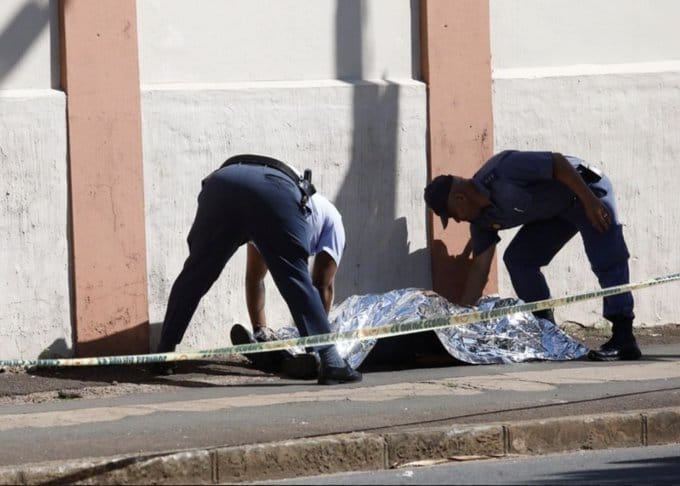
On Wednesday evening, as the sun set over Ngangelizwe, the road where Mdinwa died remained cordoned off with yellow police tape. Forensics officers in white suits combed the ground for evidence, marking bullet casings with small yellow cones. A bloodstain, dark and large, marked the spot where Mdinwa had fallen.
Residents gathered at the edge of the tape, peering at the scene, whispering among themselves. Some shook their heads. Others wept. A few looked on with expressions that were harder to read—curiosity, perhaps, or indifference, or something darker.
“They were good men and women,” said an elderly resident who gave her name only as Mama Rose. “The police here, they try. They are not corrupt like in other places. They try. And now one is dead. Another is dying. For what? For what?”
A young man, no more than 20, stood apart from the group, his arms crossed, his face unreadable. When asked what he thought, he shrugged. “The police are not our friends,” he said. “They come here, they arrest our brothers, they take them away. Maybe someone got tired of it. I am not saying it is right. I am just saying I understand.”
His words hung in the air, heavy with the weight of a community that feels both protected and oppressed by the same institution. The police are the thin line between order and chaos. But sometimes, to those who live on the wrong side of that line, the police are the chaos.
The National Crisis: Police Killings on the Rise
The killing of Sergeant Mdinwa and the attempted murder of Detective Mjoli are not isolated incidents. Police officers in South Africa are being killed at an alarming rate. According to the latest statistics from the South African Police Union (SAPU), 47 police officers were killed in the line of duty in 2025, up from 39 in 2024. So far in 2026, eight officers have been killed, including Mdinwa.
The provinces with the highest rates of police killings are KwaZulu-Natal, Gauteng, and the Eastern Cape. Most killings occur during robberies, vehicle stops, or responses to domestic violence calls. But a growing number—like the Mthatha ambush—appear to be targeted assassinations.
“Organised crime groups have become more brazen,” said SAPU spokesperson Lesiba Thobakgale. “They no longer see the police as an obstacle to be avoided. They see the police as an enemy to be eliminated. That is a fundamental shift. And it is terrifying.”
The union has called for the reinstatement of the “homicide premium”—a dangerous assignment allowance that was discontinued in 2019—as well as better protective equipment for officers, including bulletproof vests and ballistic glass in vehicles.
“Our officers are being sent to war without armour,” Thobakgale said. “They are sitting ducks. And the government does not seem to care. They hold press conferences. They express condolences. They promise action. And then nothing changes. Another officer dies. Another family grieves. Another funeral. Another flag draped over a coffin. How many more?”
The Political Reaction: Condemnation and Promises
Political leaders across the spectrum have condemned the shooting. President Cyril Ramaphosa issued a statement expressing “deep shock and sadness” and calling on law enforcement to “leave no stone unturned” in finding the perpetrators.
“The killing of a police officer is an attack on the state itself,” Ramaphosa said. “These men and women put their lives on the line every day to protect us. We owe them our safety. We owe them our gratitude. And we owe them justice. We will not rest until those responsible are caught.”
Eastern Cape Premier Oscar Mabuyane visited Mthatha General Hospital on Wednesday evening to check on Detective Mjoli and to meet with the families of both officers.
“This is a dark day for the Eastern Cape,” Mabuyane said. “We have lost a dedicated public servant. Another is fighting for her life. We will provide all necessary support to the families, including trauma counselling, financial assistance, and whatever else they need. The provincial government stands with the SAPS. We will not be intimidated by criminals. We will not back down.”
Police Minister Senzo Mchunu has announced that a specialized task team has been assembled to hunt down the killers. The team includes forensic experts, intelligence operatives, and seasoned detectives from outside the Eastern Cape to “ensure objectivity.”
“We will find them,” Mchunu said. “And when we do, they will face the full might of the law. There will be no plea bargains. There will be no early release. They will rot in prison for the rest of their lives. That is a promise.”
The Funeral: A Community Mourns
Sergeant Bongani Mdinwa will be buried on Saturday, 2 May 2026, at a cemetery outside Mthatha. His funeral is expected to be attended by hundreds of police officers, government officials, and community members. He will receive full police honours, including a procession, a guard of honour, and the traditional playing of the Last Post.
His wife, Nosipho Mdinwa, is inconsolable. “He kissed me goodbye this morning,” she told a family friend. “He said he would be home early. He said he would help the children with their homework. He said he loved me. Those were his last words to me. ‘I love you.’ And now he is gone. I cannot… I cannot…”
The couple’s three children are being cared for by relatives. The youngest, an 8-year-old boy, has not yet fully understood that his father is not coming back.
“He keeps asking when Daddy will come home from work,” the family friend said. “We tell him soon. We do not have the heart to tell him the truth. Not yet. Maybe not ever. How do you tell a child that his father was shot in the street? How do you explain that?”
The Survivor: Nolitha Mjoli’s Fight
As of Thursday morning, Detective Constable Nolitha Mjoli remained in intensive care. Her condition has been upgraded from critical to serious, but doctors caution that she is not out of danger.
“The next 48 hours are crucial,” said Dr. Siyabonga Ntuli, the head of trauma surgery at Mthatha General Hospital. “She has lost a lot of blood. Her body has been through a tremendous trauma. We are doing everything we can. But the healing process is in God’s hands now.”
Mjoli regained consciousness briefly on Wednesday night. According to a nurse who was in the room, she asked for her children. When told that they were safe, she nodded, then drifted back to sleep.
“She is a fighter,” the nurse said. “You can see it in her eyes. She is not ready to give up. She has too much to live for. Her children. Her job. Her sense of justice. She will survive. I believe that.”
Mjoli’s colleagues have set up a crowdfunding campaign to support her medical expenses and to provide for her children. The campaign has already raised over R200,000 in less than 24 hours, with donations pouring in from across the country.
“Detective Mjoli is one of us,” said a colleague who organized the campaign. “She has dedicated her life to protecting others. Now it is our turn to protect her. And her children. We will not let them fall through the cracks. We will not let her fight alone.”
The Broader Context: Policing in South Africa’s Killing Fields
The killing of Sergeant Mdinwa and the shooting of Detective Mjoli have reignited a painful conversation about the dangers of policing in South Africa—and the systemic failures that put officers at risk.
The SAPS is chronically underfunded, understaffed, and underequipped. Officers in many stations share bulletproof vests, which are often expired and ineffective. Police vehicles are poorly maintained and lack basic safety features like bullet-resistant glass. Training is often inadequate, particularly in high-risk areas like the Eastern Cape.
“Policing in South Africa is a death sentence,” said a former police officer who now works as a security consultant. “You are sent into the most dangerous areas, with the least equipment, the worst training, and the lowest pay. And then you are blamed when things go wrong. It is a miracle more officers are not killed.”
The police union has called for an urgent meeting with the Minister of Police to demand immediate improvements. The union’s demands include:
- A mandatory bulletproof vest for every officer, with spares available at every station.
- Upgraded vehicles with ballistic protection for all frontline units.
- Increased danger pay for officers in high-risk areas like Mthatha.
- A national memorial fund for officers killed in the line of duty, with immediate payouts to families.
- A dedicated task force to investigate attacks on police officers, operating independently of local command structures.
“The government has the money,” said SAPU’s Thobakgale. “They always find money for stadiums, for conferences, for luxury vehicles for politicians. They must find money for the safety of our officers. If they do not, the killings will continue. And we will continue to bury our colleagues. That is not acceptable. That is not sustainable.”
The Verdict of the Public: Grief and Anger
Outside the Mthatha police station, where the flag flew at half-mast, a small group of community members gathered on Thursday morning. They held candles and placards. One placard read: “Rest in Power, Sergeant Mdinwa.” Another read: “Protect Those Who Protect Us.”
“We are not here to protest,” said a woman who had organized the vigil. “We are here to mourn. We are here to show that the community cares. Not everyone hates the police. Some of us appreciate them. Some of us love them. And we are heartbroken.”
A young man, his face streaked with tears, held a photograph of Sergeant Mdinwa. “He helped my mother,” the young man said. “She was being abused by her boyfriend. She was too scared to go to the police. But Bongani came to our house. He talked to her. He talked to me. He made us feel safe. He made us believe that justice was possible. And now he is dead. I do not understand this world. I do not understand.”
The Unanswered Questions
As the manhunt continues, the questions multiply:
- Who killed Sergeant Mdinwa and shot Detective Mjoli? Were they known to the officers? Was this gang-related, drug-related, or personal?
- How did the attackers know the officers’ route and timing? Was someone following them? Was there inside information?
- Was the shooting a random act of violence, or a targeted assassination intended to send a message?
- Will the survivors—including Detective Mjoli’s children—ever fully recover from the trauma?
- Will the government take meaningful action to protect police officers, or will this tragedy be followed by another, and another, and another?
The answers may take weeks or months to emerge. But for the families of the victims, for the colleagues of the fallen, for the community of Ngangelizwe, the questions are not abstract. They are the stuff of sleepless nights, of whispered prayers, of a grief that will not fade.
The Last Watch
Sergeant Bongani Mdinwa was a police officer. He wore a badge. He carried a gun. He chased criminals, interviewed witnesses, and stood in courtrooms, swearing to tell the truth. He was a husband, a father, a friend. He was a man who believed in justice.
On a Wednesday afternoon, on a dusty road in an Eastern Cape township, he gave his life for that belief. He did not die in a dramatic shootout. He did not die saving a child from a burning building. He died driving home from work, ambushed by cowards who did not have the courage to face him in the light.
His killer is still out there. His partner is still fighting for her life. His children are still waiting for him to come home.
And the flag at the Mthatha police station flies at half-mast—a small, sad symbol of a loss that cannot be measured in fabric or wind.
Rest in peace, Sergeant Mdinwa. Your watch is over. The rest of us will carry on, carrying the weight of your absence, carrying the hope that justice will find its way.
About The Author