For months, the back channels buzzed with diplomacy. Emails were exchanged. Delegations shuttled between the headquarters of the African National Congress (ANC) at Luthuli House and the Johannesburg offices of the South African Communist Party (SACP). Seasoned negotiators—men and women who had sat across from the apartheid regime—were deployed to save a relationship that had survived bannings, assassinations, and exile.
It was not enough.
On Friday morning, the SACP confirmed what had long been rumoured: the party will contest the 2026 local government elections independently. The decision, announced after a special meeting of the party’s Central Committee, marks the formal end of a 30-year electoral marriage—and the beginning of a new, uncertain chapter in South African politics.
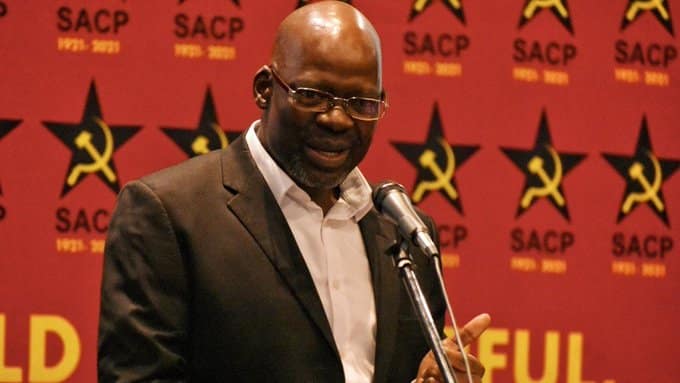
“The engagements with the ANC have reached a dead end,” said SACP General Secretary Solly Mapaila, his voice heavy but resolute. “We have crossed the red line. There is no turning back. The SACP will field its own candidates in the 2026 local government elections. We will contest independently, without fear, without favour, and without apology.”
The announcement, delivered at a packed press conference in Braamfontein, was met with a mix of cheers from red-shirted supporters and stunned silence from journalists who had hoped for a last-minute compromise. The red line—a term Mapaila has used repeatedly in recent weeks—had indeed been crossed. And the alliance that helped liberate South Africa now faces its most serious fracture since the end of apartheid.
“The Failed Engagements: What Went Wrong?”
The breakdown of talks between the ANC and the SACP was not sudden. It was a slow, grinding process of accumulating grievances, missed opportunities, and fundamental disagreements over the nature of the alliance.
According to sources close to the negotiations, the two parties held at least 12 formal meetings since January 2026, as well as countless informal discussions. The ANC delegation was led by party secretary-general Fikile Mbalula, while the SACP was represented by Mapaila and senior central committee members.
The sticking points were numerous:
1. Dual Membership: The ANC had proposed that SACP members who hold leadership positions in the ANC must choose one affiliation over the other. The SACP rejected this as “an ultimatum” and “an attack on the historic character of the alliance.”
2. Electoral Arrangements: The ANC offered the SACP a “ballot-sharing” arrangement, similar to previous elections, in which SACP members would appear on ANC lists. The SACP demanded a more visible presence, including the right to campaign under its own banner and logo.
3. Policy Differences: The SACP accused the ANC of abandoning the National Democratic Revolution (NDR) and embracing “neoliberal, pro-capital” policies, including the privatisation of state-owned enterprises and labour broking. The ANC denied the charge but refused to alter its economic trajectory.
4. Trust: Perhaps the most insurmountable barrier was a lack of trust. SACP leaders felt that the ANC had reneged on previous agreements, marginalised communist voices in cabinet, and treated the alliance as a “marriage of convenience” rather than a partnership of equals.
“The ANC came to the table with arrogance,” said an SACP central committee member who attended several meetings. “They wanted us to surrender. They wanted us to be a cheerleader, not a partner. We told them: we are not a cheerleader. We are a political party. We have our own history. Our own constituency. Our own ideas. If you cannot respect that, then there is nothing to talk about.”
The final meeting took place on Wednesday evening at a hotel in Midrand. It lasted five hours. According to sources, the ANC made a last-minute offer: the SACP could field a small number of candidates under its own banner in “symbolic” wards, while the majority would remain on ANC lists. The SACP rejected the offer as “insulting.”
“They wanted to give us table scraps,” Mapaila said in the press conference. “A few wards here, a few wards there. That is not a partnership. That is patronage. We are not beggars. We are revolutionaries. We will take our chances at the polls. Alone.”
The Historical Rupture: From Comrades to Competitors
The ANC-SACP alliance is one of the oldest political partnerships in Africa. Formed in the 1950s, it survived the banning of the Communist Party, the imprisonment of Nelson Mandela, and the torture and murder of countless cadres. The two organisations shared leaders: Oliver Tambo was an honorary communist. Chris Hani was a communist hero. Joe Slovo was both.
After 1994, the alliance became the cornerstone of the tripartite alliance (which also includes COSATU, the trade union federation). The SACP did not contest elections independently, instead placing its members on ANC lists. In exchange, the SACP gained influence over policy, particularly in areas like the Reconstruction and Development Programme (RDP) and, later, the push for economic transformation.
But the relationship has been fraying for years. The SACP grew increasingly critical of the ANC’s neoliberal turn, its tolerance of corruption, and its abandonment of the working class. In 2017, the SACP went so far as to urge its members not to vote for Jacob Zuma’s ANC—a dramatic break from tradition.
Since President Cyril Ramaphosa took power, the tensions have eased but never disappeared. The SACP has supported Ramaphosa’s anti-corruption drive but has been critical of his economic policies, particularly his embrace of private sector involvement in state-owned enterprises.
“The alliance was already on life support,” said political analyst Professor William Gumede. “The ultimatum on dual membership was the plug being pulled. The SACP’s decision to contest independently is not a bolt from the blue. It is the inevitable conclusion of a long, slow decline.”
The 2026 Local Elections: What the SACP Faces
Contesting elections independently is one thing. Winning is another. The SACP faces formidable challenges as it prepares for the October 2026 polls.
Organization: The SACP has a presence in most provinces, but it is strongest in Gauteng, the Eastern Cape, and the Western Cape. However, its grassroots infrastructure is thin compared to the ANC’s. The party has not run a nationwide campaign in decades. It lacks election experience, polling data, and a war chest.
“Our members are excited, but excitement does not win elections,” said an SACP provincial secretary. “We need money. We need volunteers. We need a message that resonates beyond the converted. We are starting from behind. That is the reality.”
Voter Perception: Many voters do not distinguish between the SACP and the ANC. For three decades, SACP leaders have appeared on ANC ballots. Voters who ticked the ANC box thought they were voting for the ANC, not the SACP. Changing that perception will be a massive marketing challenge.
“The average voter in Soweto does not know the difference between the ANC and the SACP,” said a pollster. “They see the same faces. They hear the same songs. They assume it is all the same. The SACP has to break that assumption. That is not easy. It may not even be possible in one election cycle.”
Splitting the Left: The SACP’s decision to contest independently risks splitting the left-leaning vote, benefiting the centre-right Democratic Alliance (DA) and the right-wing Freedom Front Plus. The Economic Freedom Fighters (EFF), which already occupies the left-populist space, may also gain.
“We are not splitting anything,” Mapaila insisted. “The ANC has already split the left. By moving to the right, by embracing neoliberalism, by abandoning the working class, the ANC has created a vacuum. We are filling that vacuum. The EFF is not a socialist party. It is a populist party. There is a difference. Voters will see the difference.”
The ANC’s Response: ‘Regrettable but Not Catastrophic’
The ANC’s official response was measured, but behind the scenes, there was anger and anxiety.
“We have noted the SACP’s decision,” said ANC national spokesperson Mahlengi Bhengu-Motsiri. “We regret that the alliance could not find common ground. However, the ANC remains the largest political party in South Africa. We are confident that our voters will remain loyal to the ANC. The SACP’s decision will have minimal impact on our electoral prospects.”
But some ANC leaders are privately worried. The party is already bleeding support. In the 2021 local elections, the ANC’s national vote share fell to 46%. In the 2024 national elections, it fell further to 40%. A split with the SACP could push it below 40%—a psychological threshold with consequences for coalition negotiations.
“This is a nightmare,” said an ANC provincial chairperson. “The SACP will not win many seats, but they will take votes from us. In a tight race, that could be the difference between winning a ward and losing it. We are looking at a bloodbath.”
Others are more sanguine. “The SACP is overestimating its support,” said an ANC NEC member. “They will get maybe 2% of the vote. Maybe 3% in a few hot spots. That is not a threat. That is a nuisance. We will survive.”
COSATU: The Third Pillar Wavers
The tripartite alliance is a three-legged stool: ANC, SACP, COSATU. With two legs at war, the third becomes the fulcrum. COSATU, the trade union federation, has not yet taken a position on the SACP’s decision. But its leaders are watching closely.
COSATU has its own grievances with the ANC, particularly over labour broking, the National Health Insurance (NHI) delays, and the government’s failure to create jobs. In recent by-elections, COSATU has refused to campaign for the ANC, a sign of growing alienation.
“If COSATU joins the SACP in breaking away, the ANC is in deep trouble,” said Gumede. “The alliance has been the ANC’s electoral machine. Without COSATU’s boots on the ground, without SACP’s ideological fire, the ANC is just another political party. And it will be defeated.”
COSATU general secretary Solly Phetoe called for an urgent summit of alliance partners, but the SACP rejected the overture, accusing COSATU of “trying to mediate a dispute that cannot be mediated.”
“We are past mediation,” said Mapaila. “The ANC issued an ultimatum. We have responded. There is nothing to talk about.”
The EFF Factor: A Welcome or a Warning?
The EFF, which views itself as the natural home for left-leaning voters disillusioned with the ANC, welcomed the SACP’s decision.
“The communists have finally seen the light,” said EFF leader Julius Malema in a statement. “The ANC is a counter-revolutionary party. It serves capital, not workers. We welcome the SACP to the fight. We may be rivals for the same votes, but we are united in our opposition to the ANC.”
But the SACP has been careful to distinguish itself from the EFF. “We are not the EFF,” said Mapaila. “We are not populists. We are not strongmen. We are a Marxist-Leninist party. We believe in scientific socialism. That is different from the EFF’s brand of radicalism. Voters who want socialism with a small ‘s’ should vote for us. Voters who want radical theatre should vote for the EFF.”
The distinction may be lost on many voters. The EFF’s red berets and the SACP’s red flags are visually similar. Both parties use the language of “economic freedom” and “workers’ power.” The risk is that the two parties will cancel each other out, allowing the ANC or the DA to win.
The Public’s Reaction: Divided and Uncertain
Outside the SACP’s headquarters, supporters celebrated. They waved flags. They sang “Nkosi Sikelel’ iAfrika” and “The Internationale.” But among the faithful, there was also uncertainty.
“I have been a communist all my life,” said an elderly woman wearing a red T-shirt. “I have voted for the ANC because the SACP was on their list. Now the SACP is alone. I will vote for them. But will my neighbours? Will my children? I do not know. It is a risk. But we are communists. We take risks.”
A younger supporter expressed enthusiasm. “Finally!” he said. “We are free of the ANC. We can say what we believe. We do not have to apologise for wanting socialism. I will campaign for the SACP. I will knock on doors. I will hand out pamphlets. This is our moment.”
A passerby, not a supporter, was more cynical. “Another party?” she said. “There are already 300 parties in South Africa. Now there is one more. It will make no difference. The ANC will still win. The poor will still suffer. Politics is a joke.”
The International Dimension: Solidarity and Scrutiny
The SACP’s decision has drawn international attention. Communist parties in China, Cuba, Vietnam, and the former Soviet bloc have expressed solidarity, though few have offered concrete support.
“The Chinese Communist Party values its relationship with the SACP,” said a statement from Beijing. “We respect the SACP’s decision to chart its own electoral path. We hope for continued cooperation on ideological and strategic matters.”
But other international allies are more cautious. Some worry that a split on the left could destabilise South Africa, a key player in BRICS and a gateway to the African continent.
“We are watching closely,” said a European diplomat. “A weak ANC is not necessarily in the West’s interest. A strong, stable South Africa is in everyone’s interest. We hope that the alliance can be repaired, even if it takes time.”
The Legal and Logistical Hurdles
The SACP is a registered political party with the Independent Electoral Commission (IEC). It has the legal right to contest elections at any level—national, provincial, or local. However, the party has never exercised this right in a nationwide election.
“The IEC is ready,” said a commission official. “The SACP is in good standing. They can field candidates tomorrow if they wish. The question is logistical, not legal. Can they organise enough candidates? Can they raise enough funds? Can they get their message out? Those are the real challenges.”
The SACP claims to have a membership of over 300,000, though independent estimates are lower. The party has a presence in most provinces, though it is strongest in Gauteng, the Eastern Cape, and the Western Cape.
“We are ready,” said SACP national organiser David Masondo. “We have been preparing for this moment for years. The branches are excited. The members are motivated. We may not win many seats this time, but we will build. Election by election. Year by year. We are playing the long game.”
The Road to 2026: A Bumpy Ride Ahead
The 2026 local government elections were already shaping up to be a watershed moment. With the SACP contesting independently, the race becomes even more unpredictable.
Possible scenarios:
- Best case for the SACP: The party wins 5-7% of the national vote, picking up seats in key metros like Johannesburg, Tshwane, and Cape Town. It becomes a kingmaker in coalition negotiations, extracting policy concessions in exchange for support.
- Worst case for the SACP: The party wins less than 2% of the vote, loses its deposit in most wards, and is dismissed as a fringe party. Its credibility is shattered, and its members defect to the EFF or remain with the ANC.
- Most likely scenario: The SACP wins 3-4% of the vote, wins a handful of wards, and gains valuable election experience. It remains a minor player but positions itself for future growth.
“I am not a fortune teller,” said Mapaila. “I do not know what the voters will do. What I know is that we will fight. We will campaign. We will tell the truth. And we will accept the result, whatever it is. That is democracy. That is communism. That is the SACP.”
The Final Word: An Alliance R.I.P.
The ANC-SACP alliance is not yet dead. There is still time for negotiation. There is still room for compromise. The ANC could withdraw its ultimatum. The SACP could suspend its independent plans. The tripartite alliance could stagger on, as it has for 30 years, held together by habit, fear, and the memory of a shared struggle.
But something has changed. The ultimatum was a line in the sand. The SACP’s response was a crossing of that line. The two parties are no longer allies in the same sense. They are competitors. Rivals. Potential enemies.
In the townships, in the union halls, in the party branches, the question is no longer whether the alliance will survive. The question is what will replace it.
“We are witnessing the end of an era,” said Gumede. “The tripartite alliance was a product of a specific historical moment: the anti-apartheid struggle. That moment is gone. The alliance is gone. We are entering a new moment, with new parties, new coalitions, new alliances. It will be messy. It will be unpredictable. But it is also exciting. South African politics has been stuck for too long. Now, finally, it is moving.”
At the SACP headquarters, the singing had stopped. The journalists filed their stories. The leaders dispersed. Mapaila sat in his office, a photograph of Chris Hani on the wall behind him.
He was asked: Are you afraid?
“No,” he said. “We have been waiting for this moment for 30 years. We are not afraid. We are ready.”
Outside, the red flags continued to flutter. The sun was setting over Johannesburg. And the alliance that helped free South Africa was breathing its last.
The SACP will hold a special national congress in June 2026 to finalise its election strategy, candidate lists, and manifesto. The ANC has not yet responded to the SACP’s announcement beyond its initial statement. The 2026 local government elections are scheduled for 21 October 2026.
About The Author